

Folk herbalism
Folk healer (znachor), whisperer (szeptucha, szeptun), blessing of herbs on the feast of Our Lady of the Herbs
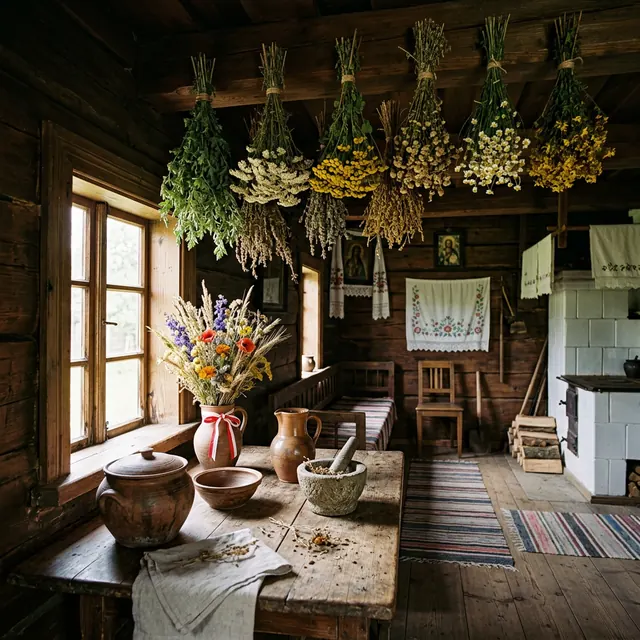
In the countryside, until the middle of the 20th century, people were treated mainly by folk healers and whisperers, not by doctors. They combined herbs with prayer, incantation and magical rites. On 15 August, the feast of Our Lady of the Herbs, bouquets of herbs, flowers and grain were blessed, then kept at home and used in illness.
How certain this knowledge is
Folk beliefs
How we know about this
Ethnography of the 19th and 20th centuries (including research by Z. Libera and W. Piątkowski on the whisperers of Podlasie); the custom of blessing herbs on 15 August.
What people believed
It was believed that illness could have a supernatural cause, e.g. a spell or witchcraft, so it was also treated with words. The whisperers of Podlasie regard their gift as a grace from God, while the Orthodox Church considers these practices dangerous. The knowledge was usually passed on within the family.
Where
All Slavs; the szeptuchy (whisperers) mainly in Podlasie
Fun fact
The link between the blessing of herbs and pre-Christian rites in honour of goddesses is only a conjecture, based partly on Długosz. Many herbs of folk medicine are poisonous, and incantations do not replace treatment.
The image is an artistic vision based on archaeology and descriptions, not a faithful copy.