

Stado
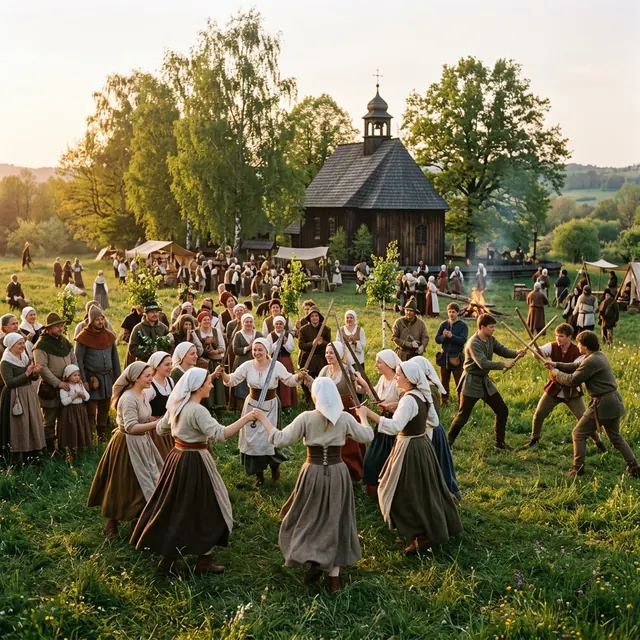
Stada (gatherings of people), Pentecost games
A spring gathering with dances and games, which preachers of the early 15th century condemned as pagan. Łukasz of Koźmin wrote that "in the language of the Poles" such gatherings are called "stada", and that girls dance with swords "as if as a sacrifice to demons". Długosz described them as games in honour of deities at Pentecost.
How certain this knowledge is
Confirmed in sources
How we know about this
Łukasz of Wielki Koźmin, Pentecost sermon (c. 1405-1412); Jan Długosz, Annals, book I (15th century); Cosmas of Prague (12th century) on games around Pentecost. Modern form: reconstruction by Slavic Native Faith adherents since 2016.
What people believed
All that is certain is that people gathered for dances, songs and contests. That it was an ancient pagan festival we know only from the judgements of the preachers and Długosz. Cosmas of Prague wrote about dances in honour of the spirits of ancestors in the same season. Karol Potkański believed that in the 16th century the custom turned into a Pentecost parish fair.
Where
Poland (records from the 15th century); similar festivities in Bohemia and in Rus'
Fun fact
The present-day Stado celebrations with the participation of Native Faith adherents are a 21st-century reconstruction. The girls' dance with sabres was taken over from the Croatian custom of ljelje (kraljice), inscribed on the UNESCO list, and not from old Polish records.
The image is an artistic vision based on archaeology and descriptions, not a faithful copy.