

Bannik
Łaźnik, łaziennik (Belarusian)
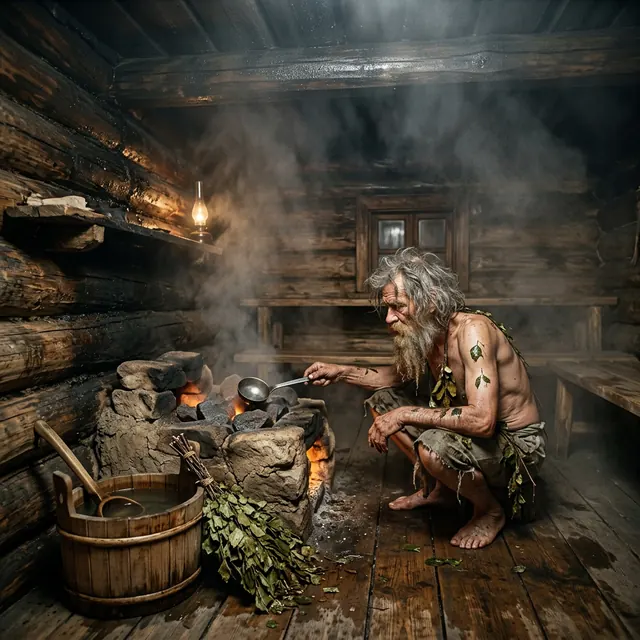
The spirit of the bathhouse (banya), known to the East Slavs. He was imagined as an old man with a large head and tousled hair, sometimes naked and plastered with leaves from birch switches. Women gave birth in the bathhouse and fortune-telling was performed there, which is why it was regarded as a place both powerful and dangerous.
How certain this knowledge is
Folk beliefs
How we know about this
Russian and Belarusian ethnography of the 19th and 20th centuries; Andrzej Kempiński, "Encyklopedia mitologii ludów indoeuropejskich" (2001); B. and A. Podgórski, "Wielka księga demonów polskich" (2005).
What people believed
The bannik could be hostile to people. He could scald someone with boiling water or suffocate a person who bathed at the wrong time. The last round of steam was left for him, and no icons were hung in the bathhouse. Water and twigs were left for him, and when a new bathhouse was built, a black hen was buried under the threshold.
Where
Eastern Slavs (Russia, Belarus)
Fun fact
The bannik was also said to foretell the future. You would stand with your back to the half-open bathhouse door. A gentle touch foretold luck, a scratch of claws foretold poverty.
The image is an artistic vision based on archaeology and descriptions, not a faithful copy.