

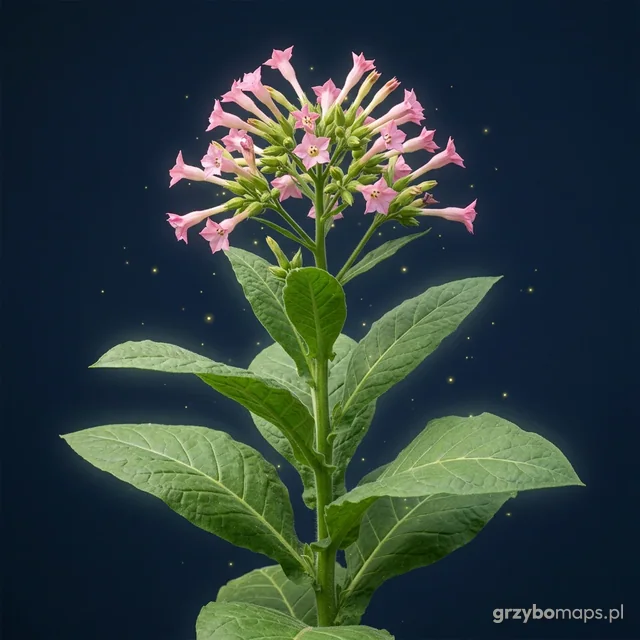
Tobacco
Nicotiana tabacum
Polish folk names: tytoń, tabaka, machorka (N. rustica), ziele królowej
What it looks like
A plant that is annual in cultivation, 1–2.5 m tall, with very large, sticky leaves covered in glandular hairs. At the top, a branched inflorescence with pink or whitish-pink, tubular flowers with five lobes. The fruit is a capsule with thousands of tiny seeds.
Where it comes from
South America (the Andes, the region of Bolivia and Argentina); cultivated all over the world. In Poland it is grown mainly in the Lubelskie region, Podkarpacie and Kujawy; it does not run wild permanently.
History
The peoples of the Americas used tobacco in rituals, healing and diplomacy (the peace pipe) long before the arrival of Europeans. Columbus encountered it in 1492, and the French envoy Jean Nicot sent it around 1560 to Catherine de' Medici as a medicine, hence the names Nicotiana and nicotine. In the 17th century tobacco, snuff and the pipe spread in Europe, including noble Poland. In the 20th century cigarettes became a mass product and the main preventable cause of death in the world.
Legend and truth
It is commonly believed that nicotine causes lung cancer. This is a myth: nicotine is mainly responsible for addiction, and it is chiefly substances from the smoke (tarry substances, nitrosamines) that are carcinogenic. This does not mean, however, that nicotine is harmless – it is strongly toxic and harms, among other things, the heart and the foetus.
Substances
Nicotine (the main alkaloid), nornicotine, anabasine, anatabine; the smoke contains thousands of compounds, including carcinogenic nitrosamines and polycyclic hydrocarbons.
How it works
Nicotine stimulates nicotinic acetylcholine receptors, releasing dopamine and adrenaline; it gives short-lived stimulation and improved concentration, and at the same time relaxation. The effect appears within seconds of inhalation and passes quickly, which favours compulsive repetition.
What it is sometimes confused with
- ornamental tobacco (e.g. N. alata, N. sylvestris)
- mullein (large, soft leaves)
Law in Poland
Growing and selling tobacco are legal, but strictly regulated (excise duty, ban on sales to persons under 18, the Act on the protection of health against the consequences of tobacco use).
Fun fact
Nicotine sulphate used to be a widely used insecticide in gardens – the plant produces nicotine precisely to defend itself against insects.
Frequently asked questions
How does tobacco work?
Nicotine stimulates nicotinic acetylcholine receptors, releasing dopamine and adrenaline; it gives short-lived stimulation and improved concentration, and at the same time relaxation. The effect appears within seconds of inhalation and passes quickly, which favours compulsive repetition.
What are the risks of tobacco?
Addictive. Nicotine is one of the most strongly addictive substances, and smoking tobacco causes cancers, heart disease, strokes and COPD. Acute poisoning (nausea, vomiting, drooling, convulsions, breathing disturbances) happens in children after swallowing cigarette butts or e-cigarette liquids. Pickers of wet leaves can suffer from “green tobacco sickness” because of nicotine absorption through the skin.
Tobacco and the law in Poland: what is allowed?
Growing and selling tobacco are legal, but strictly regulated (excise duty, ban on sales to persons under 18, the Act on the protection of health against the consequences of tobacco use).