

Tojad mocny
Aconitum firmum (syn. A. napellus subsp. firmum)
Polish folk names: mordownik, wilcza trutka, hełm Jowisza, kapturnik, wolfsbane
What it looks like
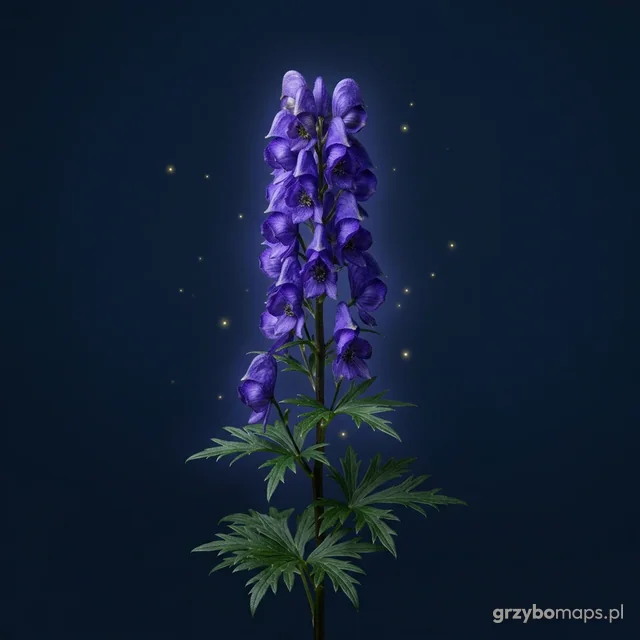
A stately perennial up to about 1.5 m with palmately, deeply divided, dark green leaves. Dark blue or navy-violet flowers gathered in a dense raceme have a characteristic upper petal shaped like a helmet or hood. Underground it has tuberous, turnip-like roots.
Where it comes from
Mountains of Central Europe. In Poland in the Sudetes and Carpathians (Tatras, Babia Góra, Pilsko, Beskids), in tall-herb communities, by streams and on damp mountain meadows; as an ornamental plant (garden monkshoods) it is also planted in the lowlands.
History
Since antiquity monkshood has been a poison: the Greeks believed it grew from the saliva of Cerberus, dragged out of Hades by Heracles, and in Europe it was used to poison baits for wolves, hence the English wolfsbane. The Romans banned its cultivation, and in the Middle Ages it was associated with witchcraft and werewolves. In modern times pop culture popularised it as the “wolfsbane potion” from the Harry Potter series. In the 21st century there have been murders and poisonings with monkshood in Europe.
Legend and truth
A legend says that monkshood protects against werewolves or betrays them. This is pure folklore; what is real, however, is that aconitine can be absorbed through the skin, so picking the plant with bare hands can be dangerous.
Substances
Aconitine and related diterpenoid alkaloids (mesaconitine, hypaconitine); most in the root tubers.
How it works
Aconitine opens sodium channels in nerves and the heart muscle. At first it causes tingling and numbness of the mouth and skin, then nausea, weakness and heart rhythm disturbances. It has no psychoactive effect in the recreational sense.
What it is sometimes confused with
- larkspur
- horseradish or celery root (tubers)
- garden plants with blue flowers
Law in Poland
A species under strict species protection in Poland (it must not be picked or dug up); the Act on Counteracting Drug Addiction does not apply to it.
Fun fact
Aconitine was one of the first poisons that attempts were made to detect with forensic chemistry; in Poland monkshood still appears on the lists of the sanitary inspectorate (sanepid) as a plant that must not be planted where children play.
Frequently asked questions
How does tojad mocny work?
Aconitine opens sodium channels in nerves and the heart muscle. At first it causes tingling and numbness of the mouth and skin, then nausea, weakness and heart rhythm disturbances. It has no psychoactive effect in the recreational sense.
What are the risks of tojad mocny?
Poison. Considered one of the most poisonous plants in Poland: even milligram amounts of aconitine can kill, and the poison passes through the skin. Death comes from dangerous heart arrhythmias or paralysis of the respiratory muscles. There is no specific antidote; immediate help (112) and heart monitoring are necessary.
Tojad mocny and the law in Poland: what is allowed?
A species under strict species protection in Poland (it must not be picked or dug up); the Act on Counteracting Drug Addiction does not apply to it.