

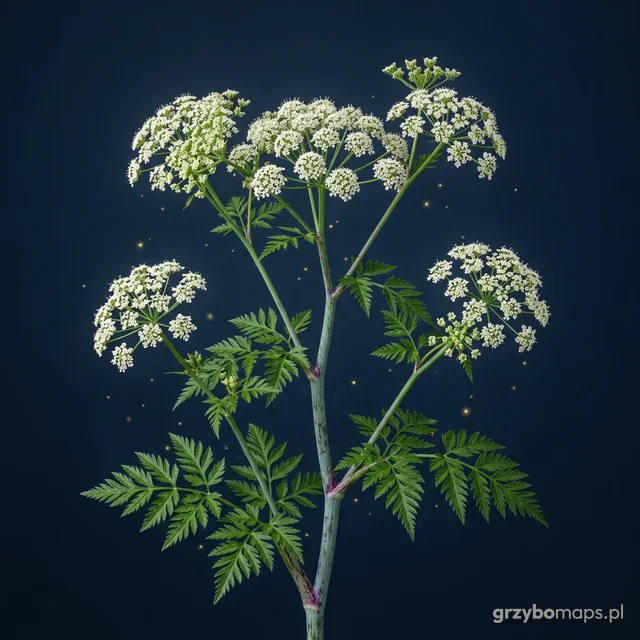
Poison hemlock
Conium maculatum
Polish folk names: cykuta (Sokratesa), psia pietruszka, szaleń plamisty, pietrasznik plamisty, świńska wesz
What it looks like
A biennial of the carrot family, 1–2.5 m, with a smooth, bluish, bloom-covered stem marked with characteristic reddish-brown spots. Leaves large, multiply pinnate, resembling parsley leaves. Small white flowers in umbels; the crushed plant smells of mouse urine.
Where it comes from
Europe, Western Asia and North Africa; introduced to other continents. In Poland fairly common along roadsides, on wasteland, by fences, on rubble heaps and in thickets.
History
In ancient Athens a decoction of hemlock was the official way of carrying out death sentences. In the “Phaedo”, Plato described how in 399 BC Socrates drank the poison and slowly lost sensation from the feet upwards – this picture agrees with the action of coniine. Coniine was the first alkaloid whose structure was determined, and the first to be synthesised (1886). To this day poisonings occur through confusion with edible plants.
Legend and truth
It is often said that poison hemlock is simply “wild parsley”, which can be easily told apart. In reality the young leaves are very similar to parsley leaves, and confusion with parsley, parsnip or carrot ends in severe poisoning – the reddish spots on the stem and the mouse-like smell may help.
Substances
Coniine, γ-conicein, N-methylconiine and other piperidine alkaloids; present in the whole plant, also after drying.
How it works
Coniine first stimulates and then paralyses the nerve ganglia and neuromuscular junctions, similarly to curare. A progressive, ascending paralysis with consciousness preserved is characteristic.
What it is sometimes confused with
- natka pietruszki
- pasternak
- dzika marchew
- cow parsley
- świerząbek
Law in Poland
The plant grows legally and is not covered by the Act on Counteracting Drug Addiction.
Fun fact
Coniine was the first alkaloid in history to be synthesised artificially – this was done by Albert Ladenburg in 1886.
Frequently asked questions
How does poison hemlock work?
Coniine first stimulates and then paralyses the nerve ganglia and neuromuscular junctions, similarly to curare. A progressive, ascending paralysis with consciousness preserved is characteristic.
What are the risks of poison hemlock?
Poison. The whole plant is poisonous, even when dried, and contact of the sap with the skin can also be dangerous. Symptoms of poisoning are burning in the mouth, drooling, nausea, muscle weakness, vision disturbances, ascending paralysis and death by paralysis of the respiratory muscles. Mistakes mainly concern collectors of wild herbs and children making “whistles” from the hollow stems.
Poison hemlock and the law in Poland: what is allowed?
The plant grows legally and is not covered by the Act on Counteracting Drug Addiction.