

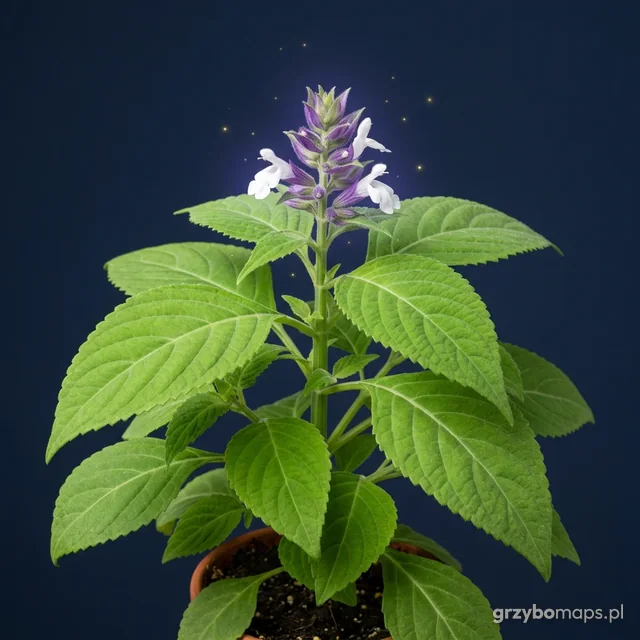
Diviner's sage
Salvia divinorum
Polish folk names: szałwia wróżbitów, ska María Pastora, hojas de la Pastora, salvia
What it looks like
A perennial of the mint family, up to 1–2 m, with hollow stems that are square in cross-section. The leaves are large, ovate, light green, slightly toothed. Flowers rarely appear: white with a violet calyx; the plant hardly sets any seed.
Where it comes from
Endemic to the Sierra Mazateca in the state of Oaxaca in Mexico, in humid forests at an altitude of about 300–1800 m. It does not occur in the wild in Poland.
History
The Mazatec Indians used the leaves in healing and divination rites, associating the plant with Mary the Shepherdess. The West described it in 1939, and in 1962 Gordon Wasson and Albert Hofmann collected specimens for the description of the species. At the turn of the 20th and 21st centuries it became popular as a legal hallucinogen sold over the internet and in “legal highs” shops; recordings of its use, including the famous 2010 video of Miley Cyrus, circulated on video sites. In Poland it was legally on sale until 2009.
Legend and truth
It is often written that salvinorin A is the “strongest natural hallucinogen”. This is largely true per mass of active substance, but it does not mean “pleasure”: many users describe the experience as terrifying and disorienting, not euphoric.
Substances
Salvinorin A (a diterpene, the main compound responsible for the effect), salvinorins B–F, divinatorins; mainly in the leaves.
How it works
Salvinorin A is a strong agonist of the kappa-opioid receptor, which distinguishes it from classic psychedelics acting through serotonin. It causes violent dissociation, loss of contact with the surroundings and distortions of space, usually short-lived, starting within minutes.
What it is sometimes confused with
- common sage (Salvia officinalis) – a completely different, culinary plant
Law in Poland
Since the amendment to the Act of 20 March 2009, diviner's sage has been a group I-N narcotic drug in Poland, and salvinorin A itself is on the list of group I-P psychotropic substances, so possessing the plant or its preparations is a crime under Art. 62 of the Act on Counteracting Drug Addiction (ustawa o przeciwdziałaniu narkomanii).
Fun fact
In studies on rats, access to salvinorin A reduced the intake of cocaine and methamphetamine, which is why scientists are studying its derivatives as potential drugs for addictions.
What research really says
Diviner's sage works differently from classic psychedelics, through the kappa-opioid receptor, and its effect is very strong but short, usually a dozen or so minutes. No deaths from overdose have been described; the main risk is losing contact with your surroundings and the accidents that result from it.
Mechanism
Salvinorin A, the plant's main active compound, stimulates the kappa-opioid receptor, not serotonin receptors as psilocybin does. This sets it apart from all classic psychedelics. The experience is usually dissociative, often unpleasant and hard to describe.
How short it lasts
In a controlled study in healthy volunteers (Johns Hopkins, 2011), the effect began almost immediately, peaked after about 2 minutes and had nearly disappeared after 20 minutes, with no significant changes in heart rate or blood pressure. In a survey of 500 users, the average duration of action was estimated at about 14 minutes. The laboratory study, however, included only 4 people with experience of hallucinogens.
Data from poison centres
Over 10 years, California's poison centre system recorded 37 reports involving diviner's sage, 18 of them without other substances. The most common were confusion, hallucinations, dizziness and stomach complaints. Most complications occurred in people who combined it with other substances.
Deaths and addiction
The California poison centre states that no deaths from overdose have been described, and the greatest risk is injury during complex activities, e.g. driving a car. In a survey of 500 users, 0.6% felt addicted and 1.2% reported a strong urge to use again. Chronic toxicity is still poorly studied.
History
The Mazatec people of Oaxaca in Mexico used the leaves, called ska María Pastora, in healing and divination rites. The anthropologist Jean B. Johnson encountered it in Huautla de Jiménez in 1938, and Wasson and Hofmann brought back specimens on the basis of which Epling and Játiva described the species in 1962.
Scientific interest
Salvinorin A is being studied as a template for designing drugs that act on the kappa receptor, including in the context of pain and addiction. For now this is basic research, and neither the plant nor salvinorin A has any approved medical use.
Authorities vs data
- Authorities exaggerate. They say: Since 2009, Polish law has classed diviner's sage as a narcotic drug of group I-N and salvinorin A as a psychotropic substance of group I-P, i.e. in the strictest groups. Data: No deaths from overdose have been described, addiction is reported by fewer than 1% of surveyed users, and in the USA neither the plant nor salvinorin A is on the federal list of controlled substances.
- Consistent with research. They say: The DEA describes sudden, intense hallucinations that impair judgement, loss of coordination, anxiety and panic. Data: Clinical studies and poison centre data confirm strong dissociation and confusion; this carries a real risk of falls and accidents.
- Consistent with research. They say: The EU drugs agency (EUDA) writes that the toxicity of diviner's sage is poorly understood. Data: Long-term data really are scarce; laboratory studies have involved from a few to a dozen or so healthy people.
What we don't know yet. It is not known whether frequent use has lasting effects on the mind, because there are no long-term studies. It is also not known whether salvinorin A derivatives will ever prove to be useful medicines.
Knowledge, not encouragement. We do not give doses or preparation methods.
Frequently asked questions
How does diviner's sage work?
Salvinorin A is a strong agonist of the kappa-opioid receptor, which distinguishes it from classic psychedelics acting through serotonin. It causes violent dissociation, loss of contact with the surroundings and distortions of space, usually short-lived, starting within minutes.
What are the risks of diviner's sage?
Dangerous. The main risk is a complete loss of control over body and consciousness: falls, injuries, walking out into the street, panic. It can cause anxiety and dysphoria, and in poison centre data most complications involved people combining it with other substances; the risk in people predisposed to psychosis is likely but poorly studied. Products sold as “extracts” had unknown and variable concentrations or were contaminated with other substances.
Diviner's sage and the law in Poland: what is allowed?
Since the amendment to the Act of 20 March 2009, diviner's sage has been a group I-N narcotic drug in Poland, and salvinorin A itself is on the list of group I-P psychotropic substances, so possessing the plant or its preparations is a crime under Art. 62 of the Act on Counteracting Drug Addiction (ustawa o przeciwdziałaniu narkomanii).
Sources
- Szałwia wieszcza – Wikipedia
- Salwinoryna A – Wikipedia
- Salvinorin A – pharmacological activity and clinical consequences (Farmakoterapia w Psychiatrii i Neurologii, 2010)
- Dopalacze – Wikipedia
- Vohra i in.: Salvia divinorum: exposures reported to a statewide poison control system over 10 years (2011)
- Johns Hopkins: Study of hallucinogen salvia shows intense, novel effects (2011)
- Baggott i in.: Use patterns and self-reported effects of Salvia divinorum: an internet-based survey (2010)
- California Poison Control: Salvia divinorum
- EUDA: Salvia divinorum drug profile
- DEA: Salvia Divinorum fact sheet
- The Early History of Salvia divinorum (Erowid)
- Salwinoryna A: działania farmakologiczne i konsekwencje kliniczne (Farmakoterapia w Psychiatrii i Neurologii 2010)
- Wykaz substancji psychotropowych, środków odurzających i NSP (tekst jedn. Dz.U. 2024 poz. 1139)
- Salvinorin A and Salvia divinorum: Toxicology, Pharmacological Profile, and Therapeutic Potential (IJMS 2025)