

Water hemlock
Cicuta virosa
Polish folk names: cykuta, szaleń, świnia wesz, wodna cykuta
What it looks like
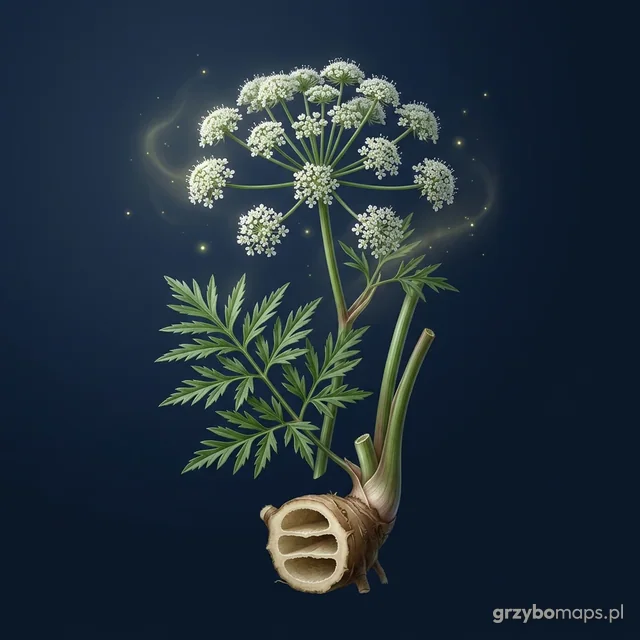
A perennial of the carrot family, up to 1.5 m, with a hollow, tube-like stem. Leaves 2–3 times pinnate with narrow, toothed segments. Small white flowers in compound umbels; the most characteristic feature is the thick rhizome, which, when cut, is divided by transverse partitions into chambers with yellowish sap.
Where it comes from
Europe, Asia and North America. In Poland it is widespread in the lowlands and foothills, on the banks of waters, in reedbeds, ditches, alder woods and on peat bogs.
History
In Polish an old saying has lived for centuries, “szaleju się najadł” (“he has eaten water hemlock”), about someone who behaves like a madman – it refers to the convulsions and delirium after poisoning by this plant. In the past the name cicuta was applied to several poisonous umbellifers, hence the confused accounts of the death of Socrates. Poisonings happen mainly by mistake: the rhizome is taken for an edible root, and the leaves for parsley leaves. Farm animals grazing by the water are also poisoned by it.
Legend and truth
It has become common knowledge that Socrates died of water hemlock, that is, “cicuta”. The description of his calm death with progressive paralysis does not fit the violent convulsions after cicutoxin and agrees rather with poisoning by poison hemlock.
Substances
Cicutoxin and cicutol (polyenes), most in the rhizome and sap.
How it works
Cicutoxin blocks GABA-A receptors, causing strong stimulation of the nervous system. Symptoms appear quickly, often within several dozen minutes.
What it is sometimes confused with
- dzika marchew
- parsley (leaves and root)
- pasternak
- seler
- marek szerokolistny
Law in Poland
The plant grows legally and is not covered by the Act on Counteracting Drug Addiction.
Fun fact
The chambers in the cut rhizome of water hemlock look like honeycombs – this is the feature by which botanists reliably distinguish it from edible umbellifers.
Frequently asked questions
How does water hemlock work?
Cicutoxin blocks GABA-A receptors, causing strong stimulation of the nervous system. Symptoms appear quickly, often within several dozen minutes.
What are the risks of water hemlock?
Poison. This is one of the most poisonous plants in Europe: a small piece of rhizome can kill an adult. Symptoms: burning in the mouth, drooling, nausea, vomiting, dilated pupils, violent convulsions, loss of consciousness and respiratory paralysis. The poison is absorbed quickly and can pass through the skin, so gloves should be used when removing the plant. Any suspicion of poisoning means calling 112.
Water hemlock and the law in Poland: what is allowed?
The plant grows legally and is not covered by the Act on Counteracting Drug Addiction.