

San Pedro
Echinopsis pachanoi (syn. Trichocereus pachanoi)
Polish folk names: huachuma, wachuma, achuma, trichocereus
What it looks like
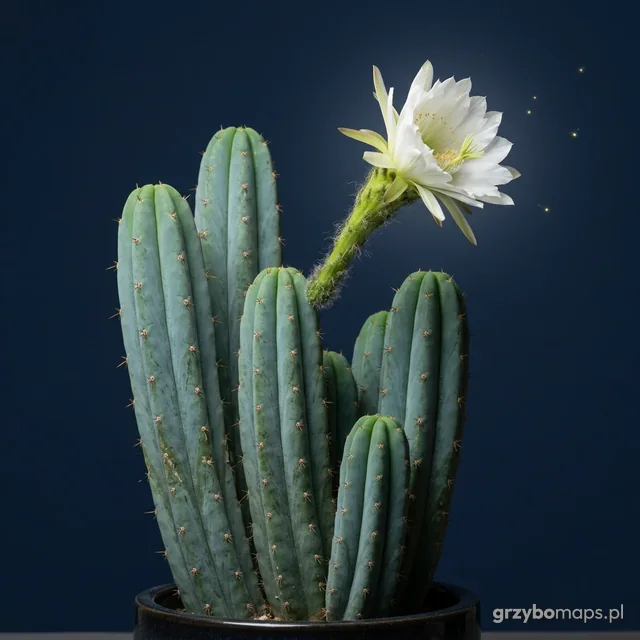
A fast-growing, columnar cactus with blue-green stems, branching at the base and growing to several metres. The stems usually have 6–8 blunt ribs with short, dark spines or almost none. At night it blooms with very large, white, fragrant funnel-shaped flowers.
Where it comes from
The Andes of Peru and Ecuador at an altitude of about 2000–3000 m above sea level; cultivated for so long that its natural range is hard to establish. In Poland found only as an ornamental plant in collections.
History
The cactus has been used in the Andes for at least 3,000 years – depictions of huachuma have been found in the temple of Chavín de Huántar and on the ceramics of the Moche and Nazca cultures. After the conquest it was named San Pedro (St Peter), because – as people said – it opens the gates of heaven. Peruvian healers (curanderos) still prepare a bitter drink from it during night-time healing ceremonies (mesa), combining Catholic and Andean symbols. Although it contains mescaline, for decades it was sold in Europe as an ornamental cactus.
Legend and truth
Myth: “San Pedro is a milder, safe version of peyote”. The mescaline content in different specimens varies by as much as several dozen times, so the effect is unpredictable, and the risks are the same as with other sources of mescaline.
Substances
Mescaline and small amounts of other phenethylamines (including hordenine, tyramine).
How it works
Mescaline stimulates 5-HT2A receptors, causing changes in visual perception, emotions and thinking that last many hours. The effect starts slowly and can last 10 hours or longer; it is often accompanied by nausea and vomiting.
What it is sometimes confused with
- Echinopsis peruviana (Peruvian torch)
- Echinopsis lageniformis (Bolivian torch)
- Echinopsis macrogona
- inne kolumnowe kaktusy ozdobne
Law in Poland
Echinopsis pachanoi (live plants, dried material, seeds, extracts and concentrates) has been on Poland's list of group I-N narcotic drugs since the 2009 amendment; since 2018 this list has been in the Regulation of the Minister of Health (consolidated text Dz.U. 2024 poz. 1139), and mescaline itself is in group I-P.
Fun fact
San Pedro flowers open at night and usually live only one to two days, filling the greenhouse with an intense scent.
What research really says
San Pedro contains the same mescaline as peyote, so the same mainly psychological risks and low physical toxicity apply to it. It differs in that it is not an endangered species, and its strength is exceptionally unpredictable, because the mescaline content of cacti in this group varies by as much as a hundredfold.
Mechanism and course
Mescaline mainly stimulates 5-HT2A receptors, and blocking this receptor clearly weakens its effects. The effects begin slowly, after about an hour, and last from several to a dozen or more hours; nausea and vomiting are typical at the start.
Unpredictable strength
In the study by Ogunbodede et al. (Journal of Ethnopharmacology, 2010), the mescaline content of 14 species and varieties of cacti in the Trichocereus group differed by two orders of magnitude. Some specimens sold as San Pedro contained none at all, while others had a great deal, and on top of that the plants are sometimes confused. This variability, not the toxicity of mescaline itself, is the main cause of unpredictable reactions.
Toxicity and deaths
Toxicology reviews describe acute mescaline poisoning as usually mild, and the single report of a death associated with mescaline dates from 1985. In controlled studies in healthy volunteers, mescaline moderately raised blood pressure and heart rate, which matters for people with heart disease.
Psychological risks
The real dangers are intense anxiety, panic, injuries and dangerous behaviour in an altered state of consciousness, as well as triggering psychosis in predisposed people. In a survey of 452 mescaline users (2022), difficult experiences were rated as very mild and did not differ between San Pedro and peyote, and no one sought medical help, but it was a self-selected sample.
Species status
Echinopsis pachanoi is listed as Least Concern on the IUCN Red List (2017 assessment). It is widely grown as an ornamental plant, so unlike peyote, harvesting does not threaten its survival.
History and culture
Depictions of the San Pedro cactus have been found in reliefs of the Old Temple at Chavín de Huántar and on ceramics of the Cupisnique culture, and the dating of one of them points to around 1300 BC. In 2022, Peru's Ministry of Culture recognised the traditional knowledge and practices associated with San Pedro as the nation's cultural heritage.
Law in Poland
Since the 2009 amendment, Echinopsis pachanoi (live plants, dried material, seeds, extracts and concentrates) has been listed in group I-N of narcotic drugs, currently in the regulation of the Minister of Health (Dz.U. 2024 poz. 1139). Mescaline itself is in group I-P.
Authorities vs data
- Authorities exaggerate. They say: Polish law (since 2009, currently Dz.U. 2024 poz. 1139) lists the Echinopsis pachanoi cactus itself in group I-N, the same group as heroin, among others. Data: Mescaline has low physical toxicity and a low potential for addictive use, and acute poisonings are usually mild. The same plant is legally grown as an ornamental in many countries, and in Poland it was listed as part of the fight against legal highs, not after an assessment of its risk.
- Consistent with research. They say: Peru's Ministry of Culture (2022) recognised the traditional practices and knowledge associated with San Pedro as the nation's cultural heritage. Data: The iconography from Chavín and Cupisnique confirms thousands of years of continuous use of the cactus in the Andes.
What we don't know yet. There are no clinical trials on San Pedro as a plant, and data on its mescaline content vary between laboratories. It is not known how often severe psychological reactions occur outside self-selected surveys.
Knowledge, not encouragement. We do not give doses or preparation methods.
Frequently asked questions
How does san pedro work?
Mescaline stimulates 5-HT2A receptors, causing changes in visual perception, emotions and thinking that last many hours. The effect starts slowly and can last 10 hours or longer; it is often accompanied by nausea and vomiting.
What are the risks of san pedro?
Dangerous. Risk of strong anxiety reactions, panic, injuries in an altered state of consciousness and triggering psychosis. It raises blood pressure and heart rate. The mescaline content of cacti in this group varies up to a hundredfold, so the strength of the effect is unpredictable and an unexpectedly strong, long and psychologically difficult experience can easily happen, although severe physical poisoning from mescaline alone is rare. Cacti in this group are sometimes confused with one another, which further increases the unpredictability.
San Pedro and the law in Poland: what is allowed?
Echinopsis pachanoi (live plants, dried material, seeds, extracts and concentrates) has been on Poland's list of group I-N narcotic drugs since the 2009 amendment; since 2018 this list has been in the Regulation of the Minister of Health (consolidated text Dz.U. 2024 poz. 1139), and mescaline itself is in group I-P.
Sources
- San Pedro (kaktus) – Wikipedia
- Echinopsis pachanoi – Wikipedia (EN)
- San Pedro: Basic Info – ICEERS
- Rośliny psychoaktywne – Psychiatria Polska 2013, t. XLVII, nr 3
- Ogunbodede i wsp. 2010, Zawartość meskaliny w kaktusach Trichocereus
- Uthaug i wsp. 2022, The epidemiology of mescaline use
- Klaiber i wsp. 2024, Dose-dependent effects of mescaline
- Dinis-Oliveira i wsp. 2019, Metabolizm i toksykologia meskaliny
- Echinopsis pachanoi, Wikipedia (status IUCN 2017)
- Rośliny psychoaktywne w Chavín, Cultura y Droga
- Resolución Viceministerial 000252-2022, Peru
- Ustawa z 20 marca 2009 r. o zmianie ustawy o przeciwdziałaniu narkomanii
- Rozporządzenie MZ, tekst jednolity Dz.U. 2024 poz. 1139