

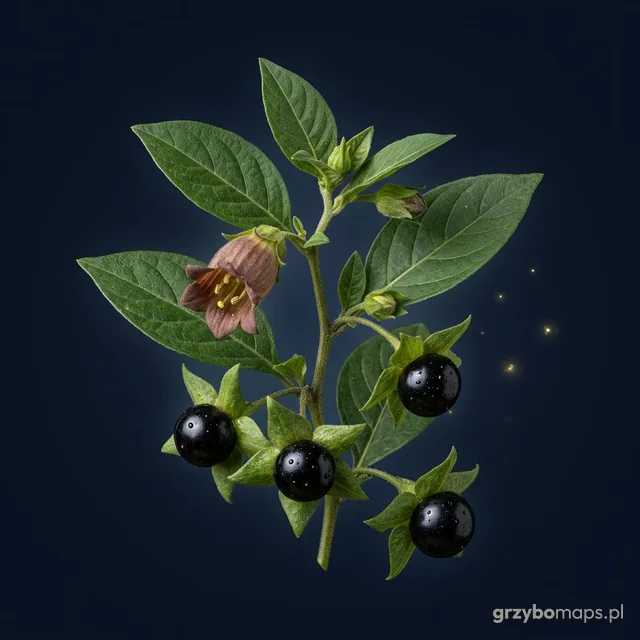
Deadly nightshade
Atropa belladonna
Polish folk names: wilcza jagoda, wilcza wiśnia, belladonna, psianka szalona
What it looks like
A perennial, 50–150 cm tall, with large, ovate leaves. The flowers are solitary, drooping, bell-shaped, brownish-violet. The fruit is a shiny, black berry the size of a cherry, set on a star-shaped green calyx, with a sweetish taste.
Where it comes from
Europe, North Africa, Western Asia. In Poland it grows wild mainly in the mountains and foothills (Carpathians, Sudetes, uplands) in damp beech forests, in clear-cuts and felled areas; formerly it was also cultivated.
History
The genus name Atropa comes from Atropos, one of the three Fates, who cut the thread of life; “belladonna” means “beautiful lady” in Italian, because Renaissance ladies put drops of the juice into their eyes to dilate their pupils. Deadly nightshade was an ingredient of medieval “witches' ointments”, to which the sensation of flight was attributed. Atropine comes from the plant and is still used today in ophthalmology and emergency medicine. In Poland the species has been protected since 1957, because the pharmaceutical industry exploited many of its sites.
Legend and truth
The myth of the “witches' ointment” that allowed flying on a broomstick has a real background: tropane alkaloids are absorbed through the skin and cause delirium with a feeling of flight or of turning into an animal. There is, however, no evidence that sabbaths and flights were anything more than hallucinations and notions fixed in the trials.
Substances
Tropane alkaloids: atropine (fruits), L-hyoscyamine (other parts), scopolamine; most in the roots and fruits.
How it works
It blocks muscarinic receptors: it dilates the pupils, speeds up the heart, and inhibits the secretion of saliva and sweat. In larger amounts it causes agitation, delirium and hallucinations.
What it is sometimes confused with
- bilberry
- sweet cherry or sour cherry
- psianka czarna
Law in Poland
A species under partial protection in Poland (it must not be picked at natural sites); it is not listed in the schedules of the Act on Counteracting Drug Addiction, and atropine is a prescription medicine.
Fun fact
Drops with atropine still dilate the pupils at the ophthalmologist's today, and atropine itself is an antidote for poisoning by organophosphorus compounds and paralytic-convulsant war gases.
Frequently asked questions
How does deadly nightshade work?
It blocks muscarinic receptors: it dilates the pupils, speeds up the heart, and inhibits the secretion of saliva and sweat. In larger amounts it causes agitation, delirium and hallucinations.
What are the risks of deadly nightshade?
Poison. The sweet, shiny berries tempt children, and just a few can endanger a child's life. Symptoms: flushed, dry skin, photophobia, very high fever, aggression, convulsions, speech and vision disturbances, finally coma and respiratory paralysis. Poisonings also happen when it is mistaken for forest berries.
Deadly nightshade and the law in Poland: what is allowed?
A species under partial protection in Poland (it must not be picked at natural sites); it is not listed in the schedules of the Act on Counteracting Drug Addiction, and atropine is a prescription medicine.