

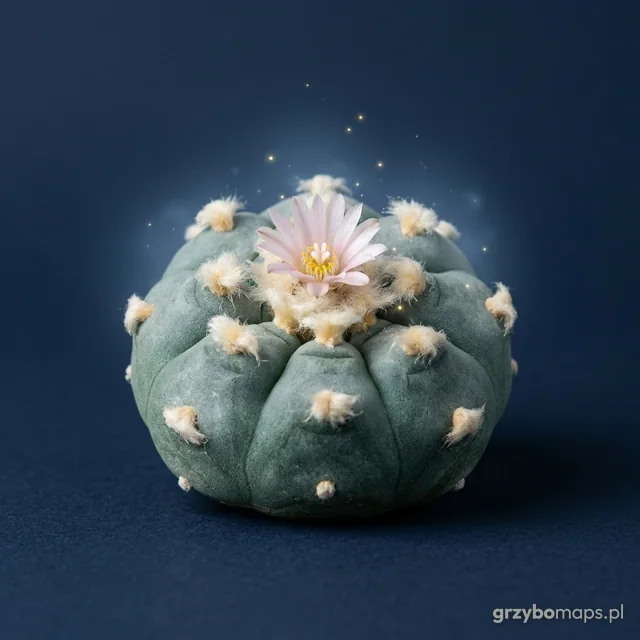
Peyote
Lophophora williamsii
Polish folk names: pejotl, pejot, hikuri (u Huiczolów), jazgrza Williamsa
What it looks like
A small, spineless, globular-flattened cactus a few centimetres across, blue-green, divided into 5–13 rounded ribs with tufts of white fluff instead of spines. It grows from a thick, turnip-like root and flowers at the top with a pink or whitish-pink flower.
Where it comes from
The Chihuahuan Desert in northern Mexico (San Luis Potosí, Coahuila, Nuevo León, Tamaulipas) and southern Texas.
History
Indigenous peoples of North America have used peyote for more than 5,000 years: specimens from a cave above the Rio Grande in Texas were radiocarbon-dated to 3780–3660 BCE and found to contain mescaline. The name comes from the Nahuatl language (peyōtl). Every year the Huichol (Wixárika) people make a pilgrimage to the sacred land of Wirikuta, where, led by a mara'akame shaman, they “hunt” peyote – in 2025 this route was added to the UNESCO World Heritage List. Since the late 19th century peyote has been a sacrament of the Native American Church; an exemption from the federal ban has been protected by regulation since 1965, and after the Employment Division v. Smith ruling (1990) Congress wrote it into a 1994 law for Native Americans using peyote in religious ceremonies. Arthur Heffter isolated mescaline from peyote in 1897, and Ernst Späth synthesised it in 1919 as the first psychedelic made in a laboratory; Aldous Huxley later described its effects in “The Doors of Perception”.
Legend and truth
Myth: “peyote cures many diseases and lets you see the future”. In the tradition of the Huichol and the Native American Church it plays a spiritual and healing role, but there is no evidence of prophetic abilities or of effectiveness in treating somatic diseases.
Substances
Mescaline (the main psychoactive phenethylamine), pellotine, anhalonine, lophophorine, hordenine and other alkaloids.
How it works
Mescaline acts on 5-HT2A serotonin receptors, causing, after an hour or more, perception changes lasting many hours (often 10–12 h): intense colours, geometric visions, changes in mood and in the sense of time. At the start, severe nausea and vomiting are typical, because of the bitter taste and the alkaloids.
What it is sometimes confused with
- Lophophora diffusa (almost no mescaline)
- Ariocarpus (“false peyote” cacti)
- Astrophytum asterias (“star” cactus)
Law in Poland
In Poland, mescaline is a group I-P psychotropic substance (Dz.U. 2024 poz. 1139), so possessing it is a crime; however, the Lophophora williamsii cactus itself, unlike San Pedro, is not named in the schedules, so the status of the live plant is ambiguous, and possessing it for the purpose of intoxication may lead to charges.
Fun fact
Peyote grows so slowly that up to 10 years pass from sowing to flowering; for this reason and because of overharvesting, the International Union for Conservation of Nature (IUCN) classifies it as a vulnerable species (Vulnerable).
What research really says
Mescaline has very low physical toxicity and low addictive potential, and its real risks are mainly psychological and cardiovascular. Today, a bigger problem than human health is the survival of peyote itself, which the IUCN lists as a vulnerable species.
Mechanism and course
Mescaline mainly stimulates serotonin 5-HT2A receptors; in a 2024 study, a drug that blocks this receptor (ketanserin) clearly weakened and shortened its effects. In controlled studies, the effects began after about an hour and lasted from about 6 to 14 hours, longer than after psilocybin or LSD.
Safety in clinical trials
In studies in Basel (Ley 2023, Klaiber 2024, a few dozen healthy volunteers in total), mescaline moderately raised blood pressure and heart rate, and nausea was the main limiting factor. A small proportion of participants experienced transient hypertension, a rapid pulse, fever or recurring perceptions. The studies were conducted in clinical settings in people without illnesses, which does not automatically carry over to other situations.
Toxicity and deaths
Toxicology reviews (including Dinis-Oliveira 2019) describe acute mescaline poisoning as usually mild; the literature contains a single report of a death associated with mescaline, from 1985. Most poisoning reports lack even laboratory confirmation, so the picture is incomplete.
How people use it
In a survey by Uthaug et al. (Journal of Psychopharmacology, 2022) of 452 people, most used mescaline rarely, at most once a year, and about 74% cited spiritual motives. Only 1% reported legal problems and 1% psychological problems; no one sought medical help. In the same sample (Agin-Liebes 2021), 68 to 86% of people with a history of depression, anxiety, PTSD or addiction reported subjective improvement, but this was a survey without a control group, with self-selected participants.
Vulnerable species
Lophophora williamsii is listed as Vulnerable on the IUCN Red List. The main causes are decades of overharvesting of wild plants, which take years to mature in nature, and the conversion of habitats into pastures and fields.
History and culture
Radiocarbon dating of two archaeological specimens from Texas pointed to 3780 to 3660 BC, and analysis detected mescaline in them. Arthur Heffter isolated mescaline from peyote in 1897, and Ernst Späth synthesised it in 1919. In 2025, the Wixárika (Huichol) pilgrimage route to Wirikuta was inscribed on the UNESCO World Heritage List.
Religious exemption in the US
Peyote is federally banned in the US, but ritual use by the Native American Church has been protected by regulation since 1965. After the Supreme Court ruling in Employment Division v. Smith (1990), Congress in 1994 wrote this exemption for Native Americans into law (American Indian Religious Freedom Act Amendments).
Authorities vs data
- Authorities exaggerate. They say: The Polish regulation of the Minister of Health (Dz.U. 2024 poz. 1139) places mescaline in group I-P, the strictest category of psychotropic substances, with no approval for medical purposes. Data: Survey data point to rare, non-addictive use and very few problems (1% each for legal and psychological ones), and controlled clinical trials have shown no serious harm in healthy people. The category does not reflect its low toxicity or low addictive potential.
- Authorities exaggerate. They say: The US federal government treats peyote as a Schedule I substance (high potential for abuse, no medical use). Data: Since 1965, the same government has permitted the ritual use of peyote by the Native American Church, and Congress confirmed this by law in 1994, which in itself contradicts the claim of an unacceptable risk.
- Authorities understate. They say: Health service warnings about mescaline focus on poisoning and drug addiction, rarely mentioning protection of the species. Data: The IUCN lists peyote as a vulnerable species, mainly due to overharvesting of wild plants, so its growing popularity is a real threat to its survival and to the culture of the peoples who use it.
What we don't know yet. There are no randomised clinical trials of mescaline for treating any disease, and data on benefits come from surveys with self-selection. It is also not known how often prolonged psychoses occur in predisposed people, because there are no registries.
Knowledge, not encouragement. We do not give doses or preparation methods.
Frequently asked questions
How does peyote work?
Mescaline acts on 5-HT2A serotonin receptors, causing, after an hour or more, perception changes lasting many hours (often 10–12 h): intense colours, geometric visions, changes in mood and in the sense of time. At the start, severe nausea and vomiting are typical, because of the bitter taste and the alkaloids.
What are the risks of peyote?
Dangerous. Severe anxiety states (“bad trip”), panic, risky behaviour and the triggering of psychosis in predisposed people are possible. Mescaline raises the heart rate and blood pressure, which is dangerous in heart disease. The effect lasts a very long time, and the alkaloid content of plants varies. Collecting wild specimens destroys the populations of a species threatened with extinction.
Peyote and the law in Poland: what is allowed?
In Poland, mescaline is a group I-P psychotropic substance (Dz.U. 2024 poz. 1139), so possessing it is a crime; however, the Lophophora williamsii cactus itself, unlike San Pedro, is not named in the schedules, so the status of the live plant is ambiguous, and possessing it for the purpose of intoxication may lead to charges.
Sources
- Jazgrza Williamsa – Wikipedia
- Pejotyzm – Wikipedia
- Peyote – Wikipedia (EN)
- An Overview on the Hallucinogenic Peyote and Its Alkaloid Mescaline (PMC)
- Pejotl to meksykański kaktus – National Geographic Polska
- The Peyote Hunt of the Huichol Indians – National Park Service
- Uthaug i wsp. 2022, The epidemiology of mescaline use
- Agin-Liebes i wsp. 2021, Naturalistic use of mescaline
- Klaiber i wsp. 2024, Dose-dependent effects of mescaline, Translational Psychiatry
- Ley i wsp. 2023, Mescaline vs LSD vs psilocybina, Neuropsychopharmacology
- Dinis-Oliveira i wsp. 2019, Metabolizm i toksykologia meskaliny
- El-Seedi i wsp. 2005, Prehistoric peyote use
- Kew POWO, Lophophora williamsii (status IUCN)
- Terry i Trout 2014, Ochrona pejotlu
- American Indian Religious Freedom Act Amendments 1994
- Trasa Wixárika do Wirikuty, światowe dziedzictwo UNESCO 2025