

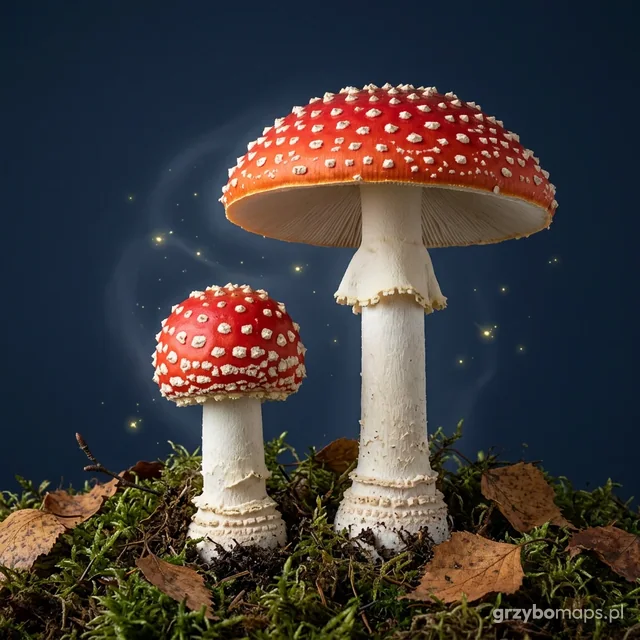
Fly agaric
Amanita muscaria
Polish folk names: muchomor, muchomór, mucharek
What it looks like
A large mushroom with a cap 8–20 cm across, bright red or orange, covered with white warts that are easily washed off by rain. Gills and stem white; on the stem a hanging ring, and at the base a bulb with remains of the veil in the form of warty rings.
Where it comes from
Forests of the temperate and boreal zones of the northern hemisphere. In Poland very common from June to November, in birch and spruce forests, where it forms mycorrhiza with the trees.
History
Fly agaric was used in the rituals of the peoples of Siberia (Koryaks, Chukchi, Khanty), and 18th-century travellers described that even the urine of people who had eaten it was drunk there, because it contained active compounds. Robert Gordon Wasson linked it with the Vedic soma. The name comes from the old use of the mushroom, crumbled in milk, to poison flies. Fly agaric has become an icon of fairy tales, games (Super Mario) and festive decorations, especially in Central and Northern Europe.
Legend and truth
A popular theory holds that Santa Claus in his red-and-white costume, flying reindeer and presents down the chimney derive from Siberian shamans and fly agarics. Most historians reject it: there is no evidence that Lapland shamans used fly agaric, and the image of Santa was shaped by 19th- and 20th-century literature and advertising. It is only true that reindeer gladly eat fly agarics.
Substances
Ibotenic acid (part of it converts into muscimol), muscimol, trace amounts of muscarine, muscazone.
How it works
Muscimol stimulates GABA-A receptors, ibotenic acid glutamate receptors. Symptoms usually start after 0.5–3 hours, sometimes up to 4: drowsiness interspersed with agitation, balance problems, distorted perception, states resembling waking dreams.
What it is sometimes confused with
- muchomor plamisty
- Caesar's mushroom (edible, does not grow in Poland)
- red russulas
- muchomor zielonawy (with washed-off warts and faded colour)
Law in Poland
Under the Regulation of the Minister of Health of 30 April 2025 (Dz.U. 2025 poz. 598), in force since 22 May 2025, ibotenic acid and muscimol were added to the list of new psychoactive substances, so manufacturing, selling and possessing products that contain them (dried material, tinctures, capsules) is punishable in Poland. The mushroom itself growing in the forest has no separate entry on the list.
Fun fact
Muscimol from fly agaric served scientists as a model in research on antiepileptic drugs acting on the GABA system.
What research really says
The fly agaric is a poisonous mushroom, but poisoning by it rarely ends in death: in case series from poison centres, deaths practically do not appear, though severe conditions requiring intubation do occur. Since 22 May 2025, its main compounds, ibotenic acid and muscimol, have been on Poland's list of new psychoactive substances.
Card in the mushroom atlas: Fly agaric
Frequently asked questions
How does fly agaric work?
Muscimol stimulates GABA-A receptors, ibotenic acid glutamate receptors. Symptoms usually start after 0.5–3 hours, sometimes up to 4: drowsiness interspersed with agitation, balance problems, distorted perception, states resembling waking dreams.
What are the risks of fly agaric?
Dangerous. The mushroom is poisonous: poisoning causes vomiting, salivation, confusion, delirium, seizures and, in severe cases, coma and the need for hospitalisation; there is no antidote. According to Prof. Anna Krakowiak, in autumn 2025 several dozen people were admitted to the toxicology ward in Łódź after fly agaric, some after products bought online; nobody publishes nationwide data. Claims that fly agaric “rebuilds neurons” have no support in research. A real danger is confusing it with the panther cap, which more often leads to coma. With products from the internet you also don't know what is really inside: “fly agaric” gummies tested in the USA contained other substances not listed on the label.
Fly agaric and the law in Poland: what is allowed?
Under the Regulation of the Minister of Health of 30 April 2025 (Dz.U. 2025 poz. 598), in force since 22 May 2025, ibotenic acid and muscimol were added to the list of new psychoactive substances, so manufacturing, selling and possessing products that contain them (dried material, tinctures, capsules) is punishable in Poland. The mushroom itself growing in the forest has no separate entry on the list.
Sources
- Moss, Hendrickson: Toxicity of muscimol and ibotenic acid containing mushrooms, Clinical Toxicology
- Vendramin, Brvar: Amanita muscaria and Amanita pantherina poisoning: two syndromes (Toxicon 2014)
- Ordak i in.: Reasons, Form of Ingestion and Side Effects Associated with Consumption of Amanita muscaria (Toxics 2023)
- Meisel i in.: Two Cases of Severe Amanita Muscaria Poisoning Including a Fatality (2022)
- Muchomor czerwony – czy jest trujący, objawy zatrucia i działanie (mp.pl)
- Komunikat GIS ws. obecnego statusu muchomora czerwonego
- Muchomor nie odbuduje neuronów (Demagog)
- Santa Claus and the magic mushroom legend (National Geographic)
- Muchomor czerwony – Wikipedia