

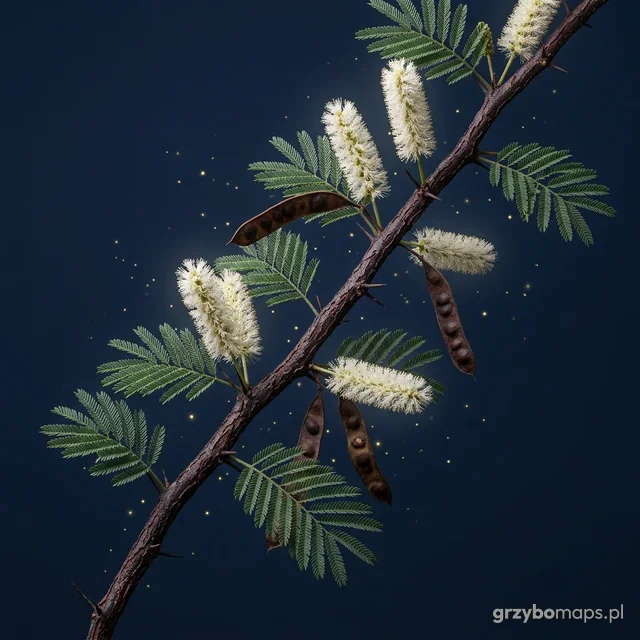
Mimosa tenuiflora
Mimosa tenuiflora (syn. Mimosa hostilis)
Polish folk names: jurema preta, jurema, tepezcohuite, MHRB (w slangu)
What it looks like
A thorny shrub or small tree of the legume family, up to about 8 m tall, with dark bark and delicate, bipinnate, fern-like leaves. It has white, fluffy, spike-like inflorescences and flat pods.
Where it comes from
North-eastern Brazil (the caatinga) and Mexico (Chiapas, Oaxaca) and other dry areas of Latin America.
History
From the root bark, the indigenous peoples of north-eastern Brazil prepare a drink called “jurema wine” (vinho da jurema), central to rituals and to the syncretic Jurema religion that combines Indigenous, Afro-Brazilian and Catholic traditions. In 1946 the Brazilian chemist Oswaldo Gonçalves de Lima isolated from it an alkaloid named nigerine, which in 1959 was identified as DMT. In Mexico, tepezcohuite bark is a traditional remedy for wounds and burns – after the gas explosion in Mexico in 1984 it was used to treat burn victims.
Legend and truth
Myth: “jurema works when swallowed without any additives, so it must contain some secret MAO inhibitor”. No beta-carbolines have been detected in the brews; the mechanism of the oral effect in the Jurema tradition remains unexplained and under study (other alkaloids, e.g. juremamine, are suspected, among others).
Substances
N,N-dimethyltryptamine (DMT) in the root bark, yuremamine, serotonin; tannins and saponins in the trunk bark.
How it works
DMT stimulates 5-HT2A receptors, causing intense, short-lived visionary states; taken orally without an MAO inhibitor it is usually broken down in the digestive tract. In the Jurema tradition the drink induces altered states of consciousness in a ritual context.
What it is sometimes confused with
- Mimosa ophthalmocentra (jurema branca)
- other thorny mimosas and acacias
- sensitive plant (Mimosa pudica)
Law in Poland
DMT is a psychotropic substance of group I-P (the strictest) in Poland, so bark used as its source may be subject to prosecution; the plant itself has not been confirmed by name in the list.
Fun fact
The same plant that is a source of DMT is in Mexico a prized remedy for wounds – bark extracts have been studied as preparations that speed up skin healing.
Frequently asked questions
How does mimosa tenuiflora work?
DMT stimulates 5-HT2A receptors, causing intense, short-lived visionary states; taken orally without an MAO inhibitor it is usually broken down in the digestive tract. In the Jurema tradition the drink induces altered states of consciousness in a ritual context.
What are the risks of mimosa tenuiflora?
Dangerous. The bark is sometimes used as a source of DMT for mixtures with MAO inhibitors (so-called ayahuasca analogues), which carries the same dangerous interactions with antidepressants and the risk of serotonin syndrome. DMT can cause acute anxiety reactions and psychoses in predisposed people, speeds up the heart rate and raises blood pressure. Raw material from the internet is often mislabelled and contaminated.
Mimosa tenuiflora and the law in Poland: what is allowed?
DMT is a psychotropic substance of group I-P (the strictest) in Poland, so bark used as its source may be subject to prosecution; the plant itself has not been confirmed by name in the list.