

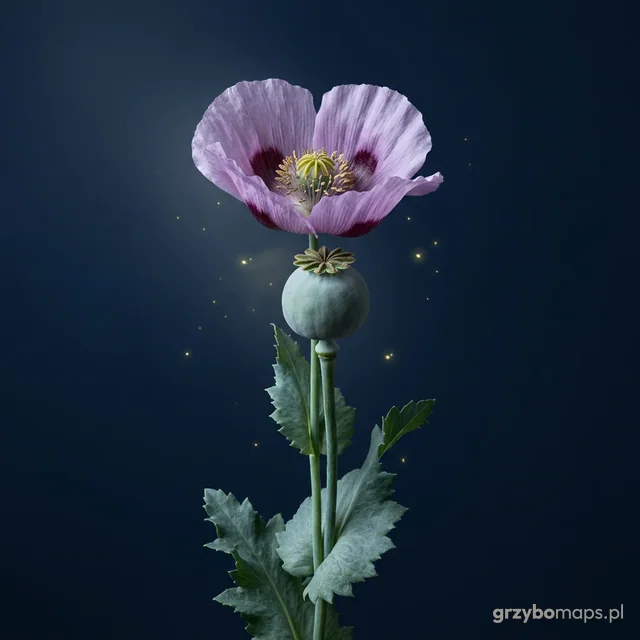
Opium poppy
Papaver somniferum
Polish folk names: mak ogrodowy, mak siewny, makówki, mak opiumowy
What it looks like
An annual, blue-green plant 50–150 cm tall with toothed leaves clasping the stem and covered with a waxy bloom. Large flowers, white, pink, red or violet, often with a dark spot at the base of the petals, soon fall. The fruit is a spherical or ovoid poppy head with a “crown” of stigma, full of tiny seeds.
Where it comes from
Probably the western Mediterranean region; cultivated since the Neolithic throughout Eurasia. In Poland it is grown for seed (low-morphine varieties) and in gardens, and sometimes runs wild temporarily.
History
The poppy has accompanied humanity for thousands of years: the Sumerians called it the “plant of joy”, and opium was the basic painkiller of antiquity and the Middle Ages. In the 19th century Great Britain fought the “Opium Wars” with China, and in 1804 morphine was isolated from opium. In communist Poland (PRL), when heroin was unavailable, in the 1970s “kompot” spread, a home-made extract from poppy straw, called “Polish heroin”. In response Marek Kotański founded the first MONAR centre in Głosków in 1978. In Polish culture the poppy is also makowiec (poppy-seed roll), kutia and noodles with poppy seeds on Christmas Eve.
Legend and truth
One often hears that after eating makowiec you can test positive for opiates. This is true: the seeds can contain trace amounts of morphine from the surface of the poppy head, which sometimes suffice for a positive result in screening tests, although they do not intoxicate by themselves.
Substances
Opium alkaloids (in the latex of unripe poppy heads): morphine, codeine, thebaine, papaverine, noscapine; the seeds contain mainly oil and only trace amounts of alkaloids.
How it works
Morphine and codeine stimulate opioid receptors: they relieve pain and cause drowsiness, euphoria and slowed breathing. Medicine makes use of the sedative and cough-suppressing effect.
What it is sometimes confused with
- corn poppy (Papaver rhoeas)
- oriental (garden) poppy
Law in Poland
Growing poppy in Poland requires a permit and is allowed only for low-morphine varieties, opium and poppy latex are narcotic drugs (group I-N), and seeds for food purposes are legal.
Fun fact
The whole of pain pharmacology descends from opium – from morphine to cough medicines with codeine – and breeders from Poland have bred poppy varieties almost free of morphine.
Frequently asked questions
How does opium poppy work?
Morphine and codeine stimulate opioid receptors: they relieve pain and cause drowsiness, euphoria and slowed breathing. Medicine makes use of the sedative and cough-suppressing effect.
What are the risks of opium poppy?
Addictive. Opiates cause very strong physical and psychological dependence, and withdrawal causes a severe withdrawal syndrome. Overdose shows as pinpoint pupils, cyanosis (bluish skin) and slowed breathing up to its stopping; the antidote is naloxone. Home-made decoctions have unpredictable concentrations and are sometimes contaminated, and intravenous use of “kompot” spread HIV and viral hepatitis infections in Poland. Combining with alcohol, benzodiazepines and other sedatives is deadly dangerous.
Opium poppy and the law in Poland: what is allowed?
Growing poppy in Poland requires a permit and is allowed only for low-morphine varieties, opium and poppy latex are narcotic drugs (group I-N), and seeds for food purposes are legal.