

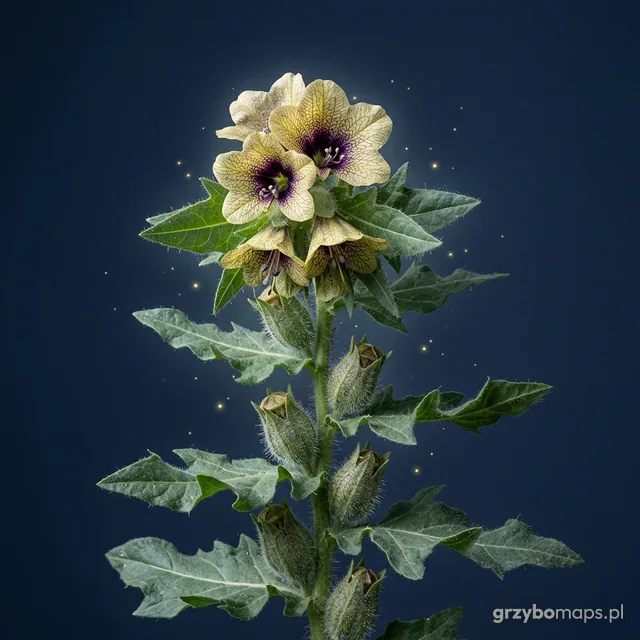
Black henbane
Hyoscyamus niger
Polish folk names: szalej, blekot, bielunek, zagorzałek, ziele szalone
What it looks like
An annual or biennial plant, 30–80 cm tall, entirely covered in glandular hairs, sticky and foul-smelling. The flowers are dirty yellow with a dense network of purple veins and a dark centre. The fruit is a capsule that opens with a lid, hidden in a pitcher-shaped calyx, with tiny grey-brown seeds.
Where it comes from
Originally the mountains of the Iranian-Anatolian region; today on all continents except Antarctica and Australia. In Poland it is naturalised (an archaeophyte) along roadsides, near rubbish bins, on rubble heaps and in poppy fields.
History
Henbane is one of the classic “witches' herbs” and was an ingredient of medieval ointments and potions attributed to witches. The Greeks called it the plant of Apollo, and tradition linked its smoke with the trance of the Delphic oracles. Archaeologists found hundreds of henbane seeds in a bone container from a Roman settlement in the Netherlands, which suggests that the plant was deliberately collected. It was also added to old herbal beers; the Bavarian beer purity law of 1516 was meant, among other things, to eliminate such additives.
Legend and truth
A claim circulates on the internet that the Czech city of Plzeň, and thus also pilsner, owes its name to the German Bilsenkraut, that is, henbane. This is an unconfirmed folk etymology; what is certain, however, is that henbane did find its way into herbal beers, and the Reinheitsgebot of 1516 limited the ingredients of beer to water, barley and hops.
Substances
Tropane alkaloids: hyoscyamine, scopolamine, atropine; most in the root and seeds.
How it works
Strongly anticholinergic: dryness of mucous membranes, dilated pupils, rapid heartbeat. In larger amounts, delirium, hallucinations, agitation, then drowsiness and coma.
What it is sometimes confused with
- nasiona maku
- root of parsley, parsnip or chicory
Law in Poland
The plant is not covered by the Act on Counteracting Drug Addiction and grows legally; its alkaloids are available only as prescription medicines.
Fun fact
Cattle usually avoid henbane because of its smell and taste, but poisonings of cows have been described in which strong agitation and convulsions predominated.
Frequently asked questions
How does black henbane work?
Strongly anticholinergic: dryness of mucous membranes, dilated pupils, rapid heartbeat. In larger amounts, delirium, hallucinations, agitation, then drowsiness and coma.
What are the risks of black henbane?
Poison. All parts are poisonous, especially the root and seeds; a dozen or so seeds can kill a child. Poisoning proceeds as with jimsonweed: fever, rapid heartbeat, delirium, convulsions, respiratory paralysis. The seeds are almost identical to poppy seeds, which is why poppy fields infested with it used to have to be destroyed. The root was sometimes mistaken for the root of parsley or parsnip.
Black henbane and the law in Poland: what is allowed?
The plant is not covered by the Act on Counteracting Drug Addiction and grows legally; its alkaloids are available only as prescription medicines.