

Kratom
Mitragyna speciosa
Polish folk names: ketum, biak, thom, kakuam
What it looks like
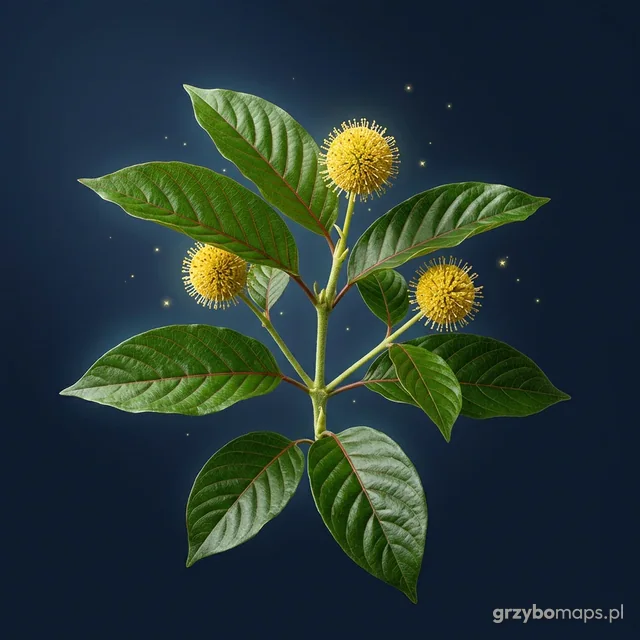
An evergreen tree of the madder family (a relative of the coffee plant), growing to 25 m tall. It has large, glossy, ovate leaves up to 20 cm long with prominent veins, which, depending on the variety, have red, green or white veinlets. The flowers are yellow, gathered in spherical heads.
Where it comes from
Southeast Asia: Thailand, Malaysia, Indonesia (Borneo, Sumatra), Myanmar, Papua New Guinea; it grows in humid forests and in swampy areas.
History
In Thailand and Malaysia, farmers and labourers have chewed kratom for centuries to cope more easily with hard work in the heat, and the leaves were also a home remedy for diarrhoea, pain and fever, and part of social gatherings. Thailand restricted it by a 1943 act (it is often said that this was partly because it competed with taxed opium), and on 24 August 2021 removed it from the list of narcotics, recognising its use as part of tradition. Since the 2000s, kratom has spread in the West as a “legal” new psychoactive substance sold online, advertised as a remedy for pain and opioid withdrawal.
Legend and truth
Myth: “kratom is a safe, natural herb that helps you quit opioids”. It acts on the same opioid receptors, causes tolerance, dependence and a withdrawal syndrome, and the American FDA warns against it and describes deaths, especially when it is combined with other substances.
Substances
Mitragynine (the main alkaloid), 7-hydroxymitragynine (present in the leaf only in trace amounts, formed mainly as a metabolite of mitragynine and acting more strongly on the μ-opioid receptor), paynantheine, speciogynine; over 40 alkaloids in total.
How it works
In small amounts it is stimulating, like coffee, in larger ones – calming, analgesic and euphoriant through μ-opioid receptors. The effect appears within a dozen or so minutes and lasts a few hours.
What it is sometimes confused with
- Mitragyna javanica
- Mitragyna hirsuta
- other Mitragyna species without mitragynine
Law in Poland
Mitragyna speciosa (live or dried plants, seeds, extracts and concentrates) has been a group I-N narcotic drug in Poland at least since the 2010 amendment, so possessing it is a crime under Art. 62 of the Act on Counteracting Drug Addiction (ustawa o przeciwdziałaniu narkomanii); in many EU countries kratom remains uncontrolled, and in 2021 the WHO did not recommend international control.
Fun fact
Kratom is the closest relative of the coffee plant among all plants with an opioid action – both belong to the madder family.
What research really says
Kratom acts on opioid receptors and can be addictive, but severe poisonings and deaths from kratom alone are rare; most deaths involve combining it with other substances. Many people in the West use it to cut down on opioids, although there are no clinical trials on this.
How it works
The main alkaloid, mitragynine, and 7-hydroxymitragynine are partial agonists of the μ-opioid receptor. 7-hydroxymitragynine occurs in the leaf only in trace amounts and is formed mainly as a metabolite of mitragynine, and it acts more strongly. Laboratory studies suggested that kratom alkaloids activate the pathway linked to respiratory depression less than morphine does, but the results are largely from animals and do not settle the question of safety in humans.
Addiction and withdrawal
In Malaysia, where many people have drunk kratom daily for years, a study of 293 regular users found that more than half had severe and 45% moderate dependence; withdrawal symptoms usually last from 1 to 3 days. In the American Johns Hopkins survey (2,798 people, 2017), fewer than 3% met the criteria for moderate or severe disorder, and about 13% met any criteria. The risk therefore depends strongly on the intensity and pattern of use.
Deaths: what the data say
The CDC analysed 27,338 overdose deaths in the USA from 2016-2017: kratom was detected in 152 (0.56%), in 91 it was judged to be one of the causes, and in only 7 was it the only substance detected. In most cases fentanyl, heroin or other drugs were also present. In 2021 the WHO assessed that serious poisonings probably make up a small percentage of all users.
Liver and contamination
In the American DILIN network, among 404 cases of liver injury caused by herbal products from 2004-2018, eight involved kratom, and in seven the link was judged convincing. In 2018 kratom was the source of a salmonella outbreak: 199 cases in 41 states, 38% hospitalised. The FDA also found lead and nickel in some products at levels dangerous with long-term use.
Self-treating opioid withdrawal
In the Johns Hopkins survey, 41% of respondents used kratom to quit or cut down on opioids and reported fewer withdrawal symptoms and less craving; 35% of them had not taken opioids for over a year. These are self-reported data without a control group. There are no clinical trials confirming effectiveness, and the FDA has not approved any kratom-based medicine.
7-OH concentrates
For several years, products with synthetically concentrated 7-hydroxymitragynine, acting much more strongly than the leaf, have been sold in the USA. In July 2025 the FDA recommended bringing precisely these concentrates under control, clearly distinguishing them from the natural leaf.
Status in Poland and Thailand
In Poland, Mitragyna speciosa (live plants or dried material, seeds, extracts and concentrates) has been on the list of narcotic drugs of group I-N at least since the 2010 amendment, so possession is a criminal offence. Thailand, where kratom had been controlled since the 1943 act, removed it from the list of narcotics on 24 August 2021, recognising its use as part of tradition; cases against more than 8,000 people were then dropped.
Authorities vs data
- Authorities exaggerate. They say: The FDA warns against using kratom because of the risk of serious adverse effects, including liver toxicity, seizures and addiction, and calls it a substance with opioid properties. Data: The risks are real but rare relative to the number of users: 8 kratom cases out of 404 herbal liver injuries in DILIN, 7 deaths involving kratom alone among more than 27 thousand overdose deaths. In 2021 the WHO found no grounds to recommend international control.
- Consistent with research. They say: WHO, Expert Committee on Drug Dependence (ECDD, 2021): the evidence is insufficient for a full critical review; kratom, mitragynine and 7-hydroxymitragynine remain under surveillance. Data: Epidemiological data are fragmentary, and harms are concentrated in combination with other substances and in contaminated or adulterated products.
- Authorities understate. They say: Sellers and some user communities present kratom as a herbal, non-addictive substitute for opioids. Data: Among daily users in Malaysia, more than half had severe dependence, and withdrawal symptoms are well described. 7-OH concentrates act more strongly than morphine.
- Consistent with research. They say: FDA (2018): kratom is not worth the risk of salmonella, and products contain heavy metals. Data: A confirmed salmonella outbreak (199 ill, 41 states) and test results for 26 products with lead and nickel show that the quality of the illegal or unregulated market is a real problem.
What we don't know yet. It is not known how often addiction develops in Western populations with different patterns of use, or whether kratom actually helps people quit opioids, because there are no randomised trials. Drug interactions and the effects of long-term use are also poorly understood.
Knowledge, not encouragement. We do not give doses or preparation methods.
Frequently asked questions
How does kratom work?
In small amounts it is stimulating, like coffee, in larger ones – calming, analgesic and euphoriant through μ-opioid receptors. The effect appears within a dozen or so minutes and lasts a few hours.
What are the risks of kratom?
Addictive. Regular, especially daily, use often leads to tolerance and dependence with opioid-like withdrawal symptoms, usually lasting 1 to 3 days; in Malaysia more than half of daily users had severe dependence, while in an American survey fewer than 3% of respondents met the criteria for moderate or severe disorder. Rare cases of liver damage (8 of 404 cases of herbal liver injury in the US DILIN network), seizures and heart rhythm disorders have been described; in a CDC analysis kratom was the only substance detected in 7 of 152 deaths involving it, and the rest mainly involved combinations with opioids, alcohol or sedatives. Products are sometimes contaminated (e.g. with salmonella, heavy metals) or spiked with 7-OH-mitragynine.
Kratom and the law in Poland: what is allowed?
Mitragyna speciosa (live or dried plants, seeds, extracts and concentrates) has been a group I-N narcotic drug in Poland at least since the 2010 amendment, so possessing it is a crime under Art. 62 of the Act on Counteracting Drug Addiction (ustawa o przeciwdziałaniu narkomanii); in many EU countries kratom remains uncontrolled, and in 2021 the WHO did not recommend international control.
Sources
- Mitragyna speciosa – Wikipedia (EN)
- Following “the Roots” of Kratom (Mitragyna speciosa) (PMC)
- Mitragyna speciosa: Clinical, Toxicological Aspects and Analysis (PMC)
- Kratom: naturalny środek o kontrowersyjnym działaniu i realnym ryzyku – National Geographic Polska
- Wykaz środków odurzających i substancji psychotropowych – Wikipedia
- WHO ECDD 44: raport wstępny o kratomie (PDF)
- CDC MMWR 2019: zgony z przedawkowania z wykrytym kratomem (PMC)
- Johns Hopkins 2020: ankieta 2 798 użytkowników kratomu
- Singh i wsp. 2014: uzależnienie i odstawienie u regularnych użytkowników
- AASLD: kratom a uszkodzenia wątroby (DILIN)
- CDC 2018: salmonella związana z kratomem
- HHS/FDA 2025: rekomendacja kontroli koncentratów 7-OH
- FDA and Kratom
- Bangkok Post 2021: kratom usunięty z listy narkotyków
- Nowelizacja ustawy o przeciwdziałaniu narkomanii, Dz.U. 2010 nr 143 poz. 962