

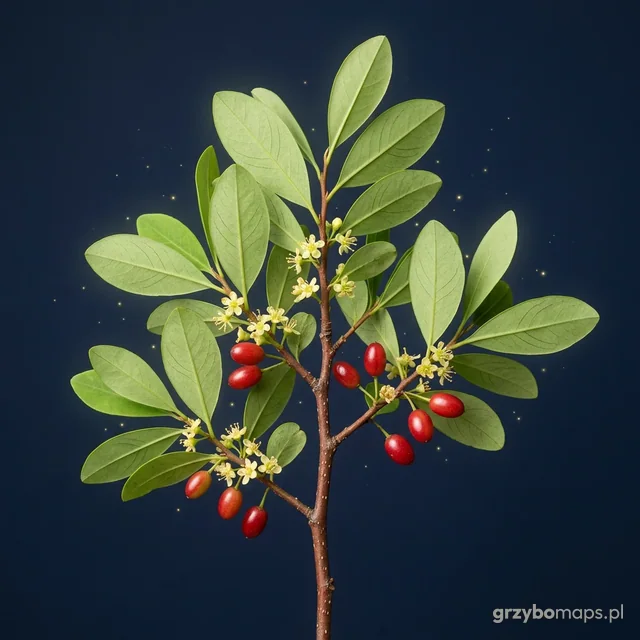
Coca
Erythroxylum coca
Polish folk names: koka, krzew kokainowy, hayo
What it looks like
A dense, leafy shrub usually growing to 2–3 m in height, with reddish-brown bark. The leaves are elliptical, light green, smooth, with two characteristic longitudinal lines running parallel to the midrib. The flowers are small, yellowish-white, and the fruits are small, red drupes.
Where it comes from
The eastern slopes of the Andes (Peru, Bolivia, Colombia, Ecuador); today known almost exclusively from cultivation in South America, formerly also in Java and Cameroon. It does not grow in Poland.
History
Coca leaves have been used by Andean peoples for thousands of years: chewing the leaves with ash or lime (so-called akulliku/chacchado) eases hunger, fatigue and altitude complaints, and the leaves have ritual significance as an offering to Pachamama. In the Inca empire coca was a privilege of the elites and part of ceremonies; the Spanish at first banned it, then taxed its trade. In 1860 Albert Niemann isolated cocaine from the leaves, and in the 19th century the coca wine Vin Mariani was popular. John Pemberton modelled himself on it when he created Coca-Cola in 1886, which in its first years contained an extract of coca leaves; since the early 20th century an extract with the cocaine removed has been used.
Legend and truth
Myth: “chewing coca leaves is the same as taking cocaine”. In reality the leaves contain only a small amount of the alkaloid, and traditional chewing has a mildly stimulating effect, like strong coffee; pure cocaine is an industrially isolated drug many times stronger. Even so, the leaves are a controlled substance in Poland and under UN conventions.
Substances
Cocaine (the main tropane alkaloid), cinnamoylcocaine, truxillines, hygrine, cuscohygrine; the leaves also contain vitamins and minerals.
How it works
Cocaine blocks the reuptake of dopamine, noradrenaline and serotonin and acts as a stimulant: it reduces hunger and fatigue and speeds up the heart. Chewing the leaves gives a mild and slow effect; pure cocaine acts quickly, with strong euphoria and briefly. Locally it acts as an anaesthetic, which was used in ophthalmology.
What it is sometimes confused with
- Erythroxylum novogranatense (Colombian coca)
- inne krasnodrzewy
Law in Poland
Coca leaves and cocaine are narcotic drugs of group I-N in Poland; possessing them without a permit is a crime under the Counteracting Drug Addiction Act.
Fun fact
In Bolivia and Peru coca leaf tea (mate de coca) is legal and given to tourists for altitude sickness, and Coca-Cola still legally uses a flavouring from coca leaves with the cocaine removed.
Frequently asked questions
How does coca work?
Cocaine blocks the reuptake of dopamine, noradrenaline and serotonin and acts as a stimulant: it reduces hunger and fatigue and speeds up the heart. Chewing the leaves gives a mild and slow effect; pure cocaine acts quickly, with strong euphoria and briefly. Locally it acts as an anaesthetic, which was used in ophthalmology.
What are the risks of coca?
Addictive. Cocaine is strongly psychologically addictive, and its use risks heart attack, stroke, dangerous rhythm disturbances, seizures and hyperthermia, even in young people. Chronic use leads to psychoses, paranoia and destruction of the nasal septum. Combination with alcohol creates cocaethylene in the liver, which is more toxic to the heart. Street cocaine is sometimes contaminated with, among other things, levamisole and fentanyl.
Coca and the law in Poland: what is allowed?
Coca leaves and cocaine are narcotic drugs of group I-N in Poland; possessing them without a permit is a crime under the Counteracting Drug Addiction Act.