

Hemp
Cannabis sativa
Polish folk names: konopie, marihuana, herb, konopie indyjskie, siemię konopne
What it looks like
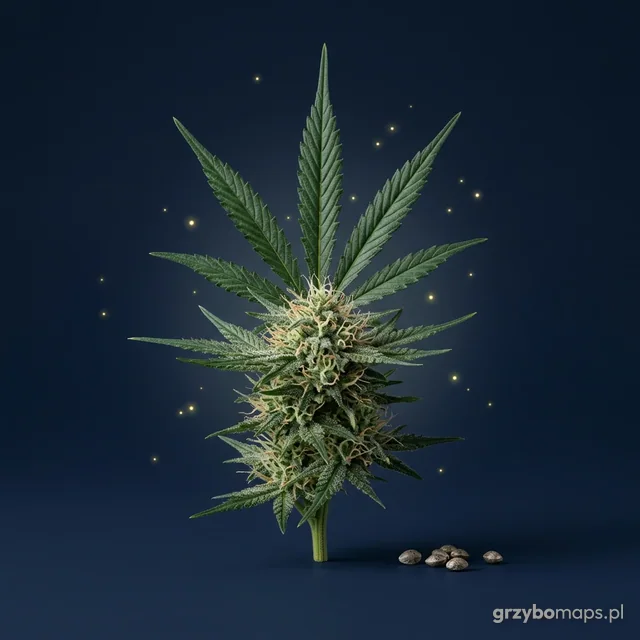
An annual plant, usually dioecious, from 1 to as much as 4 m tall. Leaves palmately compound, with 5–9 lanceolate, serrated leaflets. Female plants form dense, resinous inflorescences; the fruit is a small nutlet, the hemp seed.
Where it comes from
Central Asia; cultivated for thousands of years all over the world. In Poland it is grown as fibre (industrial) hemp, and locally runs wild along roadsides and on wasteland.
History
Cannabis is one of the oldest cultivated plants: it provided fibre for cloth, ropes and sails, oil and food. In the Polish countryside, cloth was woven from it for centuries, and on Christmas Eve many regions served dishes made from hempseed, such as Silesian siemieniotka. Herodotus described the Scythians intoxicating themselves with cannabis smoke in tents. In the 20th century the plant was placed under strict international control (the UN Single Convention of 1961); in 2020, at the WHO's request, the UN removed it from the strictest Schedule IV, and since 1 November 2017 medical marijuana has been available on prescription in Poland.
Legend and truth
A popular slogan says that marijuana “is natural, not addictive and does no harm”. Acute fatal overdose of THC is very rare, but some regular users develop dependence, and strong varieties increase the risk of psychosis, especially in teenagers.
Substances
Kannabinoidy: Δ9-tetrahydrokannabinol (THC, psychoaktywny), kannabidiol (CBD, niepsychoaktywny), kannabinol (CBN); terpeny i flawonoidy.
How it works
THC acts on CB1 cannabinoid receptors in the brain: it brings relaxation, euphoria, changes in the perception of time and increased appetite, but also impaired memory and coordination. CBD does not intoxicate; as the medicine Epidyolex it has been approved in the EU (EMA) since 2019 for treating severe childhood epilepsies (Dravet and Lennox-Gastaut syndromes).
What it is sometimes confused with
- hop (a close relative)
- ornamental plants with palmate leaves, e.g. spider flower or cinquefoil
Law in Poland
Since 7 May 2022, fibre hemp means plants with a total THC and THCA content of no more than 0.3%, and growing it requires a permit; the herb and resin of cannabis other than fibre hemp are group I-N narcotic drugs, and possessing them is a crime under Art. 62 of the Act on Counteracting Drug Addiction (ustawa o przeciwdziałaniu narkomanii), although for a small amount for personal use the prosecutor or court may discontinue the case (Art. 62a). Since 1 November 2017, cannabis herb has been a pharmaceutical raw material available in pharmacies on prescription, and since November 2024 a first prescription may only be issued after an in-person examination.
Fun fact
Hop and hemp belong to the same family, the hemp family (Cannabaceae) – so in a mug of beer and in a joint we find distant plant cousins, and some terpenes of both plants are the same.
What research really says
Cannabis does not cause fatal overdose in the way typical of opioids or alcohol, and the risk of addiction is real but lower than for nicotine, alcohol or cocaine. The most serious documented harms concern young people and daily users, especially of high-THC products.
How it works
THC is a partial agonist of the CB1 receptor in the brain, which explains the relaxation, changes in perception, increased appetite and temporary impairment of short-term memory and coordination. CBD does not intoxicate and acts through other mechanisms. CB1 receptors are sparse in the brainstem centres that control breathing, which is why THC alone does not cause respiratory depression as opioids do.
Addiction: the real numbers
In the large US NESARC study (Lopez-Quintero et al., 2011), 8.9% of people who had ever used cannabis became addicted over their lifetime, compared with 22.7% for alcohol, 20.9% for cocaine and 67.5% for nicotine. A 2020 meta-analysis (Leung et al.) estimates that around 22% of users have some cannabis use disorder, including mild. Among young people who use weekly or daily, the risk of addiction rises to around 33%.
Psychoses
A 2017 report by the US National Academies judged the association between cannabis use and schizophrenia and other psychoses to be well documented, strongest in the most frequent users. In the European EU-GEI study (Di Forti et al., Lancet Psychiatry 2019), daily use was associated with about 3.2 times higher odds of psychosis, and daily use of a strong product with about 4.8 times higher odds. This is a case-control study, so some scientists believe the causal effect may be overestimated in it.
Cannabinoid hyperemesis syndrome (CHS)
CHS is recurrent bouts of severe vomiting in people who use cannabis long-term and daily, which subside after stopping. In a study at one hospital in New York, 32.9% of patients who smoked at least 20 times a month met the criteria for CHS. A general-population study in the USA reports about 6% of past-year users, so it is not a rare phenomenon among heavy users.
Driving
A meta-analysis by Rogeberg and Elvik (Addiction, 2016) covering 21 studies found a low-to-moderate increase in crash risk after cannabis, an odds ratio of about 1.36, clearly less than after alcohol. Earlier, higher estimates turned out to be inflated by a failure to control for confounding factors, including simultaneous drinking. The increase in risk is nevertheless real, and combining it with alcohol increases it.
Proven medical uses
The US National Academies (2017) found substantial or conclusive evidence for the effectiveness of cannabinoids in chronic pain in adults, in chemotherapy-induced nausea and vomiting, and in spasticity in multiple sclerosis. In 2018 the FDA approved a pure-CBD drug (Epidiolex) for two severe childhood epilepsies, Dravet syndrome and Lennox-Gastaut syndrome, on the basis of three trials involving 516 patients. Most other advertised uses currently lack solid evidence.
Reassessment at UN level
Following the first formal WHO assessment in 2018, on 2 December 2020 the UN Commission on Narcotic Drugs voted 27 to 25 to remove cannabis and cannabis resin from Schedule IV of the 1961 Convention, i.e. from the group of substances considered particularly dangerous and without medical value. Cannabis nevertheless remained in Schedule I and under full international control.
Authorities vs data
- Authorities exaggerate. They say: The CDC (USA) states that about 3 in 10 people who use cannabis have cannabis use disorder, and presents this as roughly a 30 percent risk of addiction. Data: The figure of 30.6% comes from the Hasin study (2015) and refers to past-year users and broad DSM-IV criteria that include mild abuse. The lifetime risk of addiction for everyone who has ever used is about 9%, and by DSM-5 criteria about 19.5% meet the criteria for any disorder.
- Authorities exaggerate. They say: Until 2020, cannabis was in Schedule IV of the 1961 UN Convention, on a par with heroin, which meant it was considered particularly dangerous and of practically no therapeutic value. Data: After a review in 2018, the WHO recommended a change, and in 2020 the UN removed cannabis from Schedule IV. The evidence for effectiveness in chronic pain, chemotherapy-induced nausea, spasticity and some epilepsies is strong.
- Authorities understate. They say: The message of cannabis as a mild, non-addictive drug, common in pro-legalisation campaigns and in sellers' communications. Data: Daily use of strong products is associated with several times higher odds of psychosis (EU-GEI 2019), about one in three young daily users becomes addicted, and CHS affects a significant share of heavy users.
- Consistent with research. They say: US National Academies (2017): cannabis use is associated with schizophrenia and other psychoses, and the risk is highest in the most frequent users. Data: Later studies, including EU-GEI 2019, confirm the dependence on frequency and product strength.
What we don't know yet. It is not settled to what extent cannabis itself causes psychoses and to what extent people with a predisposition are more likely to use it. There is also a lack of good research on the effects of long-term use of modern products with very high THC content, and on the effectiveness of dried flower compared with approved medicines.
Knowledge, not encouragement. We do not give doses or preparation methods.
Frequently asked questions
How does hemp work?
THC acts on CB1 cannabinoid receptors in the brain: it brings relaxation, euphoria, changes in the perception of time and increased appetite, but also impaired memory and coordination. CBD does not intoxicate; as the medicine Epidyolex it has been approved in the EU (EMA) since 2019 for treating severe childhood epilepsies (Dravet and Lennox-Gastaut syndromes).
What are the risks of hemp?
Addictive. Dependence develops in about 9% of people who have ever used cannabis, and in about one third of young people who use it weekly or daily; daily use of potent products is linked to a several-fold higher chance of psychosis, especially in predisposed people, while the evidence for a lasting loss of motivation is weak. Anxiety attacks and palpitations can occur, and in long-term daily users cannabinoid hyperemesis syndrome (CHS), which in one study affected almost one in three heavy users presenting to the emergency department. Driving under the influence of THC increases the risk of an accident to a low-to-moderate degree, less than alcohol, but clearly more when combined with alcohol; in Poland it is punishable, and the courts assess whether the driver was in a state “after use” (a petty offence) or “under the influence” (a crime). Synthetic cannabinoids sold as “legal highs” (dopalacze) are far more dangerous and can be fatal.
Hemp and the law in Poland: what is allowed?
Since 7 May 2022, fibre hemp means plants with a total THC and THCA content of no more than 0.3%, and growing it requires a permit; the herb and resin of cannabis other than fibre hemp are group I-N narcotic drugs, and possessing them is a crime under Art. 62 of the Act on Counteracting Drug Addiction (ustawa o przeciwdziałaniu narkomanii), although for a small amount for personal use the prosecutor or court may discontinue the case (Art. 62a). Since 1 November 2017, cannabis herb has been a pharmaceutical raw material available in pharmacies on prescription, and since November 2024 a first prescription may only be issued after an in-person examination.
Sources
- Konopie siewne – Wikipedia
- Jakie związki aktywne zawierają konopie siewne? (leki.pl)
- Posiadanie konopi a prawo: Polska, Europa, świat (Infor)
- Konopie trafiają do Sejmu (Forsal)
- Narodowe Akademie USA 2017: wnioski komitetu (PDF)
- Di Forti i wsp. 2019, Lancet Psychiatry (EU-GEI)
- Lopez-Quintero i wsp. 2011, przejście od używania do uzależnienia (PMC)
- Leung i wsp. 2020, metaanaliza częstości zaburzeń używania konopi
- Rogeberg i Elvik 2016, konopie a ryzyko wypadku (PDF)
- CDC: ryzyko zaburzenia używania konopi
- UNODC: głosowanie CND w sprawie konopi, grudzień 2020
- Habboushe i wsp. 2018, częstość CHS u regularnych użytkowników
- Ustawa z 7 lipca 2017 r., Dz.U. 2017 poz. 1458 (marihuana medyczna)
- Ustawa z 24 marca 2022 r., Dz.U. 2022 poz. 763 (próg 0,3% THC)