

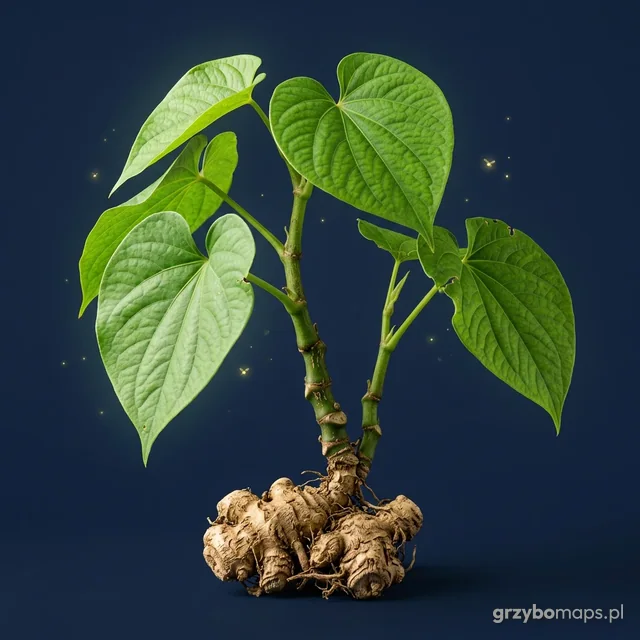
Kava
Piper methysticum
Polish folk names: kawa-kawa, yaqona (Fidżi), ʻawa (Hawaje), sakau, grog
What it looks like
A shrub of the pepper family up to 2–3 m tall, with thick, green, knee-jointed stems resembling bamboo. The leaves are large, heart-shaped, light green; the flowers are tiny, gathered in spikes. Cultivated varieties are usually sterile and propagated vegetatively; the useful raw material is the large, fleshy roots and rhizomes.
Where it comes from
Probably Vanuatu in Melanesia; cultivated for centuries on the islands of the Pacific – Fiji, Tonga, Samoa, Hawaii, Micronesia, New Guinea.
History
A drink made from kava roots has been the basis of social life in the Pacific for centuries: in Fiji the yaqona ceremony and the sevusevu gift (presenting the roots to the village chief) accompany greetings, weddings and councils, and in Vanuatu kava is drunk after dark in the men's clubhouses called nakamal. The first Europeans described it during the voyages of James Cook; the name “intoxicating pepper” was given to the plant by Georg Forster. Christian missionaries often fought against kava ceremonies. In the 1990s kava extracts became a popular herbal anti-anxiety remedy in Europe, until the bans after 2001.
Legend and truth
Myth: “kava is an exotic coffee (a coffee drink)”. It is a completely different plant – a relative of black pepper, whose drink contains no caffeine and is calming rather than stimulating.
Substances
Kavalactones (kavain, dihydrokavain, methysticin, yangonin and others); flavokavains A and B, to which part of the toxic effect is attributed.
How it works
It has a calming, anti-anxiety and muscle-relaxing effect, without clouding clarity of thought in typical traditional amounts; after drinking the beverage, local numbness of the mouth and tongue also appears. A Cochrane review (2003, updated 2010) found a small and not very robust advantage of the extract over placebo in the short-term treatment of anxiety, and a 16-week 2020 trial in people with generalised anxiety disorder did not confirm an advantage over placebo.
What it is sometimes confused with
- betel pepper (Piper betle)
- inne gatunki pieprzu ozdobnego
Law in Poland
Kava is not a narcotic drug in Poland, but since 4 April 2024 kava pepper has been on the list of substances banned in food and dietary supplements; in Germany, the 2002 ban on kava medicines was overturned by the courts in 2014 and 2015.
Fun fact
In Vanuatu the Tudei variety (“two-day”) is reserved for ceremonies, and its export is prohibited by law.
What research really says
Liver injury after kava is real but rare, and a detailed analysis of the cases that led to the bans in 2002 showed that in most of them the link was weak or doubtful. The anti-anxiety effect is small, and the largest new study did not confirm an advantage over placebo.
How it works
Kavalactones enhance the action of GABA-A receptors, but not via the benzodiazepine binding site; kavain acts, among other things, on extrasynaptic receptors. They also inhibit sodium and calcium channels and, in laboratory studies, the enzyme MAO-B. The exact mechanism of the anti-anxiety effect is still not settled.
Anxiety: what the research shows
The Cochrane review (Pittler and Ernst, 2003, updated 2010) covered 12 trials with 700 participants; in 7 of them the extract lowered the Hamilton Anxiety Rating Scale score by an average of 3.9 points more than placebo, and the authors rated the effect as small and not very robust. In a 16-week trial from 2020 (171 adults with generalised anxiety disorder), kava was no better than placebo, and remission was achieved by 17.4% in the kava group versus 23.8% on placebo.
Liver: the scale of the problem
Around 2000, about 100 cases of liver injury linked to kava were reported in Europe, but in only 14 was the link judged probable. In an analysis of 26 patients from Germany and Switzerland, the CIOMS scale gave a highly probable link in 1 person and a probable one in 2. Alcohol, other drugs that burden the liver or long-term use of high doses of extracts were often also present.
Raw material quality and form
A 2016 FAO and WHO report on the traditional water-based drink concluded that it can be consumed with an acceptably low risk, and linked earlier problems to poor-quality raw material, e.g. use of stems and peel, and to concentrated ethanol and acetone extracts. In very heavy drinkers, transient effects are common: a scaly rash (kava dermopathy) and raised GGT enzyme; both go away after stopping.
The ban in Germany and its reversal
In 2002 the German agency BfArM withdrew the marketing authorisations of kava medicines. In June 2014 the administrative court in Cologne overturned this decision, pointing among other things to duplicated reports and to cases better explained by alcohol or other drugs, and in February 2015 the court in Münster dismissed the agency's appeal.
New liver data
In the 2020 trial, abnormal liver test results occurred significantly more often in the kava group than on placebo, although no one met the criteria for drug-induced liver injury. The kava group also more often reported poorer memory and tremor.
Status in Poland
Kava is not a narcotic drug in Poland. Since 4 April 2024 a regulation of the Minister of Health has placed kava pepper (Piper methysticum) on the list of substances that may not be added to food or dietary supplements; previously it appeared in a 2021 resolution of the Dietary Supplements Team.
Authorities vs data
- Authorities exaggerate. They say: In 2002 the German BfArM judged the risk of liver injury unacceptable and withdrew kava medicines, and other EU countries followed suit. Data: The courts in Cologne (2014) and Münster (2015) ruled that the decision lacked sufficient grounds; a causality analysis using the CIOMS scale found a highly probable or probable link in only 3 of 26 patients.
- Consistent with research. They say: FAO and WHO (2016): the traditional water-based kava drink can be consumed with an acceptably low risk, provided the quality of the raw material is controlled. Data: Data from the Pacific and newer studies are consistent with this, although heavy drinking causes dermopathy and a rise in GGT, and the 2020 trial showed more frequent changes in liver tests.
- Authorities understate. They say: Sellers and websites promoting kava claim that there is no evidence at all of harm to the liver and that it is an effective natural remedy for anxiety. Data: Individual cases of severe liver injury are well documented, and the anti-anxiety effect was small in the meta-analysis and absent in the largest new study.
- Consistent with research. They say: The Polish Chief Sanitary Inspectorate and the Minister of Health: Piper methysticum may not be an ingredient of food or dietary supplements because of the risk to the liver. Data: The risk is rare and depends on the product form, but it is real; Poland has no quality-control system for the raw material, so the ban in supplements is justified as a precaution.
What we don't know yet. It is not known exactly what is responsible for the rare cases of liver injury: the kavalactones themselves, flavokavains, contaminants, plant varieties or individual susceptibility. There is also a lack of long-term safety studies with daily use.
Knowledge, not encouragement. We do not give doses or preparation methods.
Frequently asked questions
How does kava work?
It has a calming, anti-anxiety and muscle-relaxing effect, without clouding clarity of thought in typical traditional amounts; after drinking the beverage, local numbness of the mouth and tongue also appears. A Cochrane review (2003, updated 2010) found a small and not very robust advantage of the extract over placebo in the short-term treatment of anxiety, and a 16-week 2020 trial in people with generalised anxiety disorder did not confirm an advantage over placebo.
What are the risks of kava?
Dangerous. Kava extracts (especially ethanolic and acetonic ones) were linked to about 100 cases of liver damage, including severe ones, which led to bans in Germany and other countries in 2002; however, a re-analysis showed a probable link in only some of them, often involving alcohol or other medicines, and a German court overturned the ban in 2014. The risk is increased by combining with alcohol, sedatives (benzodiazepines) and medicines that strain the liver, and by poor-quality raw material (e.g. use of stems and leaves). Long-term heavy drinking causes scaly, dry skin changes (kava dermopathy). It impairs driving.
Kava and the law in Poland: what is allowed?
Kava is not a narcotic drug in Poland, but since 4 April 2024 kava pepper has been on the list of substances banned in food and dietary supplements; in Germany, the 2002 ban on kava medicines was overturned by the courts in 2014 and 2015.
Sources
- Kava – Wikipedia (EN)
- Kava culture – Wikipedia (EN)
- Biological Activity, Hepatotoxicity, and Structure-Activity Relationship of Kavalactones and Flavokavins (PMC)
- Toxicokinetics of Kava (PMC)
- Kava practitioner alert – TGA (Australia)
- Cochrane: ekstrakt z kawy a placebo w leczeniu lęku
- FAO/WHO 2016: bezpieczeństwo tradycyjnego napoju z kawy (PDF)
- Western Sydney University: kawa nieskuteczna w GAD (badanie 2020)
- HerbalGram: niemiecki sąd uchyla zakaz kawy
- Lexology: wyrok sądu w Kolonii 2014
- Teschke: hepatotoksyczność kawy, przegląd kliniczny (Annals of Hepatology)
- Ernst 2007: ponowna ocena bezpieczeństwa kawy (PMC)
- GIS: substancje niedozwolone w suplementach diety