

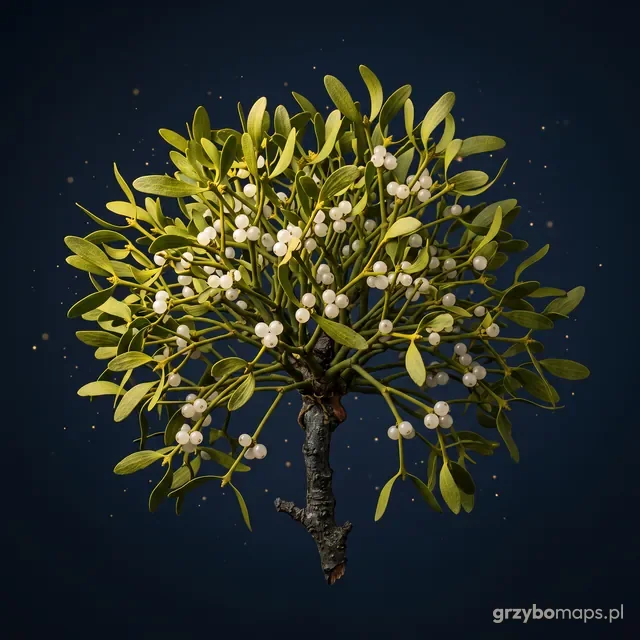
European mistletoe
Viscum album
Polish folk names: jemioła, jemiela, ptasi lep, mistletoe
What it looks like
A semi-parasitic evergreen shrub that grows on tree branches and forms round clumps up to a metre across. The stems are yellow-green and fork repeatedly, and the leathery, oblong leaves grow in pairs. It flowers inconspicuously in early spring, and in winter its white, translucent, sticky berries ripen.
Where it comes from
Europe, western and central Asia and North Africa. Common in the Polish lowlands. Its subspecies grow on broadleaved trees (poplars, limes, apple trees, birches), on pine and on fir, and are very rare on oak. The seeds are spread by birds, especially waxwings and mistle thrushes.
History
In the first century AD, Pliny the Elder described in his “Natural History” how Gaulish druids, on the sixth day of the moon, cut mistletoe from an oak with a golden sickle, caught it on a white cloth and sacrificed two white bulls. Mistletoe from an oak was seen as a gift from heaven and a cure for everything, precisely because it grows on oaks so rarely. Folk medicine gave it for high blood pressure and epilepsy, and since the 1920s mistletoe extracts have been used in anthroposophic medicine for cancer.
Legend and truth
In Norse mythology mistletoe was the only plant from which the goddess Frigg took no oath not to harm her son Baldr. Loki made an arrow from it, and the blind Höðr unknowingly killed Baldr with it. The custom of kissing under the mistletoe spread in England in the 18th century and has no proven link with the druids. Mistletoe has no effect on the mind: its power is history, not chemistry.
Substances
Viscotoxins (poisonous proteins), mistletoe lectins, flavonoids, phenolic acids, biogenic amines.
How it works
In laboratory studies mistletoe extracts stimulate the immune system and damage cancer cells. For cancer patients the benefits are uncertain: a 2008 Cochrane review found the evidence weak, and newer studies give conflicting results. Mistletoe is not psychoactive.
What it is sometimes confused with
- yellow mistletoe (Loranthus europaeus)
- American mistletoe (Phoradendron)
- artificial mistletoe sprigs with coloured berries
Law in Poland
In Poland mistletoe is neither a protected species nor a narcotic. To collect it you need the tree owner’s permission, and in a state forest the forester’s permission.
Fun fact
In Polish the waxwing, jemiołuszka, is named after mistletoe (jemioła). In winter it eats the berries and leaves the sticky seeds on branches, planting new shrubs that way.
Frequently asked questions
How does european mistletoe work?
In laboratory studies mistletoe extracts stimulate the immune system and damage cancer cells. For cancer patients the benefits are uncertain: a 2008 Cochrane review found the evidence weak, and newer studies give conflicting results. Mistletoe is not psychoactive.
What are the risks of european mistletoe?
Dangerous. The berries and leaves are poisonous. Eating a few berries usually ends in stomach ache, vomiting and diarrhoea, but larger amounts or leaf infusions can slow the heart, lower blood pressure and cause seizures. Extracts given as injections cause reactions at the injection site, fever and, rarely, severe allergic reactions. It must not be used in pregnancy. Keep mistletoe wreaths away from children and pets.
European mistletoe and the law in Poland: what is allowed?
In Poland mistletoe is neither a protected species nor a narcotic. To collect it you need the tree owner’s permission, and in a state forest the forester’s permission.