

Iboga
Tabernanthe iboga
Polish folk names: eboga, eboka, bois sacré
What it looks like
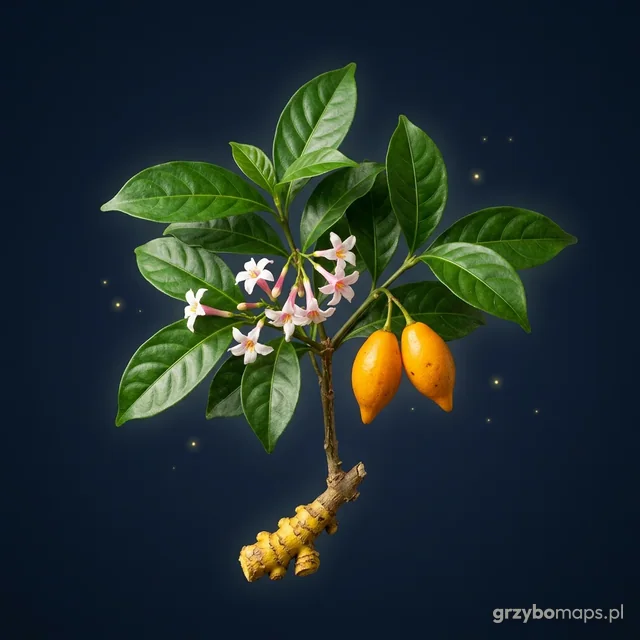
An evergreen rainforest understorey shrub, usually 1.5–2 m tall (taller in favourable conditions), with large, opposite, dark green leaves. It has small, whitish-pink, speckled flowers and oblong, orange fruits. The root has yellowish bark, which is the richest in alkaloids.
Where it comes from
Rainforests of west-central Africa: Gabon, Cameroon, the Republic of the Congo and the Democratic Republic of the Congo.
History
The root bark of iboga is the central sacrament of the Bwiti religion, practised in Gabon and Cameroon, where it accompanies initiation ceremonies – in visions the young person is to “meet the ancestors” and learn the meaning of life. The Pygmies are said to have passed knowledge of the plant on to the Bantu peoples. In the 1930s in France a drug based on it, Lambarène, was sold as a tonic. In 1962 the American Howard Lotsof noticed that ibogaine eases the symptoms of opioid withdrawal, which started research into its anti-addiction effect and the creation of illegal or semi-legal clinics in Mexico and other countries.
Legend and truth
Myth: “ibogaine is a one-time miracle cure for every addiction”. Preliminary studies are promising, but ibogaine is not an approved drug, and reports of deaths in clinics and during self-administration show that it can kill even people without heart disease.
Substances
Ibogaine (the main indole alkaloid), ibogamine, ibogaline, tabernanthine; the long-acting metabolite noribogaine is formed in the body.
How it works
Ibogaine acts simultaneously on many neurotransmitter systems (serotonin, dopamine, opioid, NMDA). In small amounts it is stimulating, in larger ones it causes a many-hour, oneiric state resembling waking dreaming, with visions of memories, followed by a long period of introspection and insomnia; the whole can last more than a day.
What it is sometimes confused with
- Voacanga africana (contains related alkaloids)
- Tabernaemontana (other shrubs of the dogbane family)
Law in Poland
Ibogaine is not an approved medicine in Poland, and the plant Tabernanthe iboga (live, dried, seeds, extracts and concentrates) has been listed in group I-N of narcotic drugs since 2009, currently in the Regulation of the Minister of Health (Dz.U. 2024 poz. 1139), so possessing it is illegal; we did not find pure ibogaine as a separate entry on the list.
Fun fact
In Gabon iboga has the status of a national treasure, and its illegal export abroad is prosecuted – excessive demand from Western clinics threatens wild populations.
What research really says
Ibogaine really does kill: dozens of deaths are known, mainly cardiac, most often during opioid detox and in people with heart disease. At the same time, small uncontrolled studies suggest a strong effect in addiction and brain injury, which no controlled study has yet confirmed.
Mechanism and duration of action
Ibogaine acts on many systems at once (serotonin, dopamine, opioid, NMDA), and in the liver it is converted by the enzyme CYP2D6 into noribogaine, which has a half-life of 28 to 49 hours. That is why both the effects and the danger to the heart persist for several days.
The heart: how the danger arises
Ibogaine and noribogaine block hERG potassium channels at concentrations reached in humans, which slows the repolarisation of heart cells and prolongs the QT interval. This can lead to torsade de pointes tachycardia and sudden death, including with a delay of several days. The risk is increased by methadone, alcohol, cocaine, other QT-prolonging drugs and electrolyte disturbances.
Deaths: hard numbers
Alper et al. (Journal of Forensic Sciences, 2012) analysed all known deaths outside West-Central Africa from 1990 to 2008: 19 people died between 1.5 and 76 hours after taking it. In 12 of the 14 fully documented cases, diseases, mainly of the heart, or other substances contributed. A non-peer-reviewed 2026 preprint (19,071 patients in 11 clinics) described 6 deaths, all in people treated for opioid addiction, and none among the remaining 8,689; the authors stress that this is a lower bound.
What controlled ECG measurement showed
In the Dutch study by Knuijver et al. (Addiction, 2022), 14 opioid-dependent patients received ibogaine under full hospital monitoring. The mean maximum QTc prolongation was about 100 ms, and half of the participants exceeded 500 ms, the threshold for a high risk of arrhythmia. All of them developed severe, transient ataxia that made walking unaided impossible.
Efficacy research
The Stanford study (Nature Medicine, 2024) included 30 special forces veterans with brain injuries, treated in Mexico with ibogaine plus magnesium: after one month, large improvements in functioning and in symptoms of PTSD, depression and anxiety were reported, with no serious adverse events. However, it was an open-label study without a control group. Observational studies in opioid addiction from Mexico and New Zealand are similarly small (about 30 and 14 people respectively).
Policy and protection of the plant
Since 2009, New Zealand has allowed ibogaine on prescription as an unapproved medicine. In 2025, Texas allocated USD 50 million to clinical trials of ibogaine (bill SB 2308). In Gabon, where iboga is a sacrament of the Bwiti religion, wild populations are overexploited, and exports were halted in 2019.
Authorities vs data
- Authorities exaggerate. They say: The US DEA classifies ibogaine in Schedule I, i.e. as a substance with no accepted medical use. Data: Since 2009, New Zealand has allowed ibogaine to be prescribed, and Texas is funding clinical trials of it. Preliminary data from open-label studies are promising, although without placebo control they do not prove efficacy.
- Authorities understate. They say: Texas (bill SB 2308, 2025) allocated USD 50 million to bringing ibogaine to approval as an addiction medicine, and the public debate presented it as a breakthrough. Data: In a controlled study with ECG monitoring, half of the patients exceeded a QTc of 500 ms, and deaths are concentrated precisely among people coming off opioids, the very group it is meant to treat. Political enthusiasm is running ahead of the safety data.
- Authorities understate. They say: The Polish regulation of the Minister of Health lists Tabernanthe iboga (the plant, dried material, seeds, extracts and concentrates) in group I-N of narcotic drugs. Data: The real danger of ibogaine is primarily cardiac, not related to addiction, and the ban is not accompanied by any public information about the risk of arrhythmia for people travelling abroad for therapy.
What we don't know yet. It is not known how many deaths in informal clinics and in Africa have never been reported, so the true mortality is unknown. There is not yet a single randomised controlled trial confirming efficacy in addiction or brain injury, nor any evidence that added magnesium protects the heart.
Knowledge, not encouragement. We do not give doses or preparation methods.
Frequently asked questions
How does iboga work?
Ibogaine acts simultaneously on many neurotransmitter systems (serotonin, dopamine, opioid, NMDA). In small amounts it is stimulating, in larger ones it causes a many-hour, oneiric state resembling waking dreaming, with visions of memories, followed by a long period of introspection and insomnia; the whole can last more than a day.
What are the risks of iboga?
Poison. Ibogaine and noribogaine block hERG potassium channels in the heart, prolonging the QT interval and possibly causing torsade de pointes, ventricular fibrillation and sudden cardiac death; a 2012 review described 19 deaths between 1990 and 2008, mostly in people with heart disease or after other substances, but dangerous arrhythmias have also been recorded in people with no known heart disease. The risk increases in combination with opioids, methadone, alcohol, cocaine and QT-prolonging medicines, and with electrolyte disturbances. Severe ataxia, vomiting and tremors occur. The effect lasts a long time, so the cardiac danger persists for up to several days.
Iboga and the law in Poland: what is allowed?
Ibogaine is not an approved medicine in Poland, and the plant Tabernanthe iboga (live, dried, seeds, extracts and concentrates) has been listed in group I-N of narcotic drugs since 2009, currently in the Regulation of the Minister of Health (Dz.U. 2024 poz. 1139), so possessing it is illegal; we did not find pure ibogaine as a separate entry on the list.
Sources
- Tabernanthe iboga – Wikipedia (EN)
- Ibogaine – Wikipedia (EN)
- The anti-addictive drug ibogaine modulates voltage-gated ion channels and may trigger cardiac arrhythmias (PMC)
- Legal status of ibogaine by country – Wikipedia (EN)
- Alper, Stajić, Gill 2012, Fatalities temporally associated with ibogaine
- Knuijver i wsp. 2022, Bezpieczeństwo ibogainy w detoksie opioidowym, Addiction
- Cherian i wsp. 2024, Magnesium–ibogaine therapy in veterans with TBI, Nature Medicine
- Koenig i Hilber, Ibogaina a serce (kanały hERG, noribogaina)
- Arns i wsp. 2026, preprint: śmiertelność 19 071 pacjentów
- MAPS 2017, badania obserwacyjne z Meksyku i Nowej Zelandii
- HPPR 2025, Teksas finansuje badania ibogainy (SB 2308)
- ICEERS 2026, raport o zrównoważonym pozyskiwaniu ibogi
- Ustawa z 20 marca 2009 r. o zmianie ustawy o przeciwdziałaniu narkomanii
- Rozporządzenie MZ, tekst jednolity Dz.U. 2024 poz. 1139