

Syrian rue
Peganum harmala
Polish folk names: ruta syryjska, harmal, esfand (Iran), üzerlik (Turcja), spand
What it looks like
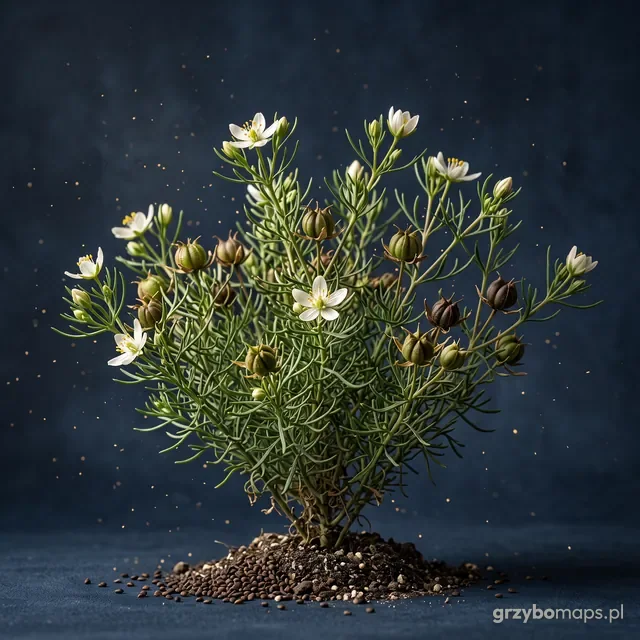
A bushy perennial 30–80 cm tall, with leaves split into narrow, thread-like lobes. It has white or cream five-petalled flowers with yellowish stamens. The fruit is a round, three-chambered capsule full of small, angular, dark brown seeds.
Where it comes from
Dry steppes and semi-deserts from North Africa and the Middle East to Central Asia, India and Mongolia. Introduced to the United States and Australia, among other places, where it is considered a troublesome weed. It does not grow wild in Poland.
History
In Iran, Afghanistan and Turkey, Syrian rue seeds have been burned for centuries as incense against the evil eye: this is the Persian esfand, sprinkled on glowing coals at weddings and when a child is born. The seeds also gave a red dye for colouring carpet wool. In the 19th century harmine and harmaline were isolated from them, and in the 1920s harmine was tried as a treatment for Parkinson’s disease.
Legend and truth
Some researchers believe that Syrian rue was in fact the ingredient of the legendary drink soma or haoma described in the sacred books of India and Iran. David Flattery and Martin Schwartz put forward this hypothesis in 1989 in the book “Haoma and Harmaline”. It is only one of the theories: others point to the fly agaric or ephedra, and the question cannot be settled today.
Substances
Beta-carbolines: harmine, harmaline and tetrahydroharmine. The seeds contain the most. They act as reversible inhibitors of the enzyme MAO-A.
How it works
Syrian rue alkaloids block the enzyme that breaks down serotonin and other amines in the body, so they strengthen the effects of many substances and medicines. On their own, in larger amounts, they cause nausea, vomiting, tremor, dizziness and images behind closed eyes. Harmine is being studied for diabetes and neurodegenerative diseases, among other things, but so far mainly in cells and animals.
What it is sometimes confused with
- common rue (Ruta graveolens)
- seeds of other plants sold as “esfand”
Law in Poland
Syrian rue is not on the Polish lists of narcotic drugs and psychotropic substances, and the dried seeds are sometimes sold as incense. A product sold for getting high may, however, be treated as a substitute drug, and mixtures with DMT are illegal because of the DMT itself.
Fun fact
Esfand seeds crackle as they burst on the coals, and in Iran people say it is the evil eye cast on the household that is bursting.
Frequently asked questions
How does syrian rue work?
Syrian rue alkaloids block the enzyme that breaks down serotonin and other amines in the body, so they strengthen the effects of many substances and medicines. On their own, in larger amounts, they cause nausea, vomiting, tremor, dizziness and images behind closed eyes. Harmine is being studied for diabetes and neurodegenerative diseases, among other things, but so far mainly in cells and animals.
What are the risks of syrian rue?
Dangerous. The interactions are the most dangerous part. Combining it with antidepressants (especially SSRIs), cold medicines with pseudoephedrine, stimulants or foods rich in tyramine can cause serotonin syndrome or a hypertensive crisis, both life-threatening. Poisonings of people and livestock have been described, with vomiting, seizures, heart rhythm disorders and kidney failure. In folk medicine it was used to cause miscarriages, which ended in severe poisoning.
Syrian rue and the law in Poland: what is allowed?
Syrian rue is not on the Polish lists of narcotic drugs and psychotropic substances, and the dried seeds are sometimes sold as incense. A product sold for getting high may, however, be treated as a substitute drug, and mixtures with DMT are illegal because of the DMT itself.