

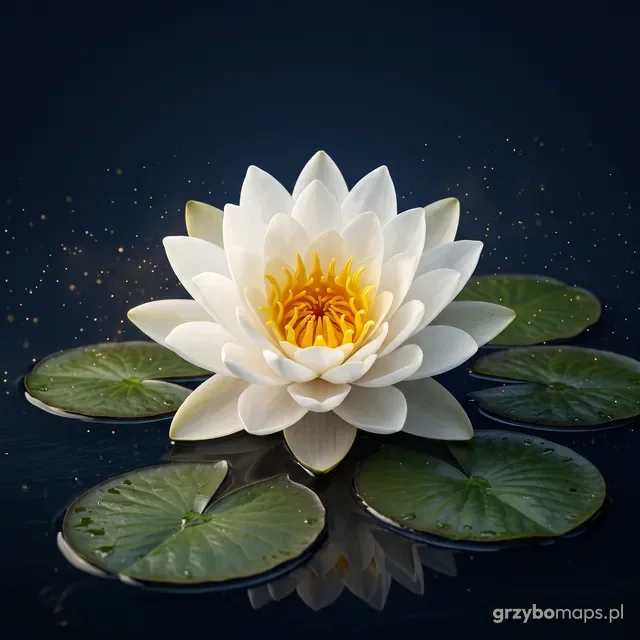
White water lily
Nymphaea alba
Polish folk names: lilia wodna, nenufar, grzybień
What it looks like
An aquatic perennial with a thick rhizome rooted in the mud. Round, leathery leaves up to 30 cm across, deeply notched at the base, float on the water. From June to September it bears large, white, fragrant flowers with many petals and a yellow centre. The flowers open in the morning and close in the evening.
Where it comes from
Europe, North Africa and western Asia. In Poland it grows in ponds, oxbow lakes and calm lake bays in the lowlands and foothills. It is becoming rarer because of drainage and water pollution.
History
Old herbalists recommended water lily syrup to suppress sexual desire, including in monasteries. The rhizomes were astringent, so they were used for diarrhoea and skin inflammation. In painting, water lilies became a symbol of calm, and Claude Monet painted about two hundred and fifty pictures of them in his garden at Giverny.
Legend and truth
In Slavic and Germanic beliefs, water lilies were linked with rusalkas and nymphs: people said drowned girls turned into them, and whoever picked the flower could be dragged under the water. The Latin name Nymphaea refers to the Greek nymphs. The warning made real sense, because anyone reaching for a flower from the bank or a boat easily falls into the mud and tangled stems. The white water lily does not affect the mind like the Egyptian blue lotus, with which it is often associated.
Substances
Alkaloids (including nymphaeine), tannins, gallic acid, flavonoids.
How it works
The rhizome is astringent. There are no studies confirming that it suppresses desire or has any other effect on the mind.
What it is sometimes confused with
- yellow water lily (Nuphar lutea)
- blue lotus (Nymphaea caerulea)
- ornamental water lily varieties from garden ponds
Law in Poland
The white water lily is partially protected in Poland (Regulation of the Minister of the Environment of 9 October 2014). In the wild it may not be picked, dug up or damaged; plants for a garden pond are bought from nurseries.
Fun fact
Red heart-shaped water lily leaves, called pompeblêden in Frisian, decorate the flag of Friesland in the Netherlands.
Frequently asked questions
How does white water lily work?
The rhizome is astringent. There are no studies confirming that it suppresses desire or has any other effect on the mind.
What are the risks of white water lily?
Dangerous. In larger amounts, the rhizome and seeds can cause poisoning with nausea, vomiting and heart rhythm problems, and their toxicity is poorly studied. The biggest danger, however, is the water itself: picking flowers from the bank or a boat sometimes ends in drowning.
White water lily and the law in Poland: what is allowed?
The white water lily is partially protected in Poland (Regulation of the Minister of the Environment of 9 October 2014). In the wild it may not be picked, dug up or damaged; plants for a garden pond are bought from nurseries.