

St John's wort
Hypericum perforatum
Polish folk names: ziele świętojańskie, krew świętego Jana, przestrzelon
What it looks like
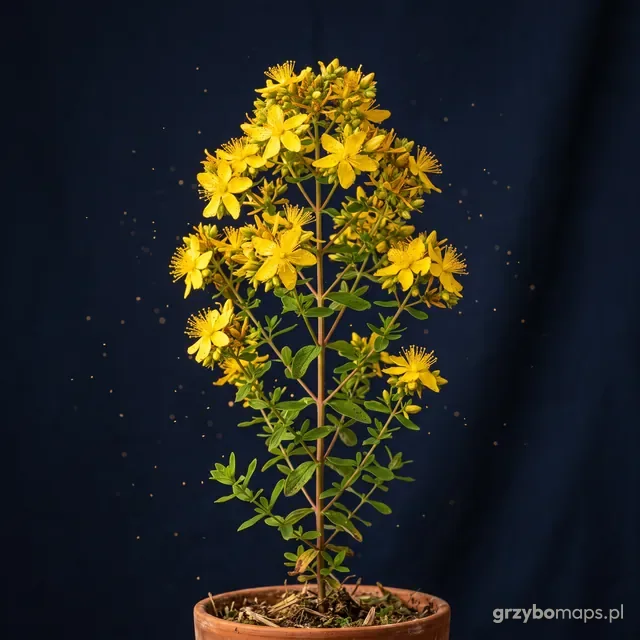
A perennial 30–80 cm tall, with an upright stem bearing two distinct ridges. Held up to the light, the small oblong leaves look as if pricked with a needle; these are translucent oil glands. The golden-yellow, five-petalled flowers have a tuft of many stamens and black dots on the petal edges, and when crushed they stain your fingers red.
Where it comes from
Europe, western Asia and North Africa. In Poland it is common in meadows, on roadsides, in clearings and at forest edges.
History
St John's wort flowers around Midsummer Night and has long been the herb of that night: it was hung over doors and in windows against lightning, witches and evil spirits. The red juice from crushed flowers was called St John's blood, and in the Middle Ages the plant was known as fuga daemonum, "the demon-chaser".
Legend and truth
Legend has it that the devil, in a rage, pricked the leaves with a needle because the herb protected people from evil. The "holes" are oil glands. The modern story of a natural remedy for low mood, on the other hand, has solid research behind it.
Substances
Hypericin and pseudohypericin, hyperforin, flavonoids (hyperoside, rutin, quercetin), essential oil and tannins.
How it works
A 2008 Cochrane review found that standardised extracts help with mild and moderate depression better than placebo and about as well as standard antidepressants, with fewer side effects. The European Medicines Agency recognises such extracts as a medicine with well-established use in mild and moderate depression.
What it is sometimes confused with
- other St John's worts, e.g. square-stalked St John's wort
- common ragwort, poisonous, also flowers yellow in summer
Law in Poland
St John's wort is not restricted in Poland; the herb and extracts are sold in pharmacies, including as medicines.
Fun fact
Cows and sheep that eat a lot of St John's wort get sunburnt skin, because hypericin makes it sensitive to light.
Frequently asked questions
How does st john's wort work?
A 2008 Cochrane review found that standardised extracts help with mild and moderate depression better than placebo and about as well as standard antidepressants, with fewer side effects. The European Medicines Agency recognises such extracts as a medicine with well-established use in mild and moderate depression.
What are the risks of st john's wort?
Mild. St John's wort strongly speeds up the breakdown of many medicines in the liver. It weakens contraceptive pills, anticoagulants, transplant drugs, HIV medicines and some cancer and heart medicines. With antidepressants it risks serotonin syndrome. It makes the skin sensitive to sunlight. Before combining it with any medicine, ask a doctor or pharmacist.
St John's wort and the law in Poland: what is allowed?
St John's wort is not restricted in Poland; the herb and extracts are sold in pharmacies, including as medicines.