

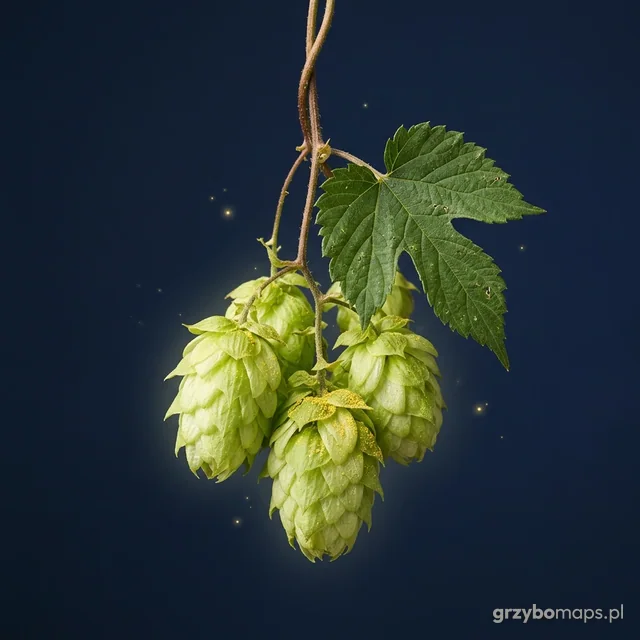
Common hop
Humulus lupulus
Polish folk names: chmiel, szyszki chmielowe, lupulina
What it looks like
A perennial climber twining clockwise, reaching 6–10 m, with rough stems bearing hooked hairs. Leaves heart-shaped, 3–5-lobed, rough. Female plants produce light green “cones” with the yellow, sticky powder of lupulin at the base of the scales.
Where it comes from
The temperate zone of the Northern Hemisphere. In Poland common in the wild in riparian forests, alder woods and thickets along rivers; grown mainly in the Lubelskie region.
History
Hops were added to beer in Europe from the early Middle Ages; in the 12th century Hildegard of Bingen wrote about them, and with time they displaced herbal mixtures (gruit). The Bavarian purity law of 1516 made them, besides water and barley, the only permitted ingredient of beer. In folk medicine the cones were put into pillows against insomnia, and Polish Lublin hops have long been a prized export commodity. Hops also appear in wedding songs, e.g. in the ditty “Oj chmielu, chmielu”.
Legend and truth
A myth circulates online that beer “turns men into women” because of the phytoestrogens of hops. Hops do contain 8-prenylnaringenin, one of the strongest known phytoestrogens, but there is very little of it in beer; the “beer belly” is rather due to alcohol and calories.
Substances
Bitter acids (humulone, lupulone), essential oil (myrcene, humulene), 2-methyl-3-buten-2-ol, flavonoids (xanthohumol, 8-prenylnaringenin).
How it works
Hop extracts have a mildly calming effect and make it easier to fall asleep, often in combination with valerian. The bitterness stimulates digestion; there is no intoxicating effect.
What it is sometimes confused with
- kielisznik
- przytulia czepna
- dzikie wino
Law in Poland
A fully legal plant, grown industrially and available as a herbal raw material.
Fun fact
Hop is the closest relative of hemp – both belong to the hemp family, and their shared smell comes from, among others, the terpene myrcene.
Frequently asked questions
How does common hop work?
Hop extracts have a mildly calming effect and make it easier to fall asleep, often in combination with valerian. The bitterness stimulates digestion; there is no intoxicating effect.
What are the risks of common hop?
Mild. The risk is small: possible drowsiness, intensification of the effect of sedatives and alcohol, allergic reactions and skin irritation in pickers. Because of the phytoestrogens, caution is recommended in pregnancy and in hormone-dependent cancers. Hops are, however, dangerous for dogs – eating the cones (e.g. brewing waste) can cause fatal hyperthermia in them.
Common hop and the law in Poland: what is allowed?
A fully legal plant, grown industrially and available as a herbal raw material.