

Wormwood
Artemisia absinthium
Polish folk names: piołun, absynt, ziele gorzkie, psia rutka
What it looks like
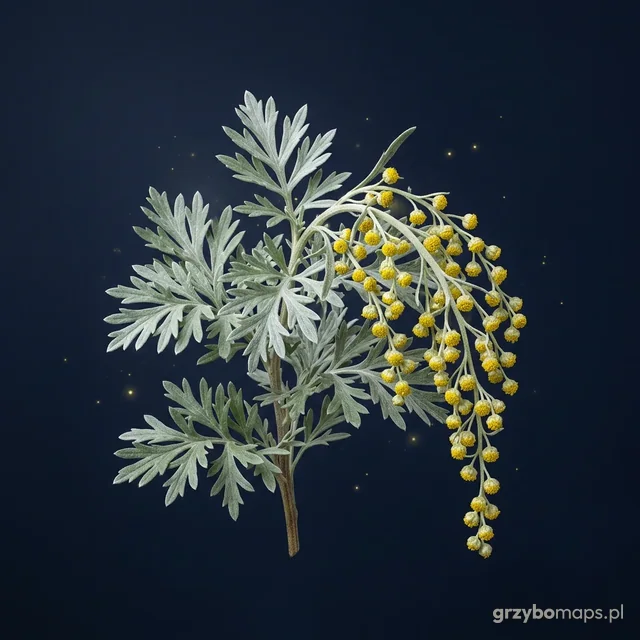
A silvery-grey, strongly aromatic perennial, 50–120 cm tall, covered all over with silky hairs. Leaves 2–3 times pinnately divided, almost white beneath. Small, spherical, yellow flower heads hang in loose panicles in summer; the whole plant is intensely bitter.
Where it comes from
The Mediterranean region and western and central Asia; today almost worldwide. In Poland common along roadsides, on wasteland, near buildings and on dry meadows.
History
Wormwood has been a symbol of bitterness since biblical times, and in the Revelation of St John a falling star bears the name Wormwood. In 19th-century France, absinthe, the 'green fairy', was made from wormwood, anise and fennel and drunk by artists such as Verlaine, Rimbaud, Toulouse-Lautrec and Van Gogh. In the early 20th century absinthe was banned in many countries, with thujone blamed for causing 'absinthism'. In the European Union it returned to sale after 1988 with a limit on thujone content.
Legend and truth
The myth says that absinthe causes hallucinations and madness thanks to thujone. Analyses of old bottles (Lachenmeier et al., 2008) showed only small amounts of thujone; today 'absinthism' is largely regarded as ordinary alcoholism, intensified by a very strong drink.
Substances
Essential oil with thujone (α- and β-thujone), bitter sesquiterpene lactones (absinthin, artabsin), flavonoids.
How it works
In herbal medicine, wormwood stimulates the secretion of digestive juices and appetite thanks to its bitterness. Thujone in high amounts blocks GABA-A receptors, acting as a stimulant and convulsant; ordinary tea and absinthe do not cause hallucinations.
What it is sometimes confused with
- bylica pospolita
- bylica polna
- common sage
Law in Poland
A legal plant; drinks with wormwood are permitted in the EU with a limit on thujone content, and mugwort (Artemisia) itself does not appear on the lists of the Act on Counteracting Drug Addiction.
Fun fact
Contrary to popular association, the name of Chernobyl does not come from wormwood but from common mugwort (Ukr. chornobyl), although after the disaster many people linked the town with the biblical star Wormwood.
Frequently asked questions
How does wormwood work?
In herbal medicine, wormwood stimulates the secretion of digestive juices and appetite thanks to its bitterness. Thujone in high amounts blocks GABA-A receptors, acting as a stimulant and convulsant; ordinary tea and absinthe do not cause hallucinations.
What are the risks of wormwood?
Dangerous. Wormwood oil and concentrated extracts are neurotoxic: they can cause seizures, vomiting, kidney damage and heart rhythm disturbances. Long-term abuse was formerly linked to “absinthism”, i.e. mainly to alcoholism. Pregnant women, people with epilepsy and children in particular should not use it; drying does not reduce the toxicity of the herb. It is also poisonous to horses, cattle and sheep.
Wormwood and the law in Poland: what is allowed?
A legal plant; drinks with wormwood are permitted in the EU with a limit on thujone content, and mugwort (Artemisia) itself does not appear on the lists of the Act on Counteracting Drug Addiction.