

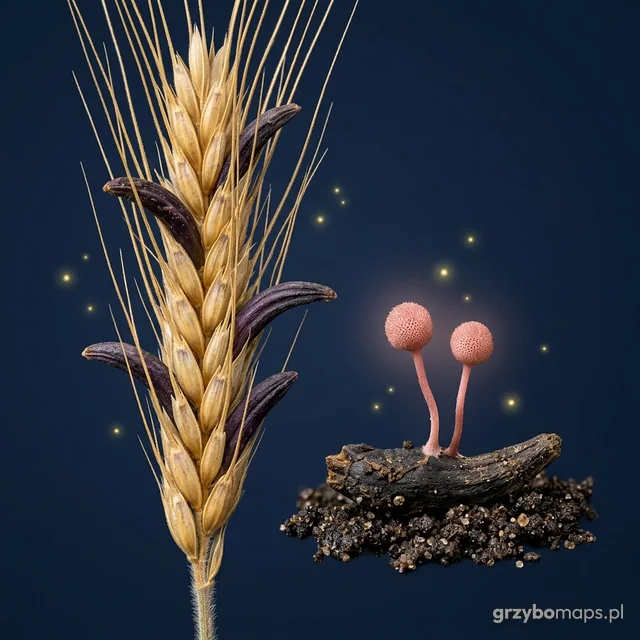
Ergot fungus
Claviceps purpurea
Polish folk names: sporysz, róg żytni, kłosiec, żytnia macica, ergot
What it looks like
A parasitic fungus of cereals and grasses; what is visible is its resting body, the ergot: a dark violet to black, horn-shaped structure from a few millimetres to 2–3 cm long, growing from the ear in place of a grain. In spring, tiny “pins” with reddish heads grow from the resting body on the ground.
Where it comes from
The whole temperate zone; it infects around 400 species of grasses. In Poland it occurs on all cereals, most often on rye and triticale and on wild grasses along field boundaries.
History
In the Middle Ages, flour contaminated with ergot caused mass poisonings known as “St. Anthony's fire” (the gangrenous form, with blackening and loss of limbs) and a convulsive form, described as St. Vitus' dance. The Order of the Antonites cared for the sick, and a better diet during pilgrimages brought them relief. Ergot was used in obstetrics to induce uterine contractions. In 1938 Albert Hofmann of the Sandoz company, while studying ergot alkaloids, synthesised LSD-25, and discovered its psychoactive effect by accident in 1943.
Legend and truth
A popular theory holds that the Salem witch trials of 1692 were caused by ergot in bread (the hypothesis of Linnda Caporael from 1976). Historians, including Spanos and Gottlieb, showed that the symptoms and the distribution of cases do not fit poisoning, so the theory is considered unlikely.
Substances
Ergot alkaloids (ergolines): ergotamine, ergometrine, ergocristine and other derivatives of lysergic acid; LSD does not occur naturally in the fungus.
How it works
The alkaloids strongly constrict blood vessels and the uterus, and act on serotonin and dopamine receptors. Poisoning does not resemble an LSD “trip”: pain, burning, convulsions, hallucinations and gangrene dominate.
What it is sometimes confused with
- rye or wheat grains (a dark grain in the ear)
- ear rot
Law in Poland
Ergot itself is not on the lists, but EU standards limit its content in grain, ergotamine and ergometrine are controlled precursors, and LSD is a psychotropic substance of group I-P (the strictest).
Fun fact
Drugs made from ergot alkaloids are still used, e.g. for migraine and postpartum haemorrhage; so the same fungus gave modern medicine both a drug and the best-known psychedelic of the 20th century.
Frequently asked questions
How does ergot fungus work?
The alkaloids strongly constrict blood vessels and the uterus, and act on serotonin and dopamine receptors. Poisoning does not resemble an LSD “trip”: pain, burning, convulsions, hallucinations and gangrene dominate.
What are the risks of ergot fungus?
Poison. Ergotism can lead to necrosis of the fingers and limbs, convulsions, miscarriages and death. The alkaloids accumulate with prolonged consumption of contaminated grain. Interactions with certain drugs (e.g. macrolide antibiotics or antifungal drugs), which intensify the effect of ergotamine, are especially dangerous.
Ergot fungus and the law in Poland: what is allowed?
Ergot itself is not on the lists, but EU standards limit its content in grain, ergotamine and ergometrine are controlled precursors, and LSD is a psychotropic substance of group I-P (the strictest).