

Ayahuasca
Banisteriopsis caapi + Psychotria viridis
Polish folk names: yagé, caapi, liana duchów, chakruna (Psychotria viridis), hoasca
What it looks like
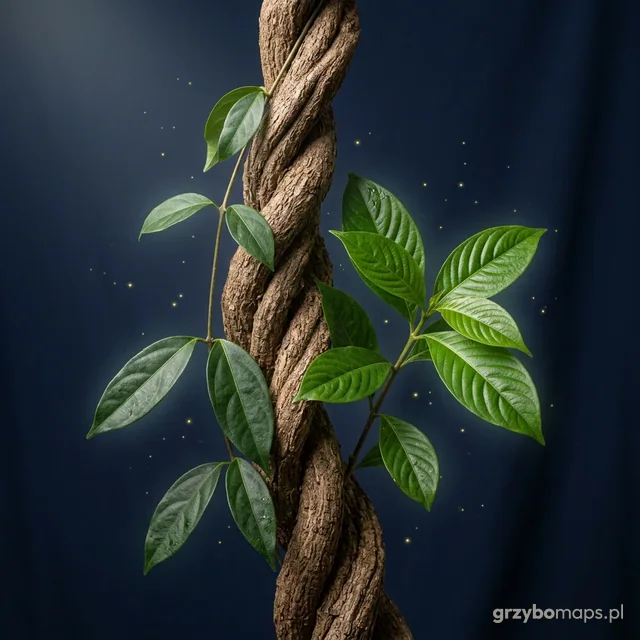
Banisteriopsis caapi is a woody liana of the Malpighiaceae family, climbing trees up to 30 m, with spirally twisted shoots, opposite heart-shaped leaves and small pink flowers. Chakruna (Psychotria viridis) is a low shrub of the madder family with glossy, elliptical leaves and red fruits.
Where it comes from
Rainforests of the Amazon: Peru, Brazil, Colombia, Ecuador, Bolivia.
History
For centuries, Amazonian peoples have prepared a brew from the vine and chacruna leaves, used by shamans (curanderos, ayahuasqueros) for healing, divination and contact with the spirit world; the name in Quechua means “vine of souls” or “vine of the dead”. Europeans described it from the 16th century, and it was scientifically identified by the botanist Richard Spruce in 1851. In 20th-century Brazil, syncretic churches arose (Santo Daime, União do Vegetal) for which the drink is a sacrament. Since the 1990s, so-called ayahuasca tourism to centres in Peru and Costa Rica has developed; much earlier, in 1953, William Burroughs searched for yagé in Colombia, Ecuador and Peru, and his letters were published in 1963 as “The Yage Letters”.
Legend and truth
Myth: “ayahuasca is a natural cure for depression, safe because it is plant-based”. Research on its therapeutic potential is ongoing, but it is not a registered drug, and in combination with popular antidepressants it can cause life-threatening serotonin syndrome.
Substances
From the liana: beta-carbolines – harmine, harmaline, tetrahydroharmine (reversible MAO-A inhibitors). From the chakruna leaves: N,N-dimethyltryptamine (DMT).
How it works
Harmala alkaloids inhibit the enzyme MAO in the intestines and liver, so DMT, normally broken down after swallowing, reaches the brain and acts on serotonin 5-HT2A receptors. It causes a state of strongly altered consciousness lasting several hours, with visions, intense emotions, and typically also nausea, vomiting and diarrhoea (regarded in tradition as “purging”).
What it is sometimes confused with
- Diplopterys cabrerana (chaliponga)
- Mimosa tenuiflora
- jimsonweed/brugmansia added by some shamans
Law in Poland
In Poland, DMT is a group I-P psychotropic substance, and since the 2009 amendment the plants Banisteriopsis caapi and Psychotria viridis themselves (live, dried, seeds, extracts and concentrates) are also listed by name in group I-N of narcotic drugs, currently in the Regulation of the Minister of Health (Dz.U. 2024 poz. 1139); possessing the brew and both plants is therefore illegal in Poland.
Fun fact
Neither the liana nor the leaves alone cause visions when swallowed – the effect results from the combination of two completely different plants, which ethnobotanists regard as one of the most remarkable discoveries of traditional pharmacology.
What research really says
Ayahuasca is neither a miracle cure nor a poison: acute poisoning by the brew alone has not been confirmed as a cause of death in any known autopsy, but vomiting is almost the rule, psychological crises happen often, and combining it with certain medicines and additives can be truly dangerous. Clinical trials on depression are promising but still very small.
How it works
The Banisteriopsis caapi vine provides beta-carbolines (harmine, harmaline, tetrahydroharmine), which reversibly inhibit the enzyme MAO-A. Without this, the DMT from chacruna leaves (Psychotria viridis) would be broken down in the digestive tract. DMT acts mainly on serotonin 5-HT2A receptors, producing a state of strongly altered consciousness lasting several hours.
Scale of use
According to a 2023 ICEERS report, about 4 million people in the Americas, Europe, Australia and New Zealand have tried ayahuasca, and about 820 thousand people in 2019 alone. Only roughly 10% of them are members of peoples in whose culture the drink is traditional.
Adverse effects in numbers
In the Global Ayahuasca Survey (10,836 people from more than 50 countries, published in 2022), 69.9% reported acute physical complaints, mainly vomiting, and 2.3% later needed medical help. About 56% described difficult mental states in the following weeks, of whom 88% rated them as part of a positive process, and about 12% sought help from a specialist. The risk was greater with physical illnesses, anxiety disorders and unsupervised use.
Deaths: what is really known
In 2023 ICEERS collected 58 media reports of deaths linked to ceremonies worldwide. Drinking ayahuasca in the hours before death was confirmed in 34 cases, and none of the 9 publicly available autopsies pointed to acute poisoning by the brew alone. Some deaths were linked to tobacco or scopolamine (datura), heart disease, water intoxication and lack of supervision. This is a compilation by an organisation sympathetic to ayahuasca, based on media reports, so it is not a complete statistic.
Drug interactions
The most serious pharmacological risk is combining MAO-A inhibitors with serotonergic drugs (SSRIs, SNRIs, tricyclics, tramadol) or stimulants (MDMA, amphetamine), which can cause serotonin syndrome. Callaway and Grob warned about this as early as 1998, based on cases in people taking SSRIs. There are few case reports and no data on frequency, but the mechanism is well known and the risk must not be underestimated.
Psychosis and mental health
The systematic review by dos Santos et al. (2017) found only a few case series and isolated reports of psychotic episodes after ayahuasca in the literature and assessed them as rare, more frequent in people with a personal or family history of psychosis. In the longitudinal study by Bouso et al. (2012), 127 regular ritual participants had lower psychopathology scores than 115 people in the control group and showed no decline in cognitive function. These are, however, self-selected people who tolerate the brew well.
Depression research and its limits
The randomised trial by Palhano-Fontes et al. (Psychological Medicine, 2019) included 29 people with treatment-resistant depression: after 7 days, a treatment response occurred in 64% of the ayahuasca group versus 27% of the placebo group. Reviews stress that there are only a handful of clinical trials, that they are small and short, and that it is hard to conceal in them who received the active substance.
Authorities vs data
- Authorities exaggerate. They say: The Polish regulation of the Minister of Health (consolidated text Dz.U. 2024 poz. 1139) lists the Banisteriopsis caapi vine itself in group I-N of narcotic drugs, the same group as heroin, among others, even though the vine does not contain DMT. Data: The vine's alkaloids are reversible MAO-A inhibitors, studied among other things as potential medicines. In its 2010 report, the International Narcotics Control Board (INCB) stated that no plants or decoctions made from them are under international control. The listing reflects the 2009 policy against legal highs, not an assessment of the risk of the plant itself.
- Authorities exaggerate. They say: Before the Supreme Court in Gonzales v. O Centro Espírita (2006), the US government argued that the ritual drinking of hoasca by the UDV church endangers the health of its members and risks diversion to the black market. Data: The Court unanimously (8:0) held that the government had not shown this to a degree that would justify a ban. Gable's risk review (2007) assessed the addictive potential of oral DMT as minimal, and studies of church members found no cognitive harm.
- Consistent with research. They say: Medical warnings against combining MAO inhibitors with antidepressants (e.g. in the 1998 paper by Callaway and Grob, cited in guidelines for doctors). Data: The mechanism of serotonin syndrome is well understood, and isolated cases have been described in people on SSRIs. A lack of data on frequency does not mean this combination is safe.
What we don't know yet. It is not known how often severe drug interactions occur, because there are no registries and the data come from surveys and case reports. The antidepressant effect has only been confirmed in small, short studies, and it is not known how much of the effect depends on the substance itself and how much on the ritual and setting.
Knowledge, not encouragement. We do not give doses or preparation methods.
Frequently asked questions
How does ayahuasca work?
Harmala alkaloids inhibit the enzyme MAO in the intestines and liver, so DMT, normally broken down after swallowing, reaches the brain and acts on serotonin 5-HT2A receptors. It causes a state of strongly altered consciousness lasting several hours, with visions, intense emotions, and typically also nausea, vomiting and diarrhoea (regarded in tradition as “purging”).
What are the risks of ayahuasca?
Dangerous. Harmala alkaloids inhibit MAO-A, so combining ayahuasca with SSRI/SNRI antidepressants, tricyclics, tramadol, MDMA, amphetamine or some cold medicines risks serotonin syndrome; isolated such cases have been described, and although data on their frequency are lacking, this is one of the most serious real dangers. The drink can trigger psychosis in predisposed people (schizophrenia, bipolar disorder), and dehydration and choking on vomit are also dangerous. A 2023 ICEERS review covered 58 reports of deaths after ceremonies worldwide; ayahuasca intake was confirmed in 34 of them, and none of the 9 available autopsies pointed to poisoning by the brew alone, whereas some deaths were linked to tobacco, scopolamine from datura, heart disease and lack of supervision. The composition of the brew is highly variable and unpredictable.
Ayahuasca and the law in Poland: what is allowed?
In Poland, DMT is a group I-P psychotropic substance, and since the 2009 amendment the plants Banisteriopsis caapi and Psychotria viridis themselves (live, dried, seeds, extracts and concentrates) are also listed by name in group I-N of narcotic drugs, currently in the Regulation of the Minister of Health (Dz.U. 2024 poz. 1139); possessing the brew and both plants is therefore illegal in Poland.
Sources
- Ayahuasca – Wikipedia (EN)
- Banisteriopsis caapi – Wikipedia (EN)
- N,N-Dimetylotryptamina – Wikipedia
- Toxicological Aspects and Determination of the Main Components of Ayahuasca: A Critical Review (PMC)
- Toxicokinetics and Toxicodynamics of Ayahuasca Alkaloids (PMC)
- Ayahuasca death – Erowid
- Palhano-Fontes i wsp., RCT ayahuaski w depresji lekoopornej, Psychological Medicine
- Bouso i wsp. 2022, Adverse effects of ayahuasca: Global Ayahuasca Survey
- ICEERS 2023, Examining deaths associated with ayahuasca
- ICEERS 2023, Four million people have taken ayahuasca
- dos Santos i wsp. 2017, Ayahuasca, DMT i psychoza: przegląd systematyczny
- Callaway i Grob 1998, Ayahuasca a inhibitory wychwytu serotoniny
- Gable 2007, Ocena ryzyka rytualnego użycia DMT i harmala-alkaloidów
- ICEERS, Międzynarodowy status prawny ayahuaski (stanowisko INCB)
- Rozporządzenie MZ, tekst jednolity Dz.U. 2024 poz. 1139
- Gonzales v. O Centro Espírita Beneficente União do Vegetal (2006)