

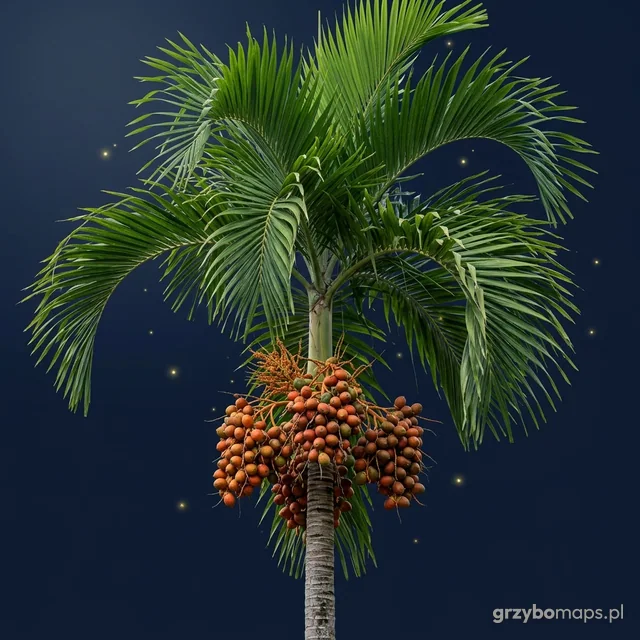
Areca catechu
Areca catechu
Polish folk names: betel, orzech betelu, orzech areki, pinang, supari, paan (zawiniątko)
What it looks like
A slender palm with a straight, thin trunk with distinct rings of leaf scars, growing to 20–30 m, with a crown of pinnate leaves at the top. The fruits are ovoid, orange or red drupes the size of a hen's egg, with a hard, marbled seed inside – the “betel nut”.
Where it comes from
Tropical South-East Asia and the Pacific islands; widely cultivated in India, Taiwan, Indonesia, Malaysia, Bangladesh and Papua New Guinea. In Poland found only as a houseplant.
History
Betel chewing – a wrap of areca seeds with lime in a leaf of the betel pepper (Piper betle), often with added tobacco and spices – is one of the oldest and most widespread customs in the world, practised by hundreds of millions of people. In India and South-East Asia betel is offered to guests, exchanged at engagements and weddings and made as an offering to deities; it appears in Sanskrit epics and Vietnamese legends. The characteristic red splashes of saliva on the streets of India or Taiwan and the red-black teeth of chewers are traces of this custom.
Legend and truth
Myth: “betel without tobacco is harmless”. The International Agency for Research on Cancer (IARC) concluded in 2003 that both betel without tobacco and areca nut alone are carcinogenic to humans (group 1).
Substances
Arecoline (the main alkaloid, a parasympathomimetic), arecaidine, guvacine, guvacoline; tannins and polyphenols.
How it works
Arecoline stimulates cholinergic receptors, causing a feeling of warmth, mild stimulation, alertness and slight euphoria, as well as increased salivation and sweating. The effect appears quickly during chewing and is short-lived.
What it is sometimes confused with
- betel pepper (Piper betle) – the leaf, not the palm
- coconut palm (young specimens)
Law in Poland
Areca and arecoline are not listed in the Polish schedules of narcotic drugs and psychotropic substances.
Fun fact
The word “betel” actually refers to the pepper leaf in which the areca seeds are wrapped – the palm itself is not “betel”.
Frequently asked questions
How does areca catechu work?
Arecoline stimulates cholinergic receptors, causing a feeling of warmth, mild stimulation, alertness and slight euphoria, as well as increased salivation and sweating. The effect appears quickly during chewing and is short-lived.
What are the risks of areca catechu?
Addictive. Regular chewing leads to addiction and to oral submucous fibrosis – a precancerous condition, and consequently to cancer of the mouth and throat; the risk grows with the number of years and the frequency of chewing. It is also linked with an increased risk of heart disease, metabolic syndrome and pregnancy complications. Arecoline can intensify the effect of cholinergic drugs and cause bronchospasm in asthmatics.
Areca catechu and the law in Poland: what is allowed?
Areca and arecoline are not listed in the Polish schedules of narcotic drugs and psychotropic substances.