

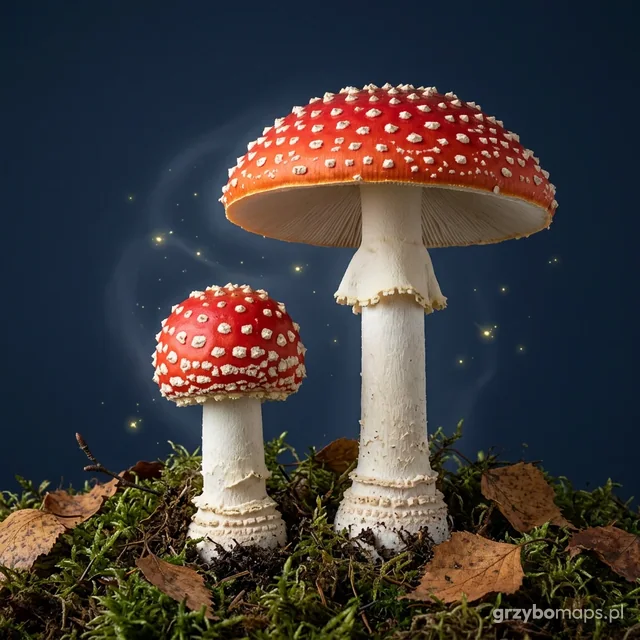
Fly agaric
Medicine from the forest or poison?
The fly agaric is poisonous. Deaths from it are rare, but severe poisonings with loss of consciousness do happen. Many of the things people say about it have a grain of truth, but no medicinal effect has been tested in studies on humans.
What science says
Poisonous, rarely life-threatening. It contains ibotenic acid and muscimol, which since 2025 have been on Poland's list of new psychoactive substances.
What research really says
The fly agaric is a poisonous mushroom, but poisoning by it rarely ends in death: in case series from poison centres, deaths practically do not appear, though severe conditions requiring intubation do occur. Since 22 May 2025, its main compounds, ibotenic acid and muscimol, have been on Poland's list of new psychoactive substances.
How it works
Ibotenic acid and muscimol are responsible for the effects. Ibotenic acid stimulates glutamate receptors, while muscimol, into which part of the acid converts, acts on GABA-A receptors and quietens the brain. That is why the picture of poisoning is mixed: agitation and confusion alternate with drowsiness. The panther cap contains the same compounds, but in different proportions.
What poisoning looks like in the data
A series from a poison centre in Oregon (2002–2016) described 34 people after eating fly agaric or panther cap: vomiting, agitation and drowsiness were typical, 5 people were intubated, no one died, and there were no seizures or kidney or liver damage. In a Slovenian series (Toxicon 2014), confusion (26 of 32 people) and agitation (20 of 32) were more frequent after fly agaric, and coma less frequent than after panther cap (2 of 32 versus 5 of 17). Symptoms usually subside within a day.
Deaths are rare, but they do happen
The best-described death is a 2022 case (Wilderness & Environmental Medicine): a 44-year-old man ate dried caps for their intoxicating effect, went into cardiac arrest and died after 9 days. The authors cite data from American poison centres according to which, of 23 mushroom deaths over 8 years, only one involved mushrooms containing ibotenic acid. According to a 2024 FDA memorandum, the Norwegian poison information centre recorded 17 cases of poisoning by these compounds in 2011–2022, including 2 fatal ones.
The Polish wave of 2023–2025
As recently as 2015, doctors writing in the journal Etnobiologia Polska described their hospital's first patient in at least 20 years after eating fly agaric, a young man who had got his knowledge from the internet. In autumn 2025, Prof. Anna Krakowiak spoke of several dozen people admitted to the toxicology ward in Łódź, some after preparations bought online. No one publishes nationwide statistics on such poisonings.
Why people reach for it
An analysis of 684 posts from social media groups (Toxics, 2023) showed that women more often reported wanting relief from pain and skin problems, and men from stress, low mood and insomnia. The most commonly reported side effects were lethargy, abdominal pain and nausea. There are no clinical trials that would confirm any of these benefits.
History and culture
Peoples of Siberia, including the Koryaks, used the fly agaric in rituals, and 18th-century travellers described the drinking there of the urine of people who had eaten it. Around Sanada in Nagano Prefecture, Japan, it was eaten locally as a delicacy after traditional processing. In Eastern Europe, old external uses in folk medicine are known, but there is little reliable ethnographic documentation for Poland.
The dispute over cultural bias
In an article in Economic Botany (2008), William Rubel and David Arora argued that English-language mushroom guides unanimously call the fly agaric poisonous, ignoring documented cases of it being eaten locally, and that in doing so they perpetuate cultural biases. Critics reply that the guides' caution is simply common sense. This dispute concerns the label in guidebooks, not whether the raw or dried mushroom causes poisoning, because that is well documented.
Authorities vs data
- Consistent with research. They say: GIS and its risk assessment team (2024) warn that the fly agaric is poisonous and that products made from it are harmful to health. Data: Case series confirm real poisonings with agitation, confusion and coma, sometimes with intubation; in Łódź in 2025, several dozen people were hospitalised.
- Authorities exaggerate. They say: Guidebooks and official notices often place the fly agaric alongside deadly poisonous mushrooms. Data: In poison centre data, deaths are exceptional (0 of 34 cases in Oregon, 1 of 23 mushroom deaths in the USA over 8 years), unlike the death cap, which kills through liver damage.
- Consistent with research. They say: The FDA (2024) concluded that there is insufficient evidence of safety to add fly agaric and its compounds to food, e.g. gummies. Data: CDC testing of fly agaric gummies in Virginia (2023–2024) found Schedule I substances in them that were not on the label; the composition of such products is unpredictable.
What we don't know yet. It is not known how often fly agaric poisoning leads to lasting effects, because long-term follow-up is lacking. Nor are there any controlled human studies testing its alleged painkilling, antidepressant or sleep effects.
Knowledge, not encouragement. We do not give doses or preparation methods.
What people say
- Small amounts of fly agaric cure depression, insomnia and pain (Unconfirmed). Supporters: In social media groups, thousands of people describe sleeping better, having a better mood or having less joint pain after fly agaric. Muscimol really does act on GABA receptors in the brain, the same ones that sleeping pills act on. Evidence: There is not a single clinical study on humans that would confirm this. An analysis of 684 posts from such groups (Toxics, 2023) also showed frequent side effects: drowsiness, stomach aches, nausea. In 2025, several dozen people ended up at the toxicology unit in Łódź, some after products bought online.
- Atlases exaggerate how dangerous it is, because in some countries it is eaten (Studied, disputed). Supporters: In the Sanada area of Japan, the fly agaric was a local delicacy after traditional processing. The researchers William Rubel and David Arora described in Economic Botany (2008) that atlases repeat each other's warnings, leaving out such traditions. Evidence: The tradition of eating it exists and is documented. But nobody has studied whether such processing is safe, and the content of poisons in the mushrooms varies greatly. This is a dispute over the label in atlases, not proof that the fly agaric is edible. We do not give preparation methods.
- Fly agaric was the “soma” of ancient sacred books and stands behind the legend of Santa Claus (Unconfirmed). Supporters: In 1968 Gordon Wasson concluded that the sacred drink soma from the Indian Rigveda was fly agaric. Others link Santa’s red-and-white outfit and flying reindeer to Siberian shamans who used fly agaric. Evidence: The use of fly agaric by Siberian peoples, such as the Koryaks, was described by travellers in the 18th century, and that is certain. The soma thesis is disputed among researchers, and the link to Santa Claus is a modern hypothesis with no old sources.
- Fly agaric kills flies, hence its name (Confirmed). Supporters: In villages, pieces of fly agaric were put in milk with sugar to lure and poison flies. Evidence: Yes, that is true. Ibotenic acid and muscimol intoxicate insects, which studies have confirmed. The name “mucho-mor” comes from exactly this custom, known in many European countries.
What we don't know
It is not known how often poisonings end with lasting effects, because long-term observations are lacking. Nobody has run controlled studies to check the alleged pain-relieving or sleep effects.
Check for yourself
- Compare fly agarics in the forest: When you find a fly agaric, without touching it, count the white dots on the cap and look at the ring and the bulb at the base of the stem. Rain washes the dots off, so young and old mushrooms look different. Wash your hands afterwards.