

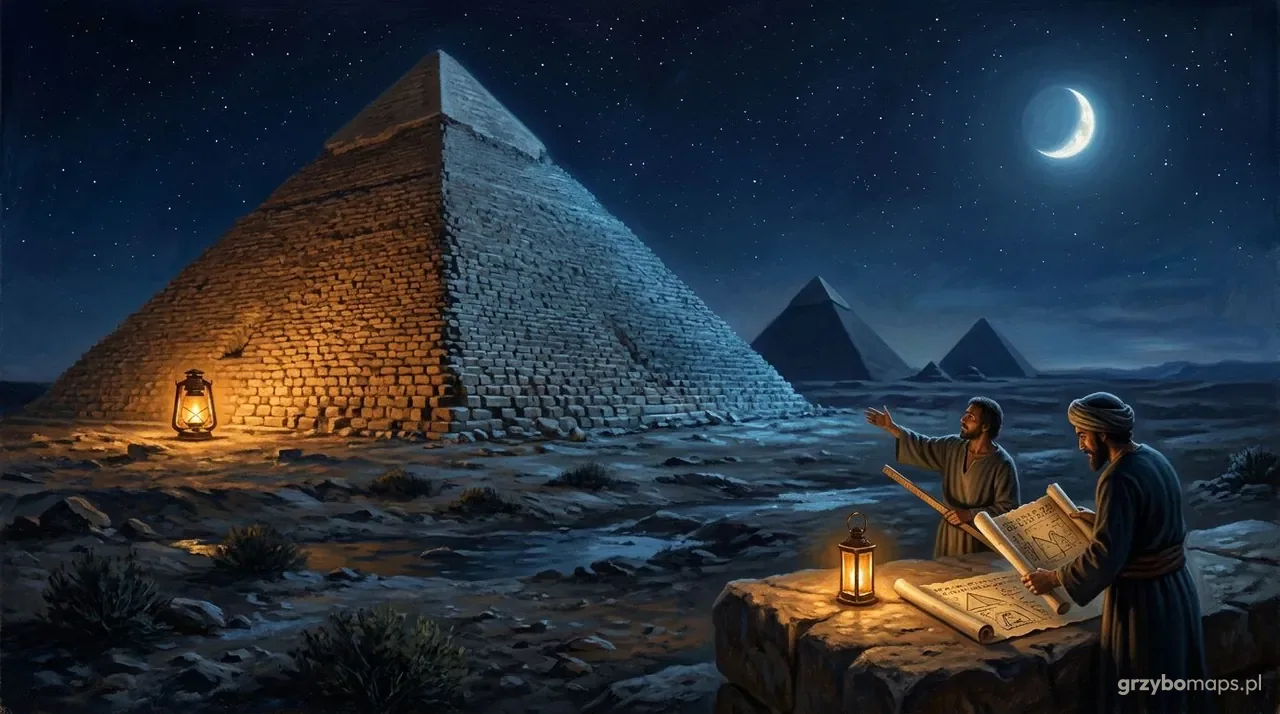
The Great Pyramid of Giza
Is the pyramid much older than the textbooks say?
Hard evidence points to construction under Pharaoh Khufu (Cheops), around 2560 BC. Theories of a much older pyramid have supporters, but none has evidence that survives scrutiny. Real mysteries remain: we do not know for sure how the blocks were lifted, or what is in the empty space discovered in 2017.
What science says
The pyramid was built under Khufu, around 2580–2560 BC. Independent traces point to this: records from the construction, dating of the mortar, the builders' village and the successively better pyramids of his father.
- The construction diary: In 2013, at the port of Wadi al-Jarf on the Red Sea, Pierre Tallet's team found the oldest known inscribed papyri. It is the diary of the inspector Merer from the 27th year of Khufu's reign: his boats carry limestone blocks from the quarries at Tura to a place called “Akhet-Khufu”, that is, “Horizon of Khufu”. That was the name of the pyramid.
- Charcoal in the mortar: In 1984 and 1995, dozens of samples of charcoal and reed were taken from the mortar between the blocks and tested by radiocarbon dating. The results came out from about 100 to several hundred years older than the date from the chronicles. Researchers explain this by the burning of old wood. What matters most is that all the results fall within the 3rd millennium BC, not thousands of years earlier.
- Learning from mistakes: You can see how the Egyptians learned: first Djoser's step pyramid, then under Sneferu, Khufu's father, the pyramid at Meidum, the Bent one (the angle was changed halfway through, because the structure was cracking) and the Red one. The Great Pyramid is the next step, not an exception from nowhere.
- The builders' village: The archaeologist Mark Lehner uncovered a workers' town right next to it, with bakeries, breweries and the bones of thousands of animals. On the slope there are the builders' tombs with their names, and the skeletons show healed fractures, which means someone treated them.
- Crew names inside: In the chambers above the King's Chamber there are crew marks painted in paint, for example “Friends of Khufu”. Some of them disappear behind neighbouring blocks, so they were painted before the blocks were laid.
- A ramp from Khufu's time: In 2018, in the Hatnub alabaster quarry, a steep ramp was discovered with steps on the sides and post holes, with inscriptions of Khufu. Ropes tied around the posts made it possible to haul sledges up a steep slope. Whether the pyramid was built the same way is still a hypothesis.
- The stars point to the date: The sides of the pyramid are aligned to the north with an error of a few arcminutes. The astronomer Kate Spence showed in Nature (2000) that this can be done by aiming at two stars circling the pole, and that their position matches about 2480 BC, close to the date from the chronicles.
What people say
- The pyramid is thousands of years older, and Khufu only took it over (Unconfirmed). Supporters: No mummy or writing on the walls was found inside. Göbekli Tepe in Turkey shows that people built monumental temples as early as 11,600 years ago, much earlier than once thought. If history was wrong once, it could be wrong here too. Evidence: Merer's diary, the dating of the mortar, Sneferu's earlier pyramids and the workers' village point to the 4th Dynasty. The lack of a mummy is no surprise, because almost all pharaohs' tombs were plundered in antiquity. Göbekli Tepe really did push back the limits of knowledge, but neither there nor at Giza are there traces of a civilisation that could have raised a pyramid 10,000 years ago.
- The Sphinx bears marks of rain from 7000 years ago (Studied, disputed). Supporters: The geologist Robert Schoch of Boston University has claimed since 1991 that the deep, rounded grooves on the walls around the Sphinx were carved by long-lasting rain. That much rain fell in Egypt thousands of years before the pharaohs, so the Sphinx would be much older. Evidence: Other geologists explain these grooves by salt crystallisation in the rock and by the limestone layers having different hardness. The Sphinx was carved from the same rock from which Khafre's neighbouring temples were built. This is a real scientific dispute, but it concerns the Sphinx, not the pyramid itself, and nobody has found other traces of such an ancient structure.
- There is an underground city beneath the pyramids (2025 scans) (Unconfirmed). Supporters: In March 2025, Corrado Malanga and Filippo Biondi presented satellite radar images. According to them, beneath the pyramid of Khafre there are chambers and shafts reaching hundreds of metres, even kilometres, down. Evidence: The results were not published in a peer-reviewed journal, and the raw data were not made available. Radar specialists, such as Lawrence Conyers, say that radar waves do not penetrate solid rock to such a depth. Some of the circulating graphics were generated by artificial intelligence. Real, verified empty spaces in the pyramid do exist, but they are small (see below).
- The name of Khufu inside was forged by the discoverer in 1837 (Evidence says otherwise). Supporters: The writer Zecharia Sitchin claimed that Howard Vyse, who blasted open the passages to the chambers, painted the cartouche of Khufu himself to become famous, and made a spelling mistake while doing so. Evidence: The marks are in hieratic script, which nobody could read in 1837, and the spelling of the name matches the 4th Dynasty. Some marks hide behind the blocks, so they were made before the blocks were laid. On top of that, Merer's diary, found 176 years later far from Giza, independently links the pyramid with Khufu.
- The three pyramids mirror Orion's Belt of 10,500 BC (Unconfirmed). Supporters: Robert Bauval noticed in 1994 that the three pyramids lie like the three stars of Orion's Belt, and the smallest is offset just like the faintest star. Graham Hancock links this with the date 10,500 BC, when, according to him, the sky matched best. Evidence: For the layout to fit, the map has to be rotated, and the date was chosen by matching a single angle. The pyramids were built by three successive rulers within a few decades, and the area has other pyramids that do not fit Orion. The Egyptians really did worship Orion as the god Osiris, and that is documented.
- The pyramid was a power plant (Unconfirmed). Supporters: The engineer Christopher Dunn, in his book “The Giza Power Plant” (1998), argues that the chambers and shafts worked like a resonator and produced energy, and that the salt deposits in the Queen's Chamber are traces of chemical reactions. Evidence: No remains of devices, cables or tools for such work have been found. Salt often blooms on limestone by itself. The hypothesis is interesting as an engineer's idea, but there is not a single piece of evidence for it.
- It was built by slaves (Evidence says otherwise). Supporters: So wrote the Greek historian Herodotus about 2000 years after the construction, and so Hollywood films show it. Evidence: This is an example of the official story from textbooks and films being wrong. The builders' tombs right by the pyramids, bread, beer and meat in their village, and healed fractures show paid, rotating crews, not slaves.
- The pyramid hides the number π (Has a simple explanation). Supporters: The perimeter of the base divided by the height gives almost exactly 2π, that is, 6.28. It is hard to believe in coincidence. Evidence: The Egyptians measured slope in “seked”: how many palms horizontally for one cubit vertically. A seked of 5½ palms, known from the Rhind papyrus, gives an angle of 51.8° and, by itself, a ratio close to 22/7, which is an approximation of π. You do not need to know π, a simple building rule is enough.
What we don't know
We do not know for sure how the blocks were hauled to the highest levels: by a straight ramp, a spiral one, an internal one or with levers. In 2017 the ScanPyramids team, measuring cosmic particles called muons, found an empty space at least 30 metres long above the Grand Gallery (Nature). In 2023 it also confirmed a hidden corridor behind the entrance. What this empty space is for, nobody knows yet.
Check for yourself
- Calculate π from the pyramid: Grab a calculator: the side of the base is about 230.3 m, the original height about 146.6 m. Calculate 4 × 230.3 ÷ 146.6. Then calculate 2 × 3.1416 and compare.
- Fold a pyramid from paper: Draw a triangle with a base of 11 cm and a face height of 8.9 cm (four such triangles and an 11 × 11 cm square). The folded pyramid will be about 7 cm tall and have the angle of the Great Pyramid, 51.8°.
- Find Orion's Belt: On a winter evening, look south: three bright stars in a row are Orion's Belt. Compare them with the view of the pyramids from above and judge for yourself whether the layout fits.