

Mushrooms · two sides
Home tests for poisonous mushrooms
Can you recognise a poisonous mushroom by a spoon, an onion or snails?
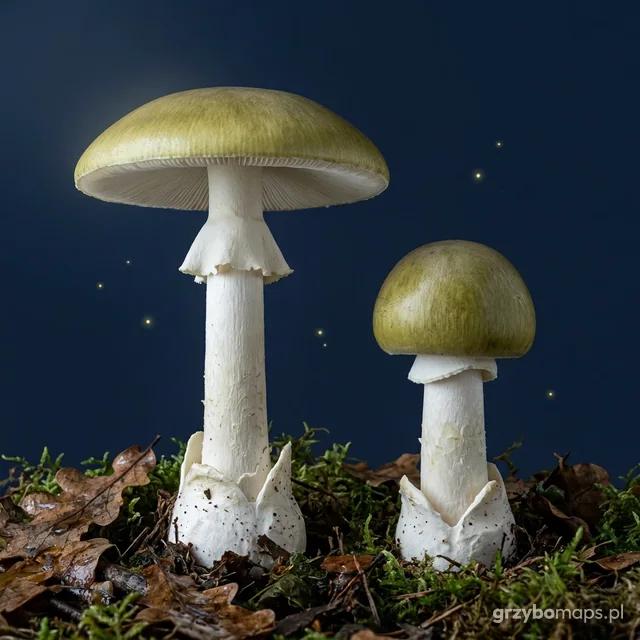
No. No home test detects amanitins, the poison of the death cap, which is responsible for most deadly mushroom poisonings. The only sure way is to know the species well, and if in doubt, take the mushroom to the sanitary inspection (sanepid) or do not eat it.
What science says
Poisonous and edible mushrooms are recognised by the features of the species: gills, ring, bulb at the base, colour of the spore print. Poisons cannot be seen or smelled, and they cannot be removed by cooking.
- Amanitins are resistant: Amanitins from the death cap do not break down when boiled, fried, dried or frozen. A single fruiting body is enough to damage the liver of an adult.
- Symptoms come late: The first symptoms usually appear after 6–24 hours, when the poison is already at work. After that there can be an apparent improvement while the liver keeps being destroyed. That is why “I feel fine after an hour” means nothing.
- Taste gives no warning: People who survived death cap poisoning described it as tasty and mild in flavour.
- The most common mistake: In Poland, deadly poisonings most often happen when the death cap is mistaken for the man on horseback (gąska zielonka), the parasol mushroom or brittlegills.
What people say
- A silver spoon or an onion turns dark next to a poisonous mushroom (Evidence says otherwise). Supporters: This is an old method, repeated from generation to generation. People see that silver turns black next to some mushrooms. Evidence: Silver and onion darken because of sulphur compounds, which are found in many edible mushrooms. Amanitins do not react with silver. The poisonous death cap will not turn a spoon black.
- If snails or animals eat it, it is edible (Evidence says otherwise). Supporters: Animals in the forest know what is good for them, so their traces should be a good clue. Evidence: Snails, insects and some mammals eat the death cap without harm, because their bodies work differently from ours. A nibbled cap proves nothing.
- Long boiling removes the poison (Evidence says otherwise). Supporters: Some mushrooms, such as the brown roll-rim (olszówka) or milk-caps, used to be boiled and the water poured off, and people then ate them. Evidence: Amanitins and orellanine (the poison of webcaps) withstand cooking. Despite boiling, the brown roll-rim can cause a dangerous immune reaction and is considered poisonous today.
- Poisonous mushrooms taste bitter or smell bad (Evidence says otherwise). Supporters: Many poisonous plants are bitter, so it seems logical that mushrooms are the same. Evidence: The death cap reportedly has a mild, pleasant taste. The bitter bolete (goryczak żółciowy), on the other hand, is not dangerous, it just ruins the dish.
What we don't know
There is no complete nationwide statistic of mushroom poisonings in Poland, because many milder cases are never recorded anywhere. Research is still ongoing on how best to treat amanitin poisoning.
Check for yourself
- Make a spore print: Place the cap of a shop-bought button mushroom gills-down on a sheet of white and black paper, and cover it with a bowl overnight. In the morning you will see the colour of the spores, one of the features foragers use to tell species apart.