

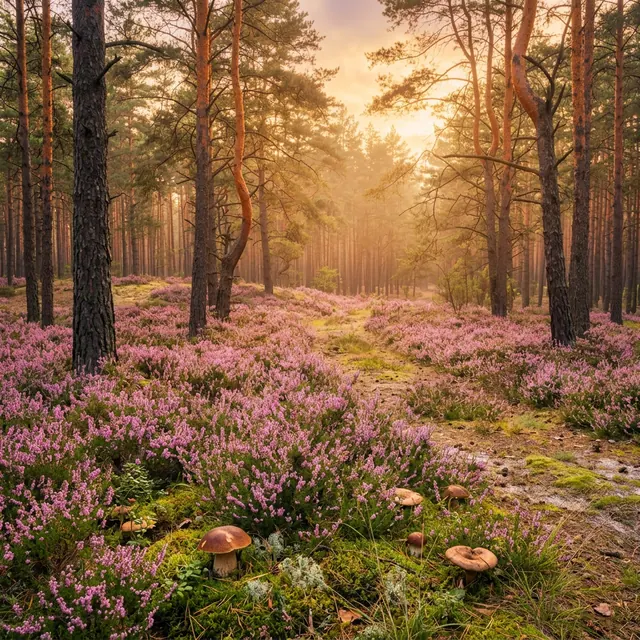
Heather
Calluna vulgaris
A low, evergreen subshrub that colours pine forests and heaths pinkish-lilac in late summer. It always grows on acidic, poor soils. A valued honey plant.
How to recognise
- Height usually up to 0.5 m, shoots thin, trailing.
- Leaves very small, 2.5 to 3.5 mm, needle-like, opposite, densely arranged on the side shoots.
- Flowers small, bell-shaped, pinkish-lilac, more rarely white, in one-sided racemes 15 to 25 cm long.
- Flowers from the end of July to the end of September, most abundantly from August.
Where it lives
Common almost throughout Poland, rarer e.g. in the Vistula Marshlands (Żuławy Wiślane) and the Pyrzyce Plain. Pine forests, heaths, peat bogs.
Fruits and seeds
The fruits are tiny capsules, not edible. From the flowers bees make heather honey with a jelly-like consistency and a sharp, bittersweet taste.
Which mushrooms grow under it
- łysostopek szpilkowy (on heather shoots)
- grzybówka krwawiąca (on heather shoots)
- honey fungus (can infect heather)
- ericoid mycorrhizal fungi, mainly Hymenoscyphus ericae (no Polish name)
In the past
A honey plant: from a hectare of heath, bees gather 50 to 120 kg of honey. The herb and flowers are herbal raw materials. Cultivated as an ornamental plant, for wreaths and dried bouquets.
Fun fact
Thanks to its mycorrhiza with fungi, heather tolerates high concentrations of heavy metals in the soil. Heaths are disappearing in Europe, and their preservation is helped, among other things, by grazing heath sheep (wrzosówki).