

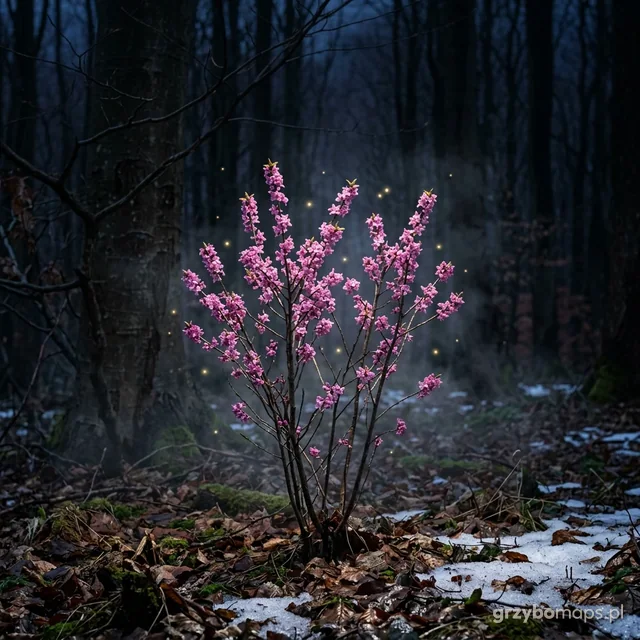
Mezereon
Daphne mezereum
A low shrub of fertile broadleaf forests, blooming in early spring before the leaves develop. Pink, strongly scented flowers sit directly on the shoots. The plant is under species protection and is among the most poisonous in our forests.
What it is
Mezereon (Daphne mezereum) is a low shrub, from a few dozen centimetres to one and a half metres tall, of the daphne family. It is one of the first plants to bloom in the forest after winter: pink flowers open on bare shoots as early as March, sometimes among the last patches of snow. The leaves appear only later. It is one of the most poisonous shrubs of Polish forests and also a protected species, so it is best admired from a distance.
How to recognise
- A shrub up to about 1 m tall, with few, straight shoots.
- Flowers pink, fragrant, sitting several together on bare shoots in March and April.
- Leaves lance-shaped, clustered at the tips of the shoots, appearing after flowering.
- Fruits are red, glossy berries set along the shoot, ripening in summer.
Where it lives
Throughout Poland, but scattered: in oak-hornbeam forests, beech woods and floodplain forests on fertile soils, more often in the south.
Fruits and seeds
VERY POISONOUS. All parts, especially the fruits and bark, are highly poisonous; even a few fruits can be dangerous for a child. The sap irritates the skin. Do not pick it, as the plant is also protected.
When you meet it
- Look, but do not touch. The sap and bark can irritate the skin and cause redness, burning or a rash in sensitive people. After accidental contact, wash your hands with soap and water and do not touch your face or eyes.
- Do not put any part of the plant in your mouth, including the fruits, and do not let children or dogs pick them. The red berries sit right against the shoot, without stalks. After eating even one fruit, call 112 or a poison control centre.
Role in the forest
The early flowers are one of the first sources of nectar for insects waking up after winter. Birds eat the red fruits and spread the seeds through the forest. The plant is poisonous to humans and most mammals, so animals usually avoid it. It grows most readily on fertile, moist soils in shade, which is why it can indicate richer forest habitats.
In the past
In the past the bark was used in folk medicine as a skin irritant, among other things for rheumatism and slow-healing ulcers. Dyeing of fabrics and old cosmetic uses were also described. Older textbooks mention chewing the root for toothache and bark compresses for bites. Once the toxicity of the plant became known, these uses were abandoned. Do not try to repeat them, because they are dangerous.
Forager's account
- One of our foragers reports that the root of the plant feels like human skin to the touch. We checked this in the sources and found no such description, so we do not present it as an established fact.
- Old herbals and pharmacopoeias describe the root and bark as flexible, fibrous and tough. On the outside they are brownish and wrinkled, inside whitish and cottony. Such an impression could be associated with soft, elastic skin, but that is only our cautious interpretation. If anyone wants to check this, they should not dig up the plant, because it is protected and the sap and bark irritate the skin.
Fun fact
The flowers appear so early that they often poke out from under the snow, and their scent can be smelled in the forest from afar. According to Latvian research teams, the shoots and bark contain the most terpene compounds, and the fruits, leaves and roots fewer.
What the law says
- Mezereon is under partial species protection in Poland, under the regulation of the Minister of the Environment of 9 October 2014 on the species protection of plants (Journal of Laws 2014, item 1409, as amended). This means a ban on, among other things, destroying wild plants, so do not pick twigs and do not dig up shrubs.
- Check the current text of the regulation for the detailed list and rules, because regulations are sometimes amended.
What the theory says
- The plant contains diterpene esters, mezerein and daphnetoxin, and the glycoside daphnin. Mezerein and daphnetoxin activate an enzyme called protein kinase C. In laboratory studies mezerein acts on the skin as a tumour promoter, which is why it must be avoided. The importance of daphnin itself for the toxicity is debated in the literature.
- After eating the fruits there is burning in the mouth, swelling of the lips and face, drooling and hoarseness, then abdominal pain and vomiting. One poisoning report indicates that the severe symptoms are caused mainly by chewed seeds, not the pulp. Data from the poison centre in Erfurt for 2010 to 2019 mention 37 enquiries and 7 mild symptoms, but the literature warns that even a few fruits can be dangerous for a child. We never consider this plant safe.
- Ethnobotanical reviews report past use in folk medicine despite the known toxicity. Modern phytochemical research on this species is still modest.
Sources
- Wikipedia: Wawrzynek wilczełyko
- mp.pl: Truciciele z naszych lasów
- Murator: wawrzynek, piękny ale niebezpieczny
- Przegląd chemii i tradycyjnych zastosowań rodzaju Daphne (Sovrlić i Manojlović, 2017)
- USDA: baza fitochemiczna, Daphne mezereum
- Wikipedia: Mezerein
- King's American Dispensatory 1854: opis kory korzenia
- ISAP: rozporządzenie w sprawie ochrony gatunkowej roślin (Dz.U. 2014 poz. 1409)