

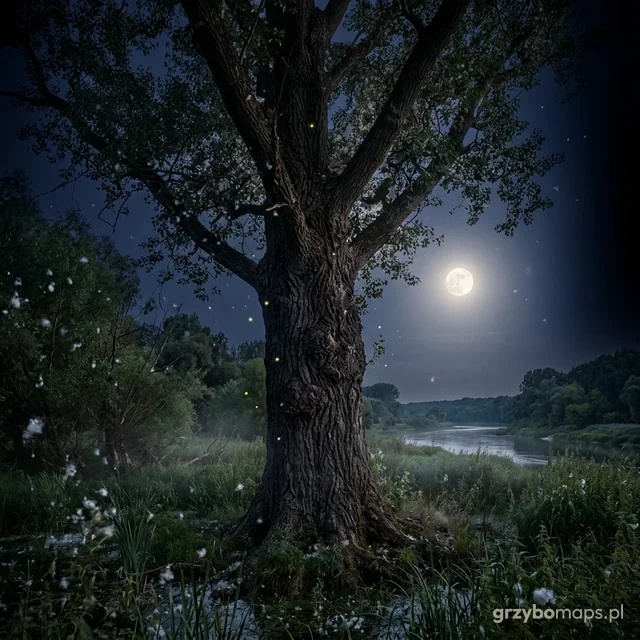
Black poplar
Populus nigra
A native poplar of large river valleys, also called sokora. It grows very fast and forms willow-poplar floodplain forests along the Vistula and Oder. Truly wild black poplars are rare today because they hybridise with planted hybrid poplars.
How to recognise
- Bark dark grey, deeply fissured in a network, with large burls often on the trunk.
- Leaves triangular to rhombic, long-pointed, crenate.
- In spring red male catkins, in June masses of white seed fluff.
- A huge, spreading tree with thick boughs.
Where it lives
Valleys of large rivers: the Vistula, Oder, Bug; often planted along roads.
Fruits and seeds
The seeds with fluff are not edible. The fluff does not cause allergies as much as is commonly believed; more often the culprit is the pollen of grasses flowering at the same time.
Which mushrooms grow under it
- oyster mushroom (on dead wood)
- chicken of the woods (on trunks)
In the past
Light wood for matches, plywood and cellulose. Poplar buds were used in old herbal medicine.
The most famous in Poland
The Marian Poplar in Ostromecko (Dąbrowa Chełmińska municipality, Kuyavian-Pomeranian Voivodeship), a natural monument since 1991, circumference about 908 cm.
Fun fact
The Marian Poplar of Ostromecko has a circumference of about 9 m and is the thickest known black poplar in Poland.