

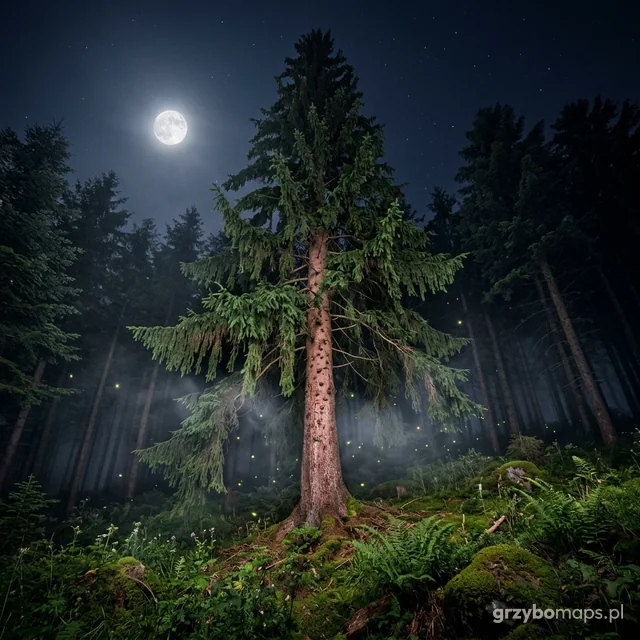
Norway spruce
Picea abies
A tall tree with a conical crown, dominant in the mountains and in the north-east of the country. It has a shallow root system, so the wind easily topples it. In recent years many spruce stands have died from drought and the European spruce bark beetle.
How to recognise
- Bark thin, reddish-brown, flaking in small scales.
- Needles single, stiff, four-angled and prickly, set on brown little pegs all around the shoot.
- Cones long (10 to 15 cm), hanging, falling whole once ripe.
- Crown narrowly conical, branches often hanging like curtains.
Where it lives
Mountains (upper montane zone in the Carpathians and Sudetes), north-eastern Poland, Puszcza Białowieska, and also numerous plantings in the lowlands.
Fruits and seeds
Cones and seeds are not food for people. The seeds are eaten by squirrels, woodpeckers and crossbills.
Which mushrooms grow under it
- borowik szlachetny
- false saffron milkcap
- podgrzybek brunatny
- fly agaric (poisonous)
In the past
Timber for construction and paper-making, and resonance wood for the soundboards of musical instruments. Since the 19th century the spruce has become the Christmas tree in many homes.
Fun fact
Spruces in the Białowieża Forest exceed 50 m, but the record for native trees belongs to a fir in Pieniny National Park (55.86 m). The tallest in Poland is the non-native Douglas fir (about 59 m).