

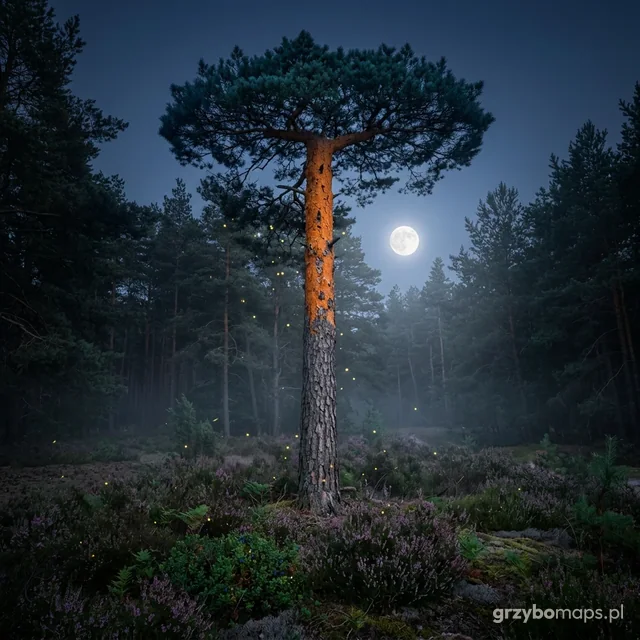
Scots pine
Pinus sylvestris
The most common tree of Polish forests, it grows in pine forests on sands from the sea to the mountains. It is a light-demanding tree and very resistant to drought and poor soil. For the forager it is the number one tree, because many prized mushrooms grow under pines.
How to recognise
- Bark thick and grey-brown on the lower trunk, thin, flaking and orange-red higher up.
- Needles in pairs in a bundle, stiff, grey-green, 4 to 7 cm long.
- Cones small, conical, hanging, ripening in the second year.
- In old age a tall straight trunk and an umbrella-shaped crown at the top.
Where it lives
All over Poland, most of all in pine forests on the sandy soils of the lowlands. It covers about 60 percent of the forest area in Poland.
Fruits and seeds
Cones and seeds are not edible in practice. Young shoots and resin were formerly used in folk herbal medicine, but this is not advice.
Which mushrooms grow under it
- borowik sosnowy
- slippery jack
- velvet bolete
- mleczaj rydz
- podgrzybek brunatny
- chanterelle
In the past
Timber for construction, furniture and poles. From the resin, rosin and turpentine were obtained, and from resinous stumps pitch and tar.
The most famous in Poland
Sosna Rzepicha near Górki Małe (Sulechów commune, lubuskie voivodeship), a natural monument since 1996, trunk circumference 568 cm.
Fun fact
The thickest known Scots pine in Poland, Sosna Rzepicha, has a circumference of over 5.6 m. Earlier the title belonged to the nearby Sosna Waligóry.