

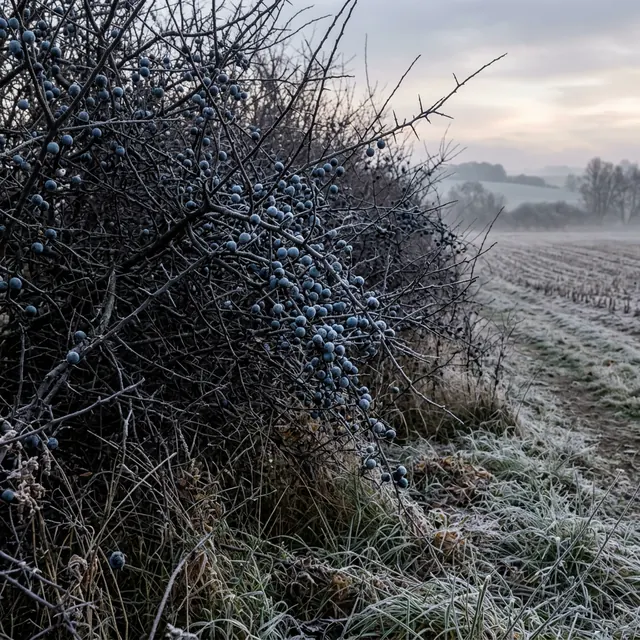
Blackthorn
Prunus spinosa
A thorny shrub forming dense thickets on field boundaries and forest edges, called czyżnie. It blooms abundantly in white in April and May, before the leaves develop. Its blue-black fruits, called tarki (sloes), become tastier after frost.
How to recognise
- A shrub usually up to 3 m, densely branched, the short shoots ending in strong, long thorns.
- The white flowers appear before the leaves.
- Fruits spherical, 1 to 1.5 cm, blue-black with a bluish bloom, with green, astringent flesh.
- Bark of older trunks black-violet, finely cracked.
Where it lives
Common in the lowlands and lower mountain areas, in the Tatras up to 1100 m above sea level. More scattered in the north-east. Field boundaries, forest edges, thickets, sunlit slopes.
Fruits and seeds
The fruits are edible after frost; before that they are very astringent. Do not crack or eat the stones: they contain cyanogenic glycosides, including amygdalin, from which strongly poisonous hydrogen cyanide is formed. Also beware of the thorns, which break off in the skin.
Which mushrooms grow under it
- dzwonkówka tarczowata (grows under rosaceous plants, including plum trees; easily confused with poisonous pinkgills)
- czyreń śliwowy
- Taphrina pruni (plum pocket disease, deforms the fruits)
In the past
Fruits for preserves, compotes, liqueurs, wines and juices. Hard wood. A honey plant, planted in wildlife-habitat plantings.
What the beliefs say
A folk saying goes: “When the blackthorn blooms, it will be cold.” Blackthorn blossom often coincides with a cold snap in May.
Fun fact
Caterpillars of 135 butterfly and moth species feed on blackthorn leaves. Shrikes impale caught insects and small animals on its thorns, creating larders.