

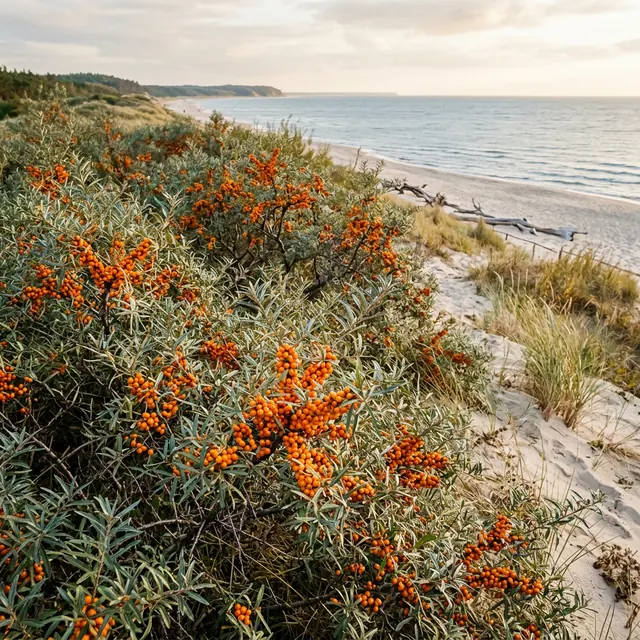
Sea buckthorn
Hippophae rhamnoides
A thorny shrub of coastal dunes with silvery leaves and orange fruits. It fixes nitrogen from the air thanks to actinomycetes in its root nodules. In Poland it is partially protected at natural sites.
How to recognise
- A shrub usually 1.5 to 6 m, with thorns 2 to 7 cm long.
- Leaves narrowly lanceolate, 5 to 9 cm, grey-green above, silvery beneath.
- Fruits roundish, 6 to 10 mm, orange to red, on short stalks.
- A dioecious plant: only female shrubs bear fruit.
Where it lives
Along the whole Polish coast, on dunes and cliffs; it is often hard to tell natural sites from plantings. Inland it is planted and becomes feral.
Fruits and seeds
The fruits are edible, very sour, with a slightly bitter aftertaste; juices and jams are made from them. Because of their high oil content, they should not be eaten by people who are sensitive to fats or by people with acute inflammation of the pancreas, liver or gallbladder. Sea buckthorn is protected at natural sites.
Which mushrooms grow under it
- guzoczyrka rokitnikowa, also called czyreń rokitnikowy (causes trunk dieback)
In the past
Stabilising dunes, escarpments and spoil heaps. Berries and sea buckthorn oil in food, medicine and cosmetics. Planted for hedges and in urban greenery.
Fun fact
Root nodules can reach the size of a pigeon's egg, about 3 cm. In sea buckthorn thickets in eastern England, nitrogen fixation was estimated at 179 kg per hectare.