

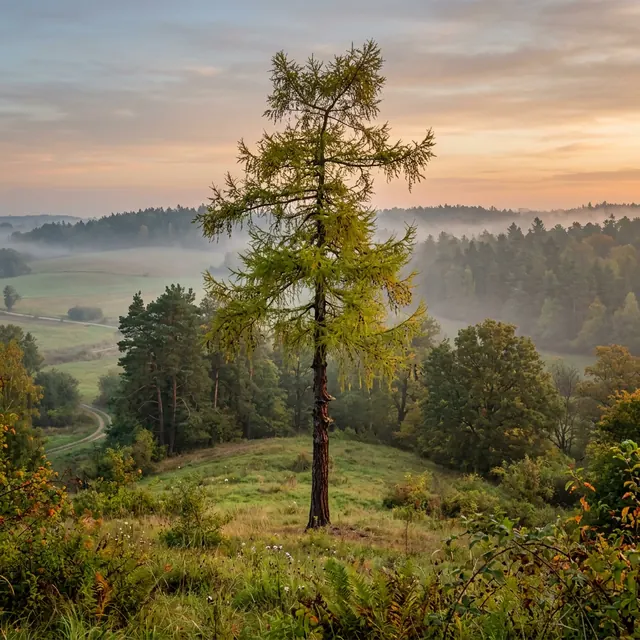
Polish larch
Larix polonica
A rare relative of the European larch, growing at scattered sites in Poland and neighbouring countries. Some botanists regard it as a subspecies of the European larch. Like every larch it sheds its needles for the winter, and mushrooms found only with larches grow beneath it.
How to recognise
- Needles soft, light green, on short shoots in bundles of 15 to 40, falling in winter.
- Cones small, 2 to 3 cm long, egg-shaped or spherical, with concave scales with a thick, non-recurved edge.
- Young shoots very pale, straw-yellow, almost white.
- Bark dark cherry-coloured; a tree up to 30 m tall with an irregular crown.
Where it lives
Pieniny, Western Beskids, the area around Radom, Góra Chełmowa in the Świętokrzyskie Mountains, Modrzewina in Mała Wieś near Grójec and Trębaczew on the Rawa Upland. Outside Poland in the Czech Republic, Slovakia, Ukraine and Romania.
Fruits and seeds
Cones and seeds are not food for people. Many sites of the Polish larch lie in nature reserves, where picking plants is prohibited.
Which mushrooms grow under it
- maślak żółty (grows only under larches)
- maślak lepki, called maślak szary (only under larch)
In the past
Today the most important thing is protecting its sites. It grows in more than 20 nature reserves, among them Modrzewina, Modrzew Polski w Noskowie, Trębaczew and Świnia Góra.
Fun fact
Botanists distinguish several forms of the Polish larch, including the Pieniny form and forms with red and with green female flowers. In the IUCN Red List it has the category endangered.