

Small-leaved lime
Tilia cordata
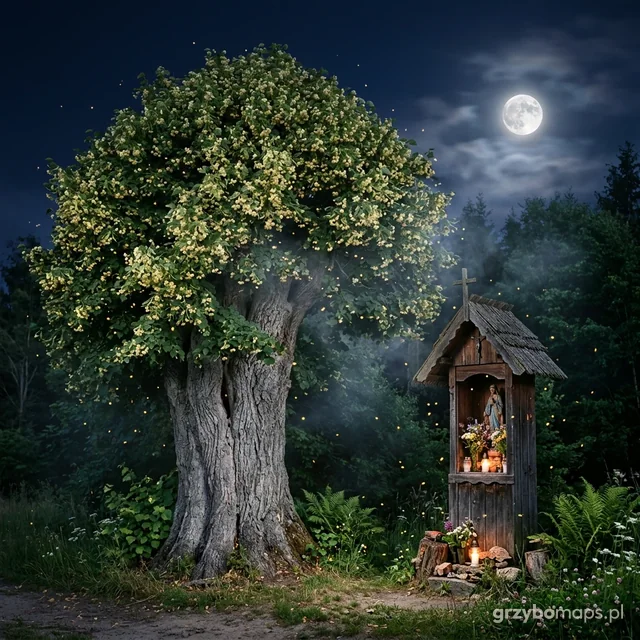
A long-lived tree of oak-hornbeam forests and parks, fragrant in July with flowers full of nectar. It grows beside manors, churches and wayside shrines throughout Poland. Lindens and oaks together make up about two thirds of the country's monumental trees.
How to recognise
- Bark grey, fissured lengthwise on old trees.
- Leaves heart-shaped, serrated, with rusty tufts of hairs in the vein axils underneath.
- Flowers yellowish and fragrant, followed by round nutlets hanging from a tongue-shaped bract.
- Crown dense, dome-shaped.
Where it lives
Throughout Poland, in oak-hornbeam forests, mixed forests, parks, avenues and beside churches.
Fruits and seeds
The nutlets are not food. Linden blossom has long been gathered for infusions, and bees make precious linden honey from it.
Which mushrooms grow under it
- borowik usiatkowany
- modroborowik ponury
- Patouillard's fibrecap (poisonous)
In the past
Soft, uniform wood is the best carving material: the figures of the Veit Stoss altarpiece in Kraków were carved from linden. Bast was plaited into bast shoes and ropes.
The most famous in Poland
The linden in Cielętniki (Częstochowa county) was the thickest small-leaved lime in Poland, with a circumference of about 10.8 m; it was toppled by Storm Xavier in October 2017.
What the beliefs say
Among the Slavs and Balts the linden was regarded as a sacred and good tree. It was believed to protect against evil spirits and lightning, which is why it was planted by houses.
Fun fact
The famous "Guest, sit beneath my leaves and rest" is from Jan Kochanowski's epigram "Na lipę" ("To the Linden").