

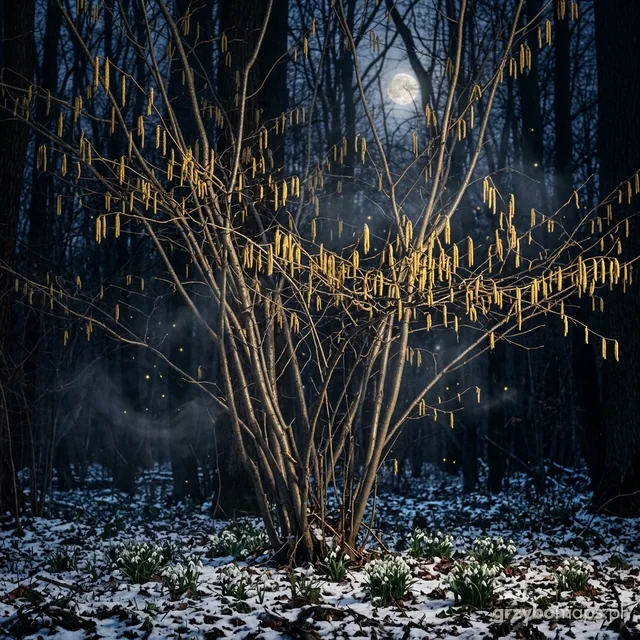
Common hazel
Corylus avellana
A multi-stemmed understory shrub that is one of the first to bloom, as early as February. Its hanging yellow catkins are the first feast for bees. In autumn it yields edible hazelnuts.
How to recognise
- Bark grey-brown, smooth, with pale lenticels.
- Leaves roundish, doubly serrated, roughly hairy, with a short point.
- In winter and early spring yellow, hanging male catkins and tiny red stigmas of the female flowers.
- Nuts in a green, frilly husk, several together.
Where it lives
Throughout Poland, in the understory of oak-hornbeam forests, at forest edges, in thickets and ravines.
Fruits and seeds
Hazelnuts are edible and tasty. Be careful with people who are allergic to nuts.
Which mushrooms grow under it
- hornbeam bolete (more rarely)
- trufla letnia
In the past
Flexible rods for fences, baskets and hoops. Dowsers' rods were made from hazel forks.
What the beliefs say
In Polish folk tradition the hazel was regarded as a shrub resistant to lightning. According to legend it sheltered the Mother of God during the flight into Egypt and was therefore blessed.
Fun fact
Hazel forms mycorrhiza with truffles; in Poland, hazel and oaks are precisely what is planted in summer truffle plantations.