

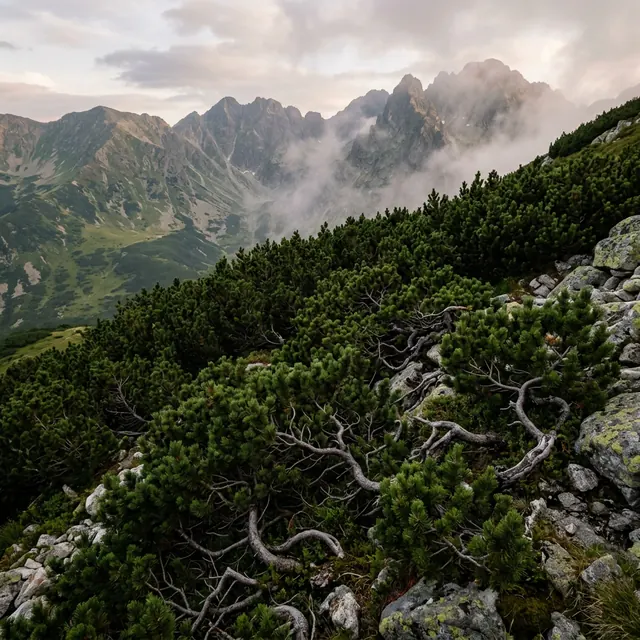
Mountain pine
Pinus mugo
A shrubby mountain pine forming dense, creeping thickets above the tree line, in the so-called dwarf pine zone. It protects slopes from erosion, landslides and avalanches. It was also planted on coastal dunes.
How to recognise
- Trunks creeping along the ground or bent in an arch, usually up to 3.5 m tall.
- Needles two to a bundle, 3 to 8 cm, dark green, glossy, shorter and thicker than in the Scots pine.
- Cones sessile, about 5 cm long, young ones with a bluish or violet bloom, ripe ones brown.
- Bark dark grey, slightly cracked, does not flake off.
Where it lives
Wild in the Tatras, the Sudetes, on Babia Góra and Pilsko, with small sites also on Polica, Romanka and Czyrniec. The lowest natural site in the country is Hala Izerska (840 m a.s.l.). Planted on dunes by the sea.
Fruits and seeds
Cones and seeds are not food for people. An oil is obtained from the needles, but do not pick the shoots: the mountain pine is partially protected in Poland, and most of its sites lie in mountain national parks.
Which mushrooms grow under it
- klejek czerwonawy
- maślak błotny (in peat bogs, protected)
- mleczaj strefowany (protected)
- złotoborowik wysmukły (non-native species, on dunes)
In the past
Stabilising dunes and slopes, protection against avalanches and erosion. Planted in gardens in many varieties. An oil is obtained from the needles.
Fun fact
Cones ripen only 15 to 17 months after pollination. Branches lying on the ground can take root and produce new plants.