

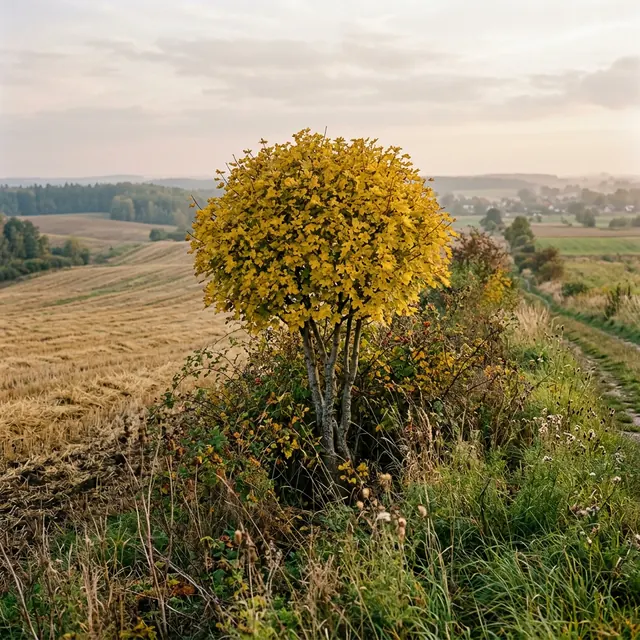
Field maple
Acer campestre
A small maple, often growing as a multi-stemmed shrub in field thickets and on warm slopes. In Poland it is rarer than the Norway maple and the sycamore. It tolerates drought and air pollution well, which is why it is planted in cities.
How to recognise
- Leaves small, blade 5 to 8 cm, with 3 to 5 blunt lobes; the leaf stalk contains milky sap in summer.
- The winged fruits (samaras) are set in a straight line, at an angle of 180°.
- Bark of old trunks grey-brown, cracked in a net-like pattern; the variety suberosa has corky ridges on the twigs.
- In autumn the leaves turn yellow.
Where it lives
Carpathian Foothills, Vistula valley, Upper and Lower Silesia, Greater Poland and Kuyavia, up to about 700 m above sea level. In Pomerania probably only introduced. Field thickets, dry slopes, oak-hornbeam woods, riparian forests.
Fruits and seeds
The fruits are samaras and are not food for humans.
Which mushrooms grow under it
- tar spot of maple (black, tar-like spots on the leaves)
- Sawadaea bicornis (powdery mildew of maples, very common on field maple)
In the past
For centuries used for trimmed hedges and for lining narrow streets. Very hard, pale wood for joinery, woodturning and veneers. A honey plant.
Fun fact
In May 2022 the register of nature conservation forms listed 69 field maples protected as natural monuments. The monument criterion for this species is a circumference of 150 cm at a height of 130 cm.