

Trees and shrubs
Silver fir
Abies alba
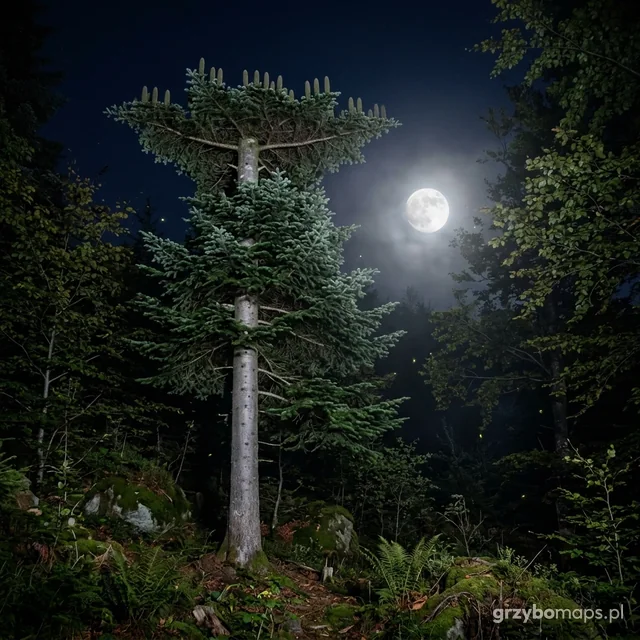
A majestic tree of mountains and foothills, it likes shade and moist air. Together with beech it forms the fertile beech-fir forests of the Carpathians. In the 20th century it suffered mass disease from air pollution; today it regenerates well again.
How to recognise
- Bark pale grey, smooth for a long time, with resin blisters.
- Needles flat, soft, notched at the tip, with two white stripes underneath, arranged like a comb.
- Cones stand upright on the branches and fall apart on the tree, so you will not find them whole on the ground.
- In old trees the top of the crown is flattened, the so-called stork's nest.
Where it lives
Carpathians, Sudetes, Roztocze, Góry Świętokrzyskie; in the lowlands rare and mainly from plantings.
Fruits and seeds
Cones and seeds are not food for people.
Which mushrooms grow under it
- borowik szlachetny
- Lactarius salmonicolor
In the past
Light, resin-free wood for construction, shingles and instruments. In the Carpathians, fir was used to build cerkwie (wooden churches) and cottages.
Fun fact
A fir from Brenna in Beskid Śląski had a circumference of 452 cm in 2014 and was regarded as probably the thickest in Poland.