

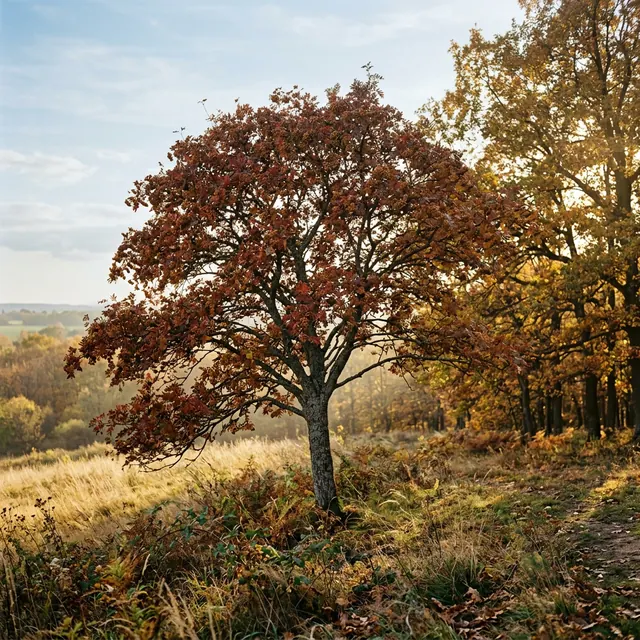
Wild service tree
Sorbus torminalis
A rare tree of the rose family with lobed leaves that resemble maple leaves. In Poland it grows in the western half of the country, in light-filled forests and thickets on fertile soils. It has been under strict protection since 1946.
How to recognise
- Leaves broadly egg-shaped, up to 10 cm, with 3 to 5 pairs of pointed lobes; the lower lobes stick out almost horizontally.
- In autumn the leaves turn red and brown.
- Flowers white in loose corymbs, blooms in May and June.
- Fruits about 1 cm long, first reddish-yellow, then brown with pale dots.
Where it lives
Scattered sites west of the line Trójmiasto, Tczew, Ciechocinek, Strzelno, Gołuchów, Wrocław, Strzelin, Ojców, Nowy Sącz. In the Carpathians only on Białowodzka Góra and in Rożnów. Grows on calcareous and loamy soils, not on sands.
Fruits and seeds
The fruits are edible only once overripe, when they have softened; before that they are very astringent. The wild service tree is strictly protected in Poland, so do not pick the fruits or twigs.
In the past
Reddish-brown wood, hard and heavy, prized in woodturning and furniture making. Before hops came into use, the fruits were used to flavour beer.
The most famous in Poland
The oldest known specimen in Poland grows in Lubotyń (Greater Poland Voivodeship): height 24 m, trunk diameter 65 cm, age about 190 years.
Fun fact
The Latin name torminalis means “good for colic”, because the fruits were an old folk remedy. The old Polish name of the service tree was brzęk, hence the names of nature reserves such as Bytyńskie Brzęki.