

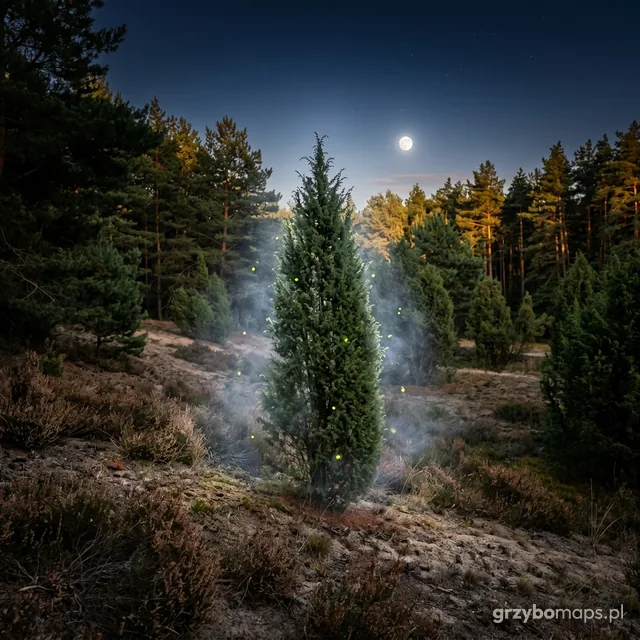
Common juniper
Juniperus communis
A prickly shrub or small tree of columnar or spreading habit. It grows in open pine forests, on heaths and pastures. It has separate male and female plants.
How to recognise
- Bark grey-brown, flaking in narrow strips.
- Needles prickly, in whorls of three, with one white stripe on top.
- Berry-like cones round, green at first, navy-black when ripe with a bluish bloom, ripening in 2 to 3 years.
- Habit from columnar to a broad, multi-stemmed shrub.
Where it lives
All over Poland, in open pine forests, on heaths and dry grasslands.
Fruits and seeds
The berry-like cones of common juniper are a spice (e.g. for game and bigos) in small amounts. Do not confuse it with the ornamental savin juniper, which is highly poisonous.
In the past
Berry-like cones as a spice and for flavouring spirits (e.g. gin). Twigs were used to smoke meats and to fumigate houses.
What the beliefs say
In folk belief, juniper smoke was supposed to drive away disease, plague, witches and evil spirits. It was used to fumigate the house and the cowshed, e.g. around Christmas.
Fun fact
On junipers you can often see rusty, gelatinous growths. This is rust, a fungus that moves in spring onto the leaves of pear trees.