

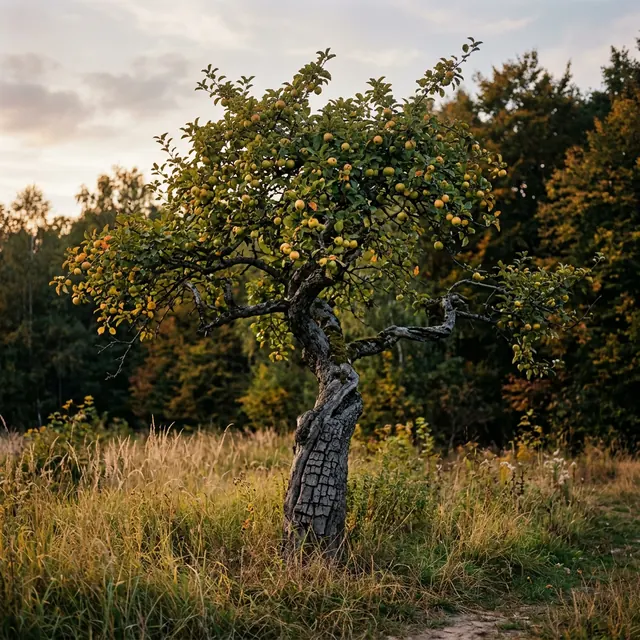
Wild crab apple
Malus sylvestris
The wild ancestor of orchard apples, growing rarely at forest edges, in glades and in thickets. A small tree with a loose crown, often thorny. It is easily confused with a feral domestic apple tree.
How to recognise
- A small tree up to 10 m, sometimes up to 15 m, with several similar main branches and no distinct leader.
- Thorns on short shoots, especially on young trees.
- Leaves 3 to 6 cm, sharply and finely serrated, almost hairless underneath when mature.
- Fruits small, up to 3.5 cm in diameter, green to yellow-green, hard and sour, on long stalks.
Where it lives
Rare in the lowlands and lower mountain areas, usually up to about 900 m above sea level, in the Bieszczady up to 1200 m above sea level. Edges of deciduous and mixed forests, glades, thickets.
Fruits and seeds
The fruits are edible, but very sour and astringent; they taste better after frosts. Do not eat the seeds: they contain amygdalin, a cyanogenic glycoside from which poisonous hydrogen cyanide can form.
Which mushrooms grow under it
- dzwonkówka tarczowata (grows under rosaceous plants; easily confused with poisonous pinkgills)
- czyreń śliwowy (on trunks)
- apple scab (disease of leaves and fruits)
In the past
Formerly a rootstock for noble apple varieties and a medicinal plant. The hard, reddish wood was prized in carving and woodturning.
Fun fact
The domestic apple tree arose from a cross between the wild apple and the low apple. Single trunks usually live 60 to 80 years, but thanks to suckers the age of some specimens is estimated at as much as a thousand years.