

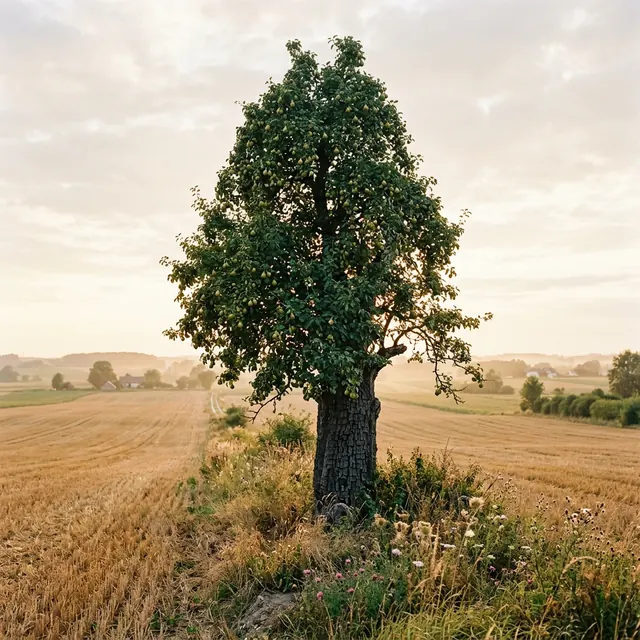
Common pear (wild pear, ulęgałka)
Pyrus communis
A wild-growing pear whose astringent fruits are called ulęgałki, found on field boundaries, along roads, sometimes in forests and thickets. It is a complex of hybrids from which orchard pears descend. In Poland it crosses with the field pear, so a pure wild pear is hard to find today.
How to recognise
- A tree up to 20 m, crown pyramidal, domed in old trees.
- Bark grey-black, cracked into fairly regular rectangles.
- Leaves glossy, leathery, finely serrated, with a stalk almost as long as the blade.
- Flowers white with reddish anthers; wild young trees have numerous, strong thorns.
Where it lives
Throughout the country in fields, on field boundaries and along roads, sometimes in forests and thickets. A species permanently established in Poland.
Fruits and seeds
Wild pears are hard, astringent and full of stone cells (grit). They are fit to eat only after being left to ripen for several weeks.
Which mushrooms grow under it
- dzwonkówka tarczowata (grows under rosaceous plants; easily confused with poisonous pinkgills)
- nagoć sawinowa (causes pear rust, moves over from savin juniper)
- czyreń śliwowy
- honey fungus
In the past
Reddish-brown wood, hard and easy to work: drawing instruments, pianos, furniture, marquetry, woodcut blocks. Spirits and liqueurs were made from the ulęgałki.
The most famous in Poland
The oldest pear tree in Poland grows in Nekla near Września (Greater Poland Voivodeship): height 18 m, circumference 329 cm (2005); in 1992 its age was estimated at 192 years.
Fun fact
About 5000 varieties of the European pear are cultivated worldwide. A pear tree can live up to 300 years.