

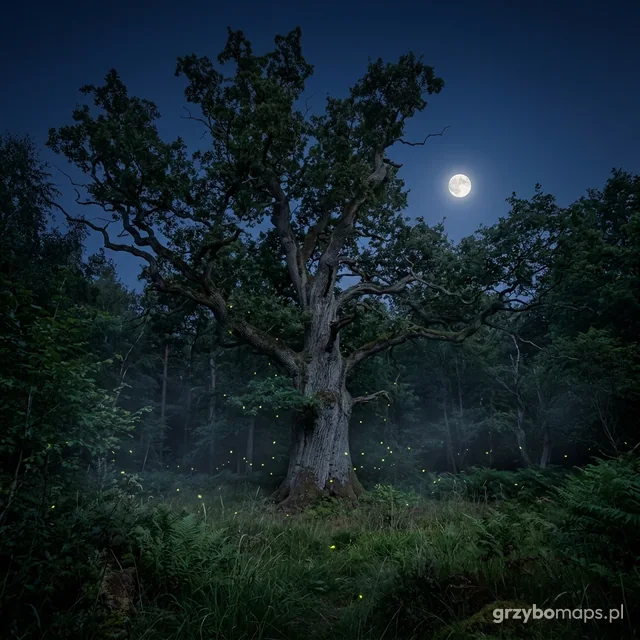
Pedunculate oak
Quercus robur
The king of Polish forests, it can live for many centuries and reach enormous size. It grows in oak-hornbeam forests, floodplain forests and oak woods. A single old oak is home to hundreds of species of insects, fungi and lichens.
How to recognise
- Bark grey, thick, deeply and lengthwise fissured.
- Leaves lobed, on a very short stalk, with two small ear-like lobes at the base.
- Acorns on a long stalk, 1 to 3 together.
- Crown broad and irregular, with thick, crooked boughs.
Where it lives
Throughout Poland in the lowlands and foothills, in oak-hornbeam forests, floodplain forests, oak woods and parks.
Fruits and seeds
Acorns are bitter from tannins and inedible raw. In times of famine they were leached and made into flour and grain coffee. They are an important food for wild boar, roe deer and jays.
Which mushrooms grow under it
- borowik szlachetny
- borowik usiatkowany
- chanterelle
- beefsteak fungus (on trunks, protected)
- chicken of the woods (on trunks)
In the past
Very durable timber for barrels, ships, beams and furniture. Tannins for tanning leather were obtained from the bark.
The most famous in Poland
The oak Bartek in Bartków (Zagnańsk municipality, Świętokrzyskie Voivodeship), one of the most famous natural monuments in Poland. Studies indicate an age of about 650 to 700 years, although tradition spoke of more than a thousand.
What the beliefs say
In the beliefs of the ancient Slavs, the oak was the sacred tree of Perun, the thunder god. Offerings and oaths were made beneath oaks, and an acorn in the window was meant to protect the house from lightning.
Fun fact
The oak Józef from Wiśniowa in Podkarpacie won the European Tree of the Year 2017 competition. According to accounts, a Jewish family hid in its trunk during the war.